
A chemistry review lesson for class 9A1 at Tran Van On Junior High School in HCMC reveals a fascinating time. Children are actively being taught how to spot AI’s inherent flaws. The class kicked off by reviewing the intricate knowledge of balancing chemical equations previously covered in the eighth grade.
From this foundation, Ms. Dang Thi My Hanh, the presiding teacher, posed a highly practical challenge. “Why don’t we create our own custom software dedicated solely to balancing chemical equations?” she asked. Students then autonomously selected AI tools to write code and architect their own applications.
During the initial test run, the application yielded flawlessly accurate results. Ms. Hanh subsequently presented another prompt. The students diligently inputted the equation, and entirely unsurprisingly, the application delivered a balanced outcome incredibly fast, seemingly devoid of any errors.
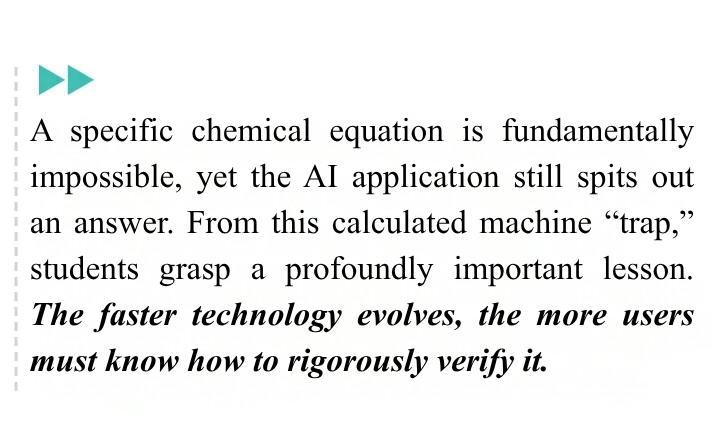
They assumed it was running smoothly; however, the application had actually just stumbled right into the teacher's trap. Ms. Hanh systematically broke down the AI’s critical flaw, explaining that this specific chemical reaction was scientifically impossible. Since the equation doesn’t actually exist in reality, it couldn’t possibly be balanced in the manner the application fabricated.
Drawing upon their eighth-grade chemistry knowledge alongside their teacher’s particular guidance, the students successfully learned how to catch the AI red-handed.
The subsequent task proved significantly more daunting. They had to refine their prompts so the application could seamlessly identify impossible reactions, articulate the underlying reasons, spot factual errors within the input formula, and accurately propose the correct equation.
Capitalizing on the tool’s technological stumble, learners were forced to navigate the entire developmental lifecycle of creating a product, beta-testing it, verifying the data, and rigorously debugging it. That’s precisely how this teacher and her pupils are effectively “training” their AI applications to become increasingly astute.
For Le Nguyen Linh An, a student in class 9A1, the exercise proved highly revealing. She recounted that her group had utilized AI to architect a balancing assistance application, diligently testing it against numerous equations. The tool even provided molar mass, the number of moles, and the precise mass of each substance. The glaring flaw in the aforementioned example compelled the group to leverage their acquired knowledge to meticulously cross-check the application. Beyond merely using AI to balance equations, they realized they had to train this software to discern which reactions occur in reality versus which ones don’t.
Thanks to seamlessly manipulating AI and exploiting pre-existing online functionalities, the group spent a mere 15 to 20 minutes finalizing the task, fully encompassing both practical coding and beta-testing timeframes. In addition to their self-created software, the students proactively explored other available online applications.
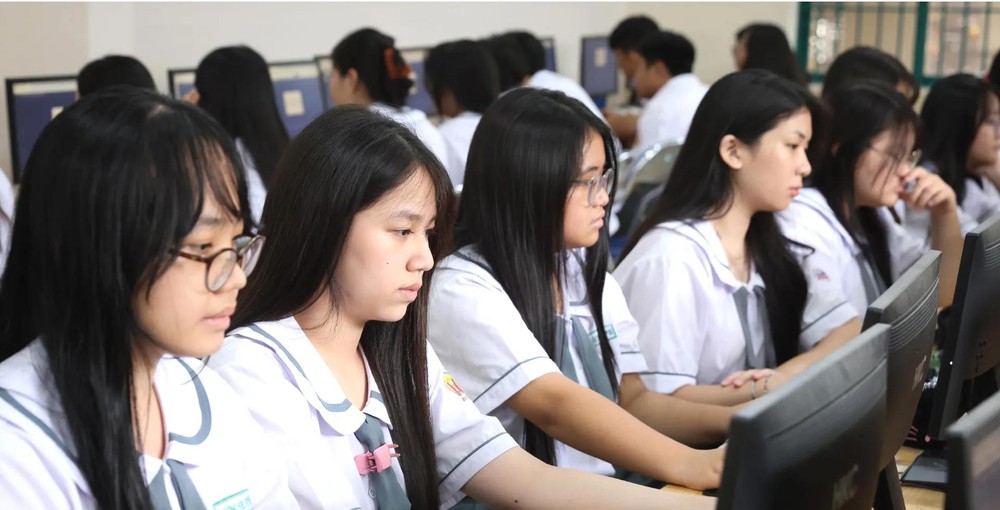

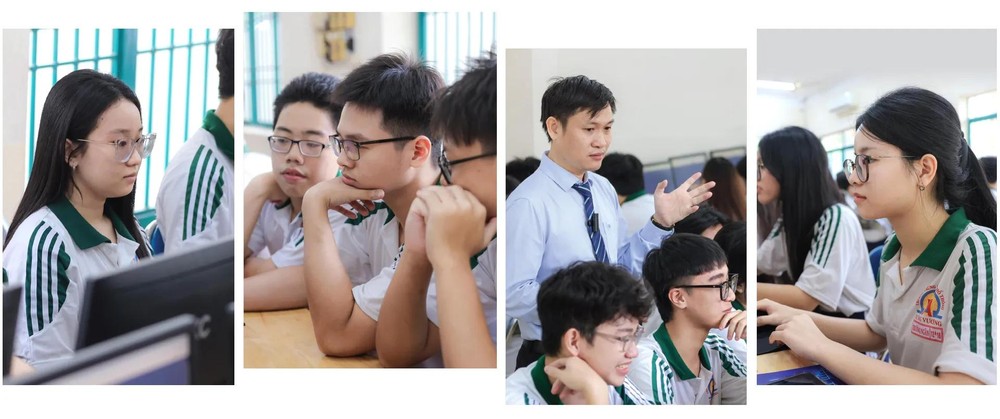
Meanwhile, Mr. Pham Van Tu from Hung Vuong High School in HCMC teaches his students how to “train” AI in an entirely different fashion, engaging in head-to-head critical debates with the machine. During an IT period for class 11A16, Mr. Tu challenged his students and the AI to vigorously debate a specific premise.
“Using AI to solve homework is exactly like using a handheld calculator to crunch numbers; since both are merely supplementary tools, utilizing AI for assignments can never be considered academic fraud.” The AI was programmed to staunchly defend this viewpoint. Conversely, the students were tasked with formulating robust arguments to persuade the AI to fundamentally shift its perspective.
Mr. Tu thoughtfully explained that if they wanted the AI to concede, the students had to present highly logical, scientifically grounded viewpoints and perspectives. Each group was strictly allotted a maximum of three argumentative turns. If they resorted to poorly constructed prompts like “just believe me” or “you must trust me,” it constituted sheer coercion rather than a substantive argument. Despite tackling the exact same requirement, the respective groups received vastly disparate outcomes.
For Vo Tuan Minh, a student in class 11A16, the challenge required patience. Minh and his peers persistently examined the core issue from multiple dimensions, continuously firing back with the group’s carefully crafted arguments. Thanks to this rigorous methodology, they systematically managed to
“conquer” the AI.
Minh reported that this hands-on experience profoundly shifted his perspective on technology while simultaneously unlocking a potential career pathway. Following his teacher’s engaging lesson, he’s now intensely enthusiastic about researching and deploying AI. He’s currently nurturing a dream to major in computer science or ultimately evolve into a dedicated AI research and development expert.
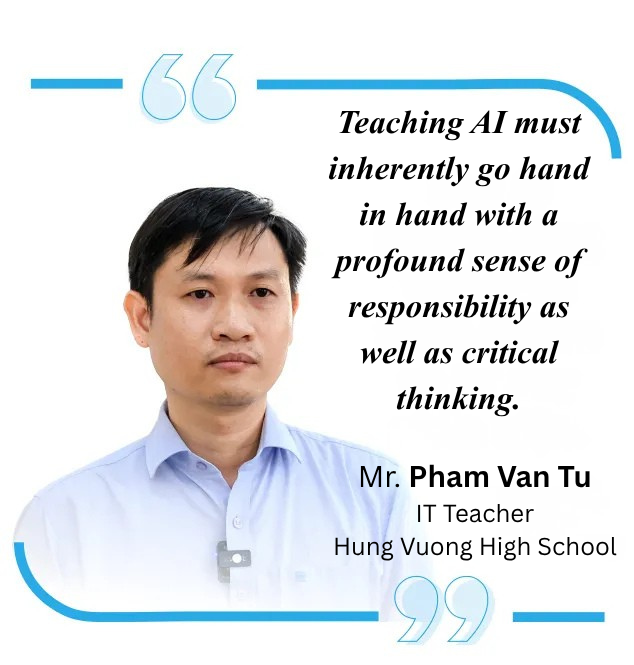
Mr. Tu noted that teaching AI must irrevocably intertwine with a spirit of accountability and sharp critical reasoning. Students need to comprehend that not every single answer generated by these digital tools is factually accurate. Information must be heavily vetted and cross-referenced prior to utilization.
To proactively curb the troubling trend of dependency or blatant AI abuse within academic deliverables, schools must unequivocally stipulate permissible usage levels alongside robust safety control mechanisms. Technology can undeniably be leveraged to monitor progress, calculate grades, and autonomously flag glaring signs of academic abuse.
Nevertheless, software simply can’t replace a teacher’s thorough oversight throughout the duration of a student’s assignment. The feedback style and complex linguistics utilized by AI often starkly contrast with a student’s actual age and authentic cognitive capabilities. By astutely picking up on these subtle red flags, educators can accurately discern which segments the kids completed independently versus which parts suffered from heavy algorithmic intervention.
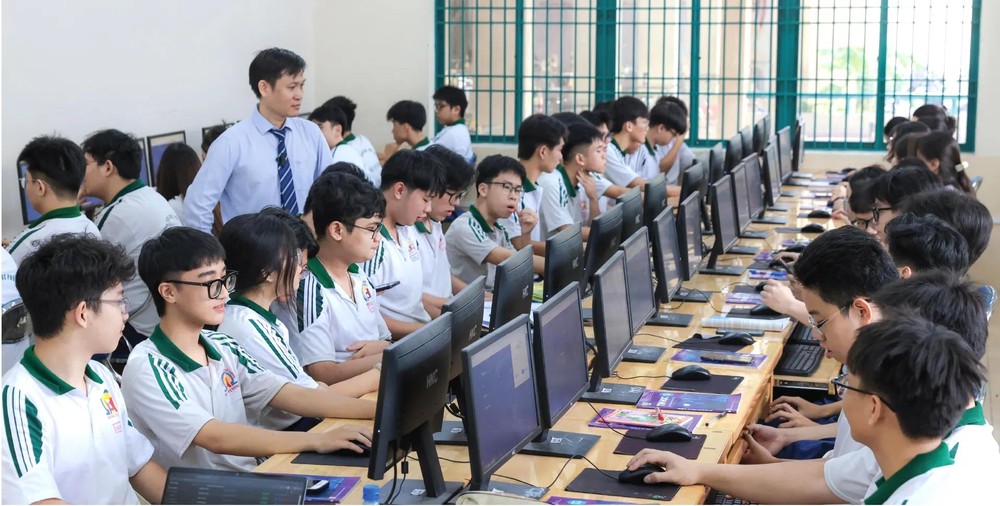
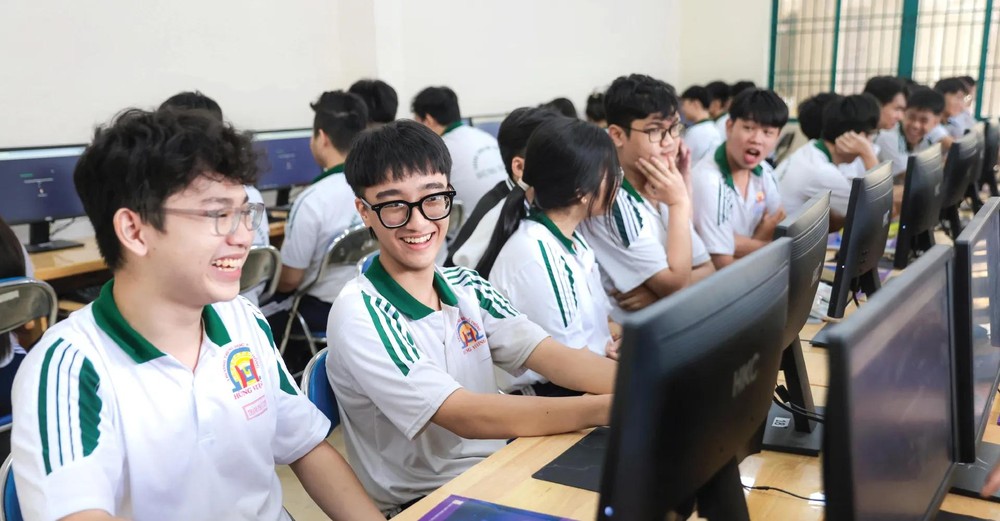

To firmly guarantee that students aren’t subjected to unforeseen digital risks, Mr. Pham Van Tu shared that the school provides a rigidly controlled AI environment for practical exercises, rather than allowing direct access to unfettered, open-source platforms. The scope of the digital exchange is strictly constrained by the lesson’s explicit objectives, preventing the conversation from rambling off-topic.
The system strategically doesn’t cough up the final answer right away; instead, it offers step-by-step hints, gently guiding students to think autonomously and hunt down the solution themselves. The learners can continuously interact, supplementing the prompt with additional contextual data so the tool can properly assist in troubleshooting the problem.
This heavily controlled ecosystem profoundly helps students forge the necessary skills to utilize technology correctly, foster robust problem-solving mindsets, and cultivate a deep awareness of responsible AI usage, serving as a highly practical asset for their academic journey.
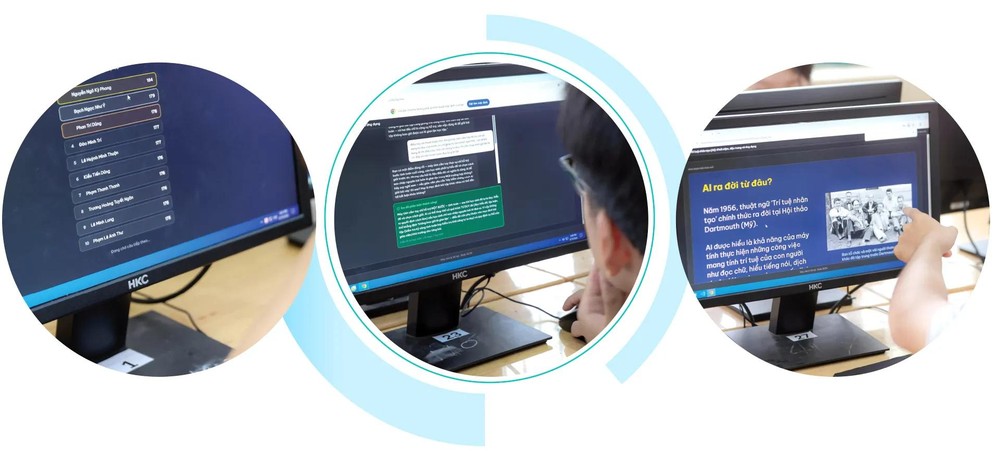
Vice Principal Le Thanh Trung of Hung Vuong High School explained that the institution has seamlessly integrated AI content and digital competencies into its curriculum, operating under the strict directive that every single academic task must be thoroughly verifiable.
Educators actively design interactive methodologies that perfectly suit the students’ cognitive levels. Every assigned task must crystal-clearly delineate which segments the students tackled independently and which parts received AI assistance. It’s only when the kids can articulately explain exactly where they spotted the error, how they re-prompted the tool, and how they subsequently debugged it, that the lesson truly transcends into the learner’s internalized knowledge.
Assoc Prof Dr Tong Xuan Tam, Dean of the Biology Faculty (HCMC University of Education)
If not cautious, an entire student generation will suffer
Currently, teaching AI remains incredibly novel in Vietnam, dictating that cultivating the teaching staff must be a pressing mandate. Otherwise, the educational system will harbor massive underlying risks. Standardizing digital competencies from the get-go is the quintessential determining factor, as a biased initial orientation will affect an entire student generation’s cognitive reasoning. To construct a capable workforce, authorities must thoroughly assess the faculty’s current reality. Ongoing professional development absolutely needs to avoid fragmented approaches where teachers merely snag isolated certificates without a systemic methodology.
Educational institutions should apply standardized toolkits pinpointing exact competency levels. These benchmarks are explicitly stipulated within the Ministry of Education and Training’s Circular 18/2026. Predicated on these evaluations, schools must establish crystal-clear standards; a teacher must demonstrably achieve the “Proficient” tier before they’re qualified to teach “Basic” content.
Furthermore, it’s profoundly necessary to construct a systemic training curriculum spanning grades 1 through 12. Teaching AI must be deployed with extreme caution according to a strict roadmap, as recklessly burning through phases isn’t allowed.
The main objective must be to develop students’ cognitive reasoning. Digital tools can’t replace the actual academic workload, which inevitably renders students dangerously passive. AI should exclusively be applied in preliminary stages like brainstorming. From that baseline, students must utilize their independent reasoning to critically evaluate harvested data.
Content: staff writers
Design: Huu Vi
Translation: Thanh Tam