The successful implementation of the policy to build socialist communes and wards in Ho Chi Minh City requires not only proper awareness but also institutionalization into policies and effective execution, said Prof. Tran Vi Dan, a member of the Central Theoretical Council.

Prof. Tran Vi Dan told Sai Gon Giai Phong Newspaper that for any Party policy to be successfully implemented, the necessary condition is proper awareness. Party committees, Party organizations, civil servants, Party members and the people must correctly understand the policy's objectives and significance so they can have confidence, consensus and determination to implement it. The sufficient condition is for the Party's policy to be promptly institutionalized into policies, laws and regulations and effectively implemented.
For Ho Chi Minh City, Politburo Resolution No. 09-NQ/TW on building and developing the city in the new era identifies among its key tasks and solutions the need to "build and soon establish socialist residential areas; pilot the construction of socialist wards and communes," as well as to "implement practical solutions to effectively meet the needs of society and the people by concretizing and comprehensively realizing the socialist model in the city, creating spillover effects and linkages with localities in the region."
Ho Chi Minh City needs to promptly define a set of criteria for socialist-oriented residential areas, communes, and wards that align with the city's specific conditions and characteristics; at the same time, it must make comprehensive preparations regarding mechanisms, policies, resources, and implementation plans. Once the necessary conditions are met and implementation is synchronized, the pilot model will have the foundation to operate effectively and be gradually replicated.
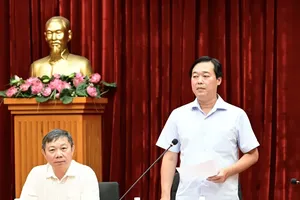
Prof. Tran Vi Dan
Soon afterward, the Ho Chi Minh City Party Committee's Executive Committee issued an action program to implement the resolution. It identified the task of building and establishing socialist residential areas and piloting socialist communes and wards in line with the city's actual conditions. This can be affirmed as an honor and a political task, as well as the aspiration of the city's Party organization, government and people.
To realize the Party's policy, Party committees and authorities at all levels, particularly at the grassroots level, need to fully disseminate the resolution and action program to all cadres, Party members and social groups so they develop proper awareness and strong determination. At the same time, they should proactively propose or, within their authority, institutionalize the resolution into mechanisms and policies and demonstrate determination to organize substantive and effective implementation in practice.

Prof. Tran Vi Dan said that bringing the policy into people's lives requires many tasks, including correctly identifying the actors who determine the success of the pilot model. The first are Party organizations, Party committees and local governments in the areas where the pilot is implemented. Grassroots Party committees and authorities must thoroughly understand the spirit of the resolution and the characteristics of their localities in order to develop plans and select approaches suited to actual conditions, with a spirit of deep understanding and proper action.
Moreover, he said, the people are both the beneficiaries and participants in building the model. When people clearly understand what values they will gain from the model and understand their role as masters, implementation will certainly succeed. Therefore, broad public communication is needed to help people clearly understand the objectives and benefits of the policy and create unity between the Party's will and the people's aspirations.
During implementation, the Vietnam Fatherland Front and socio-political organizations play an important role in bringing people together and mobilizing them to participate and exercise their role as masters under the principle of "people know, people discuss, people do, people inspect, people supervise, people benefit."
For Ho Chi Minh City, this spirit needs to be applied throughout the pilot process of building socialist communes and wards. What must remain steadfast is the objective and nature of the model, while its implementation methods must be flexible and suited to the characteristics of each locality. Each commune or ward may choose different models and solutions, but all must work toward the common goal of better serving the people and building a united, civilized and sustainably developing community.
The country's reform experience shows that it has always been possible to inherit progressive values to serve development goals. Therefore, building socialist communes and wards also requires promoting innovation and creativity, staying closely aligned with reality while never departing from established principles.
He said there will be many difficulties and challenges in realizing this strategic policy. Such difficulties are an opportunity for cadres and Party members to demonstrate their resolve, capabilities and spirit of innovation and creativity, and to dare to think, dare to act and dare to take responsibility for the common cause. The realization of socialist communes and wards begins with the confidence of each cadre and Party member in the Party's policy, a full understanding of the significance of building socialist communes and wards, and a clear determination of their responsibilities in the implementation process.
The most important factor in turning the policy into reality is ensuring that people clearly understand its objectives and benefits and genuinely participate as stakeholders, with confidence and revolutionary commitment, in the process of building socialist communes and wards. When the Party's will meets the people's aspirations, implementation of the policy will certainly succeed.