After more than a year of operating under the two-tier local government model, changes at the grassroots level are laying the foundation for Ho Chi Minh City to implement its policy of building socialist wards and communes. The policy must be translated into specific actions, with clear responsibility, progress monitoring and evaluation based on residents’ satisfaction.
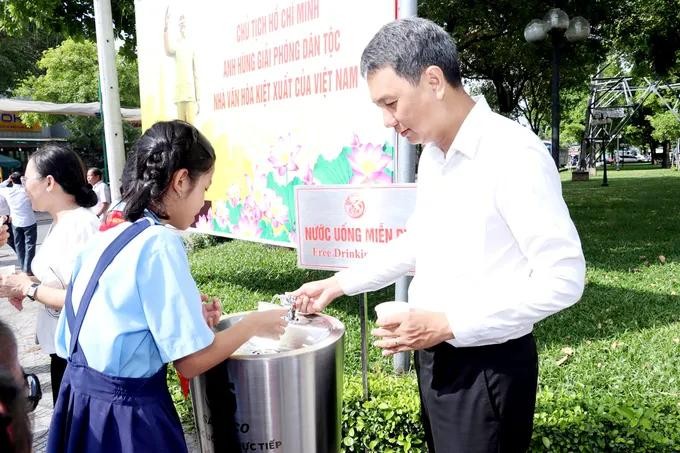
Grassroots action brings socialist wards and communes closer
One of the most populous areas of HCMC, with more than 208,000 residents, Tang Nhon Phu Ward is handling a very large workload following the administrative reorganization.
Nguyen Bach Hoang Phung, Secretary of the Tang Nhon Phu Ward Party Committee, said the locality recognizes that building socialist wards and communes must begin with building Party organizations that are truly close to the people, understand them and effectively lead efforts to address issues of public concern.
A policy can only be validated when it translates into concrete results in people’s daily lives, such as more convenient administrative procedures, more timely responses to petitions, a safer and more civilized living environment, and officials providing services with a greater sense of responsibility. With this approach, the Tang Nhon Phu Ward Party Committee has focused on leadership and determined that every task must have a clearly assigned person or agency responsible for it and must be followed through to completion.
Meanwhile, at Minh Phung Ward, Party Committee Secretary Nguyen Tran Binh said building socialist wards and communes must be reflected in the quality of services provided to residents through every specific task. The neighborhood receives information; the government organizes its handling; and the Party Committee leads, monitors and supervises the entire process so that any issues that arise are resolved quickly and fully.
For example, residents of Neighborhood 20 in Minh Phung Ward recently reported that numerous cars were frequently making U-turns and parking in the common yard of Cay Mai apartment complex on Tan Thanh extension street, damaging the concrete pavement and flower beds and affecting access. Instead of submitting petitions to multiple agencies, residents used the “Minh Phung Digital - Accompanying and Listening to Residents” app to submit their complaint along with photos. After receiving the information, officials of the ward Vietnam Fatherland Front Committee conducted a field inspection and verification before forwarding the case to the Ward Police for handling within its authority. About 10 days later, the improper parking was brought under control.
According to an assessment by the Standing Committee of the HCMC Party Committee, the reorganization of the administrative apparatus has brought positive changes toward a more streamlined system operating with greater effectiveness and efficiency. Government agencies are becoming increasingly close to residents and providing better services, while digital transformation has been accelerated and online public services expanded. The resident satisfaction rate has reached nearly 96.3 percent.
Public satisfaction measures government performance
Beyond quickly handling procedures at government offices, many localities have also proactively brought public services directly to residents’ homes.
Recently, resident Dang Thi Khoa went to the Public Administration Service Center of Phuoc Thang Ward to complete authorization procedures for her father, Dang Van Phong, 90, to receive his pension. After receiving the information, officials at the center introduced a mobile model for providing guidance and receiving online public-service applications for elderly and disabled people in the area. Officials then went to Mr. Phong’s home and completed the certification of his signature and the authorization document in 20 minutes.
Following a directive from HCMC People’s Committee Chairman Nguyen Van Duoc to prioritize support for elderly people, people with disabilities, people serving for the cause of the nation's revolution and other vulnerable groups when they carry out administrative procedures, many wards and communes across the city have introduced mobile public-service models to receive applications from people who have difficulty traveling.
In addition, many localities have brought administrative services to neighborhoods, apartment complexes and coffee shops, making them more convenient for residents. These approaches demonstrate a shift from waiting for people to come to government offices toward proactively bringing public services closer to residents.
For these models to be implemented consistently and effectively, grassroots authorities have been given sufficient authority, resources and conditions to organize their implementation, alongside the sense of responsibility of officials.
Accordingly, the HCMC People’s Council issued Resolution No. 29/2025/NQ-HDND, allowing Chairmen of People’s Committees at the commune level to authorize officials under people’s committees in communes to perform certain tasks in the field of judicial administration.
The HCMC People’s Committee also issued Decision No. 41/2026/QD-UBND, decentralizing certain land-related responsibilities to chairmen of people’s committees at communes. At the same time, the Public Administration Service Center system has been organized on the principle that it is not bound by administrative boundaries, enabling residents to complete a wider range of procedures more conveniently.
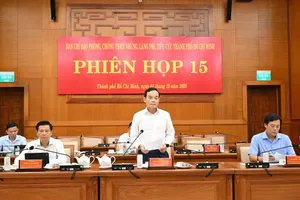
Speaking at a recent conference reviewing the first year of the two-tier local government model, Secretary Tran Luu Quang of the HCMC Party Committee called for continued improvements in the “capacity, effectiveness and efficiency” of the administrative apparatus while ensuring that the government is truly close to residents and promptly addresses issues arising at the grassroots level. The Party Committee Secretary stressed that leadership and administration must produce concrete results and deliverables, while the apparatus must remain truly close to residents and resolve problems arising at the grassroots level.
This direction also shows that the effectiveness of grassroots governance must ultimately be measured through very concrete aspects of everyday life: more convenient procedures, faster resolution of petitions, a better living environment and residents’ clear sense that they are being served. This is also the foundation for HCMC to gradually realize its goal of building socialist wards and communes under Resolution No. 09-NQ/TW on building and developing HCMC in the new era.
Associate Professor Doan Minh Huan, Director of the Ho Chi Minh National Academy of Politics, stated that the development of socialist communes and wards stems from the need to realize the Vietnamese socialist model in this new phase of development.
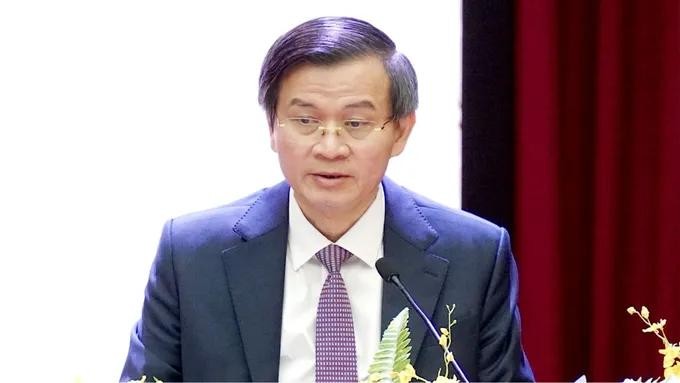
The defining characteristics of the Vietnamese socialist model prioritize human well-being and happiness. Therefore, communes and wards—the administrative levels closest to the people—must serve as the primary arenas for translating the principles and characteristics of Vietnamese socialism into concrete, practical criteria that citizens can witness and benefit from in their daily lives.
The development of socialist communes and wards must proceed step-by-step, grounded in theoretical research, pilot programs, and practical assessments before being scaled up. It is essential to avoid two pitfalls: hasty, voluntaristic approaches, or superficial implementation that reduces the model to a mere "movement" without effecting substantive change. The ultimate goal is to establish a grassroots governance model with a distinct Vietnamese identity—one where socialist values are realized through improved living standards and quality of life, fostering happiness, comprehensive human development, and social trust within every community.




)