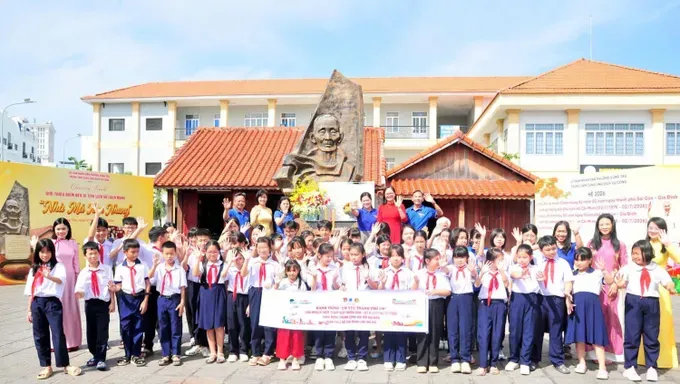
Safeguarding tales of yesteryear
During these August days, the former home of Mrs. Chung Thi Qua in Da Phuoc Commune has welcomed several visitors. This strategic location once sheltered numerous revolutionary cadres, serving as a secret hub for printing leaflets and organizing critical meetings for the 1945 general uprising.
While the ancient house didn’t remain entirely intact, memories of the family wholeheartedly hiding cadres are tenderly preserved. Welcoming people into the current house, Mrs. Qua’s grandson, Nguyen Huu Tien, slowly recounted fragmented stories handed down through multiple generations. He's the nephew of Chairman Nguyen Van Tran of the Cho Lon Provincial Administrative Resistance Committee at that time.
For Mr. Tien, this revolutionary legacy is a point of immense pride. “My grandma directly took care of and protected the cadres, and many of my uncles actively participated in the revolution,” he explained. “Those stories were recounted by the elders in the family so many times that none of the descendants could ever forget them.”
Mr. Tran studied in the Soviet Union before returning to domestic revolutionary activities. After his Cochinchina Party Committee base was unfortunately compromised, French colonialists incarcerated him at Saigon’s infamous Catinat station for 19 months. Although eventually released, he remained under strict surveillance. Nevertheless, he returned to his mother’s house and tenaciously continued his activities.
At this very house, numerous Marxist-Leninist study sessions were secretly organized. Thanks to the family’s unwavering protection, it effectively transformed into a safe haven for prominent cadres like Tran Van Giau. In 1945, it served as an underground base for printing propaganda and forging political forces. When the family constructed a new house in 2007, they remarkably kept the original wooden planks intact. Mr. Tien now passes those stories down, ensuring a historical address remains vibrantly alive.
Across HCMC, houses that once sheltered cadres remain present. Over in Vung Tau Ward, the Ma Tam Nhung (Mother Tam Nhung) House Revolutionary Historical Relic at the address of 1 Tran Xuan Do Street was once a vital meeting place for the Viet Minh Front Committee to meticulously plot the seizure of power. Recognized as a national-level relic in 1989, it successfully morphed into a famous educational destination. Every August autumn, numerous students flock back to delve into these bygone days.
At the end of the day, these excursions help the youth profoundly understand the intrinsic value of independence and their forefathers’ supreme sacrifices.
Indelible marks at Chi Hoa Communal Temple
A visit to Chi Hoa Communal Temple in Hoa Hung Ward reveals an architectural marvel that’s over 300 years old. This national-level historical relic was once a major rallying point for local youth and peasant forces, massively contributing to forging revolutionary momentum during the autumn of 1945. Today, the road leading straight into it fittingly bears the name August Revolution.
Right in the martial arts pavilion, the Temple’s manager Pham Thanh Lam was actively narrating historical tales to over 50 students during the annual Vo Truong Toan scholarship ceremony. At 81 years old, he remains incredibly lucid as he flips through vivid memories about the communal temple and the generations who made history. Through his storytelling, a narrative about a deeply ingrained tradition of studiousness seamlessly extends alongside the enduring footprints of their predecessors.
During the late 18th century, renowned master Vo Truong Toan borrowed this communal site as an impromptu teaching venue, with some famous students being Trinh Hoai Duc, Le Quang Dinh, and Ngo Nhan Tinh.
Moving into the early 20th century, that vigorous undercurrent continued when the house evolved into a convergence point for the Heaven and Earth Society movement, led by Phan Xich Long. It became a secret haven where robust young men flocked to practice martial arts and nurture their indomitable will against French colonialism for resistance.
In 1945, as the Vanguard Youth movement developed, Chi Hoa Communal Temple once again became an indispensable focal point for amassing forces. On August 25, 1945, Hoa Hung youths carrying spears and wooden sticks decisively left the communal temple, merging into the roaring throngs to seize power.
For student Pham Huynh Truc Anh, the history was profoundly inspiring. “I’ll recount the historical tales to all my friends,” she said. At the end of the day, it’s a simple sentence, but it demonstrates that these rich traditional stories are still being effectively transmitted down to today’s younger generation.
August spirit alive in today’s daily life
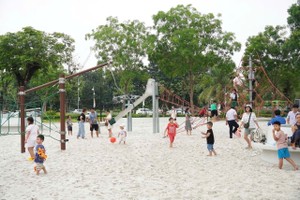
Within Ong Thuong Garden, presently known as Tao Dan Park, vivid memories of a historical autumn remain strikingly present amidst contemporary daily life. Stopping by on a weekend morning, visitors encounter towering trees alongside picturesque scenes of residents rigorously cultivating their physical health. Nestled in the city’s bustling heart, this green oasis provides a refreshingly peaceful refuge.
The moment the National Anthem’s majestic melody resonated, everyone immediately halted their activities, solemnly directing their gazes toward the red flag being hoisted high. This flag-raising ceremony is a traditional ritual executed every Sunday morning by children participating in the Northern Star General Union. Following the salute, the kids enthusiastically start intensive skill-training sessions.
For Tran Thi Hong Tham, a local resident, watching her daughter bond over tent-building was a heartwarming sight. “I bring my child here for team activities every single Sunday,” she explained. Ms. Tham recounted how she frequently heard her parents fondly mention Ong Thuong Garden, a place deeply intertwined with Vanguard Youth activities during the historic August Revolution.
“My parents told me that right here, thousands of youths collectively swore a solemn oath, and Dr. Pham Ngoc Thach passionately called upon the masses to seize independence,” she recalled. “Today, seeing my daughter in this exact spot, I feel overwhelmingly proud because she’s being rigorously trained to follow our forefathers’ footsteps,” she shared.
Visiting the park today, it’s not difficult to spot young people vigorously honing life skills or youths helping the elderly or assisting disabled individuals. These incredibly simple deeds tangibly demonstrate their patriotism and burning desire to unconditionally contribute to the community.


)