Ho Chi Minh City is advancing pilot policies, strengthening its startup ecosystem, and attracting high-skilled talent while promoting a “three-party” cooperation model between government, universities, and businesses to achieve its ambition of becoming a leading technology hub.
Ho Chi Minh City strengthens role as Vietnam’s startup hub
Ho Chi Minh City is currently the most vibrant startup center in the country, accounting for approximately 50 percent of the total number of startups in Vietnam, 40 percent of startup incubation and support facilities, 44 percent of total investment capital, and 60 percent of fundraising deals. This ecosystem is nurturing nearly 2,000 startups with the participation of 55 incubators and 143 science and technology (S&T) enterprises.
Simultaneously, the city has invested in building three Centers of Excellence (COEs) approaching international standards at the Vietnam National University Ho Chi Minh City and the Saigon High-Tech Park (SHTP). These centers focus on six strategic technology groups with 18 key products, playing a core role in enhancing research capacity, mastering technology, and promoting the commercialization of scientific research results.
However, for the innovation ecosystem to develop sustainably and be regionally competitive, the city still needs to remove many bottlenecks, especially in institutions and mechanisms to attract high-quality science and technology human resources.
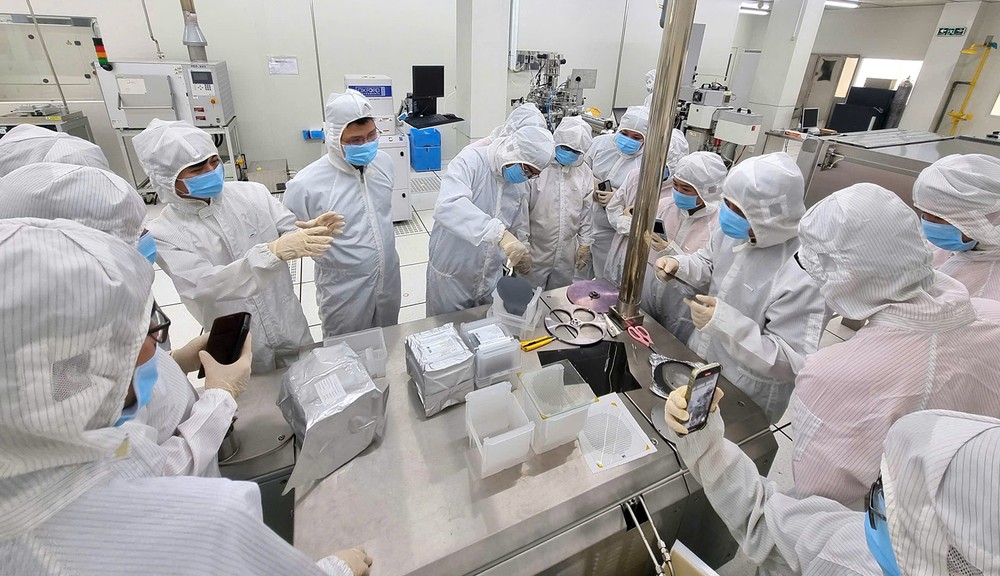
According to Associate Professor Nguyen Ky Phung, Head of the SHTP Management Board, the High-Tech Park is gradually asserting its role in the city's technology ecosystem, especially in the fields of microchips and biotechnology. SHTP currently has nearly 70 enterprises in the microchip sector and about 30 biotechnology projects, attracting investment from many renowned corporations such as Intel and Samsung.
The Ho Chi Minh City Hi-Tech Park is applying a “three-party” cooperation model that brings together government, universities, and businesses to drive the commercialization of research, strengthen infrastructure, and mobilize resources for high-tech product development. For this approach to succeed, experts emphasize the need for clearer mechanisms that directly align research outcomes with business demands and market needs.
Le Hong Minh, Chairman of VNG Group, suggested that Ho Chi Minh City position itself as an international-scale startup with a synchronized strategy, focusing on global benchmark indicators. The top priority should be promoting the innovation ecosystem based on perseverance and risk acceptance, while making the "three-party" cooperation substantive and effective. Ho Chi Minh City, in general, and innovation centers, in particular, should fully utilize the potential of the high-quality human resources of nearly 70 research institutes and universities.
Ho Chi Minh City faces a human resource bottleneck in high-tech development
Despite its strong base of universities and research centers, experts warn that the city’s shortage of skilled talent in fields like AI, semiconductors, and biotechnology could hinder its ambition to become a regional innovation hub.
According to Le Cam Ha, Deputy Head of the Department of Human Resource Management, Academy of Public Administration and Management, Ho Chi Minh City has a significant advantage in concentrating many universities, research institutes, and research and development (R&D) centers. The city is also oriented towards developing key areas such as artificial intelligence (AI), microchips, semiconductors, automation, and biotechnology. However, the scale and quality of the science and technology human resources currently do not fully meet development requirements.
Strategic fields such as AI, microchips, semiconductors, new energy, automation, and biotechnology/biomedical technology still lack a workforce with in-depth research skills and technology development capabilities. Many experts believe this is one of the important bottlenecks, directly affecting the city's science and technology development and innovation goals in the coming years.
Professor Mai Thanh Phong, Principal of the Ho Chi Minh City University of Technology (Vietnam National University Ho Chi Minh City), believes that to attract and retain high-quality science and technology personnel, the city should improve financial support mechanisms, scholarships, and the research environment for young scientists. According to him, currently, most postgraduate students have to pay their own tuition fees, while research scholarships are limited. This leads to many people not having the resources to focus on in-depth research.
Based on this reality, experts suggest that the city should soon finalize investment mechanisms for science and technology, strengthen support for postgraduate training programs, and build a more favorable research environment to attract and develop high-quality human resources. Removing institutional barriers, improving research conditions, and promoting connections between the Government, universities, and businesses are considered crucial factors for Ho Chi Minh City to unleash the potential of its innovation ecosystem, aiming to become a regional science and technology hub.