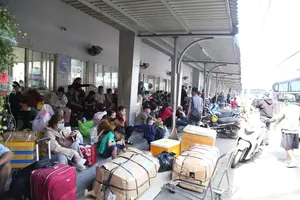
Authorities in the city are accelerating research and preparations to implement projects to build underground parking facilities at parks located at No. 1 Ly Thai To, 23 Thang 9 Park, and Le Van Tam Park.
These projects are expected to contribute to addressing the persistent shortage of parking spaces, an issue that has caused considerable concern among residents and commuters for many years.
Many projects remain on paper
According to data from the transport authorities, the number of privately owned cars in Ho Chi Minh City has grown by an average of around 7–9 percent annually. Prior to the administrative merger, the city had more than 9.6 million vehicles, including over 1 million cars and nearly 8.6 million motorbikes.
Following the merger, the city now manages nearly 12.7 million vehicles, including more than 1.4 million cars and nearly 11.3 million motorbikes. Despite this extremely high vehicle density, parking facilities remain scarce.
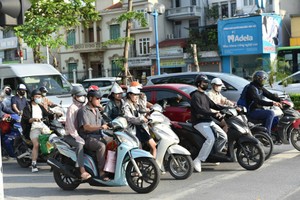
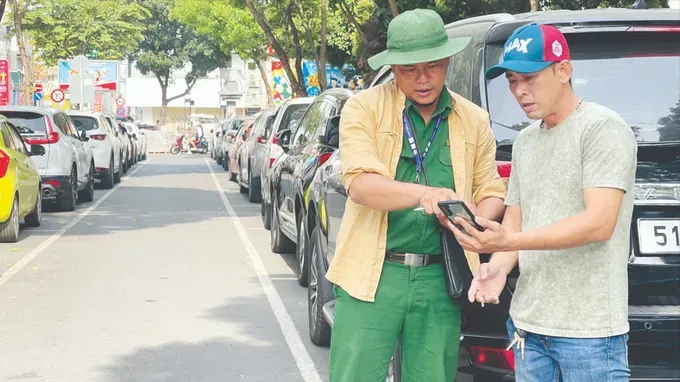
On many streets in the central area, finding a parking space has become a persistent concern for both residents and visitors. In wards such as Saigon, Ben Thanh, Tan Dinh, and Cau Ong Lanh, a number of roads with heavy traffic flows are still burdened with long rows of vehicles parked along both sides.
This situation significantly hampers traffic circulation and increases the risk of congestion, particularly in areas near shopping centers, service hubs, and tourist attractions.
According to urban transport experts, the lack of public parking spaces is one of the major causes of increasing traffic pressure in the city center. Meanwhile, the availability of land on the surface is becoming increasingly limited, making it difficult to develop large-scale above-ground parking facilities.
Therefore, utilizing underground space to develop a network of parking facilities has become a necessary solution. Underground parking structures can be integrated with parks, public squares, or other public facilities, thereby making more efficient use of urban land resources while still preserving community spaces for public activities.
As early as around 2005, Ho Chi Minh City put forward a policy to implement four underground parking projects at Le Van Tam Park, Trong Dong Stage, Tao Dan Park, and Hoa Lu Stadium, with a combined capacity of about 6,300 cars and 4,000 motorbikes.
In August 2010, the investor held a groundbreaking ceremony for the underground parking project at Le Van Tam Park under a Build–Operate–Transfer (BOT) model, with a total investment of around US$100 million.
The underground parking project at Hoa Lu Stadium was planned with an investment of more than VND3.4 trillion (US$130 million), including five basement levels serving commercial activities and parking space for more than 2,500 cars and 2,873 motorbikes. Meanwhile, the underground parking project at Tao Dan Park had a total investment of VND1.055 trillion (US$40.3 million), comprising one ground floor and four basement levels, designed to accommodate nearly 1,200 cars and 900 motorbikes.
However, despite these early plans and announcements, the projects have yet to be realized and largely remain on paper to this day.
Expectation for the early implementation of underground parking projects

Leaders of the Ho Chi Minh City Department of Construction said the department, in coordination with relevant units, is urgently reviewing and studying plans to build underground parking facilities at Park No. 1 Ly Thai To, 23 Thang 9 Park, and Le Van Tam Park.
According to preliminary assessments, these parks offer a number of favorable conditions for project implementation. They are located along major traffic corridors leading into the city center, while the surrounding areas host numerous government offices, commercial centers, service facilities, and tourist attractions.
As a result, the demand for parking in these areas remains consistently high, particularly during peak hours and on weekends. The construction of underground parking facilities at these locations is expected to significantly meet parking demand in nearby areas while easing pressure on surrounding road networks.
According to MSc Pham Ngoc Cong, a construction specialist at the University of Technology under Vietnam National University–Ho Chi Minh City (VNUHCM), underground parking projects in the city’s central area should be considered urgent infrastructure works.
Therefore, he suggested that state budget funding should be utilized during the initial phase to ensure implementation progress. Public investment would enable the city to take a more proactive role in project preparation, shorten the time required for related administrative procedures, and accelerate the construction process.
Such an approach would help bring the facilities into operation sooner, thereby better meeting the parking needs of residents and contributing to improved urban traffic management in Ho Chi Minh City.
According to experts, the prompt implementation of underground parking projects in the central area would not only help address the immediate demand for parking spaces but could also serve as a model for replication in other parts of Ho Chi Minh City.
Such projects would contribute to reorganizing urban traffic in a more orderly manner while supporting the city’s broader orientation toward building a modern, civilized, and sustainable urban environment.
Dr. Sci.–Architect Ngo Viet Nam Son also noted that, in addition to completing planning frameworks and identifying investment resources, Ho Chi Minh City could consider implementing these projects through special mechanisms and policies that the National Assembly has permitted on a pilot basis to create stronger momentum for urban development.
Among these, the public–private partnership (PPP) model is regarded as a suitable solution for large-scale urban infrastructure projects with a significant role in promoting socio-economic development.
This mechanism would not only help share the financial burden on the state budget but also create favorable conditions to attract enterprises with strong financial capacity, management experience, and technological expertise to participate in the investment, construction, and operation of the projects.