These outcomes are laying a solid foundation for the city’s policy on developing cultural industries to take root in everyday life.
Public spaces developed through social participation
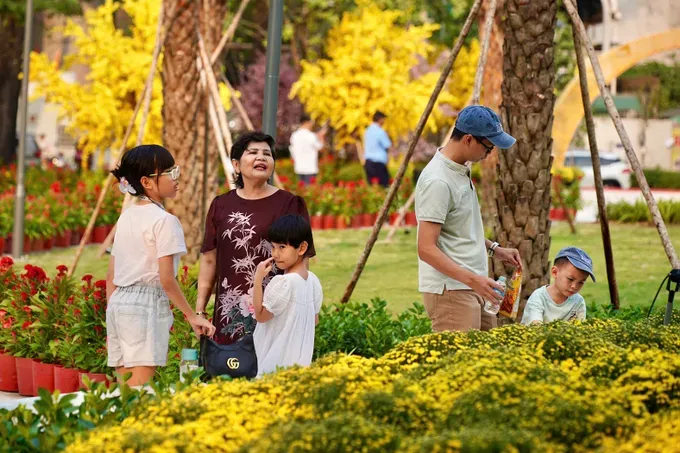
In the days leading up to the Lunar New Year, numerous areas across Ho Chi Minh City have been “reawakened” through urban embellishment projects. Notably, nine long-stalled development sites have been transformed into flower gardens and public parks for community use. These include sites at 8–12 Le Duan Street; 2–4–6 Hai Ba Trung Street; 33 Nguyen Du Street; 34–36 and 42 Chu Manh Trinh Street; 135 Nguyen Hue Street and 39 Le Loi Street in Saigon Ward; 87 Cong Quynh Street, 74 Ho Hao Hon Street, and 289 Tran Hung Dao Street in Cau Ong Lanh Ward; as well as 8 Vo Van Tan Street in Xuan Hoa Ward.
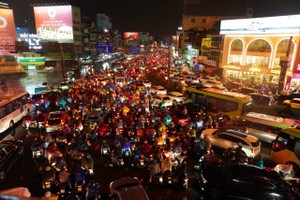
The emergence of new green spaces amid the dense urban landscape has helped ease “urban pressure” while enhancing the quality of life for city residents. These public spaces also reflect a new approach to urban governance, including mobilizing social resources and promoting the active participation of residents and businesses in the city’s development.
A notable example is the Covid-19 Memorial Park at No. 1 on Ly Thai To Street in Vuon Lai Ward, Ho Chi Minh City. Its centerpiece, the “Teardrop” monument, serves as a place of remembrance for those who lost their lives and as a tribute to the collective solidarity of the city’s residents during the Covid-19 pandemic.
Although the park has yet to be officially inaugurated, many residents have already expressed deep emotion in response to the project. “I lost a family member during the pandemic. Just hearing about the park through the media has already moved me deeply. When it is inaugurated, I will definitely come,” said Nguyen Huu Trong, 38, an information technology worker who lives in Vuon Lai Ward.
In practice, when urban renewal projects deliver clear and direct benefits, residents are willing to offer their support, and in many cases, to take an active role in preserving and protecting shared spaces. This forms a vital foundation for shaping a modern urban landscape that remains people-centered, a core principle of a truly developed city.
Heritage conservation driven by social investment and public awareness
Alongside urban renewal efforts, heritage conservation in Ho Chi Minh City has also seen encouraging signs, driven by increasingly active community participation. Many important historical and cultural sites have been, and continue to be, restored and upgraded through a combination of state funding and socially mobilized resources. Notable examples include the headquarters of the Ho Chi Minh City People’s Council and People’s Committee, Giac Vien Pagoda, Chi Hoa Communal House, the Ho Chi Minh City History Museum, Notre-Dame Cathedral Basilica of Saigon, and Van Thanh Pagoda.
According to Deputy Director of the Ho Chi Minh City Department of Culture and Sports, Nguyen Minh Nhut, approximately VND1.4 trillion (US$54 million) was invested in the restoration and preservation of historical and cultural sites in 2025. Of that amount, around VND900 billion came from public investment, with the remainder mobilized from social and private-sector contributions. This is a clear indicator of the community’s growing awareness and commitment to preserving and promoting heritage values, Mr. Nguyen Minh Nhut said.
Public spaces that have been revitalized and heritage sites that have been preserved and enhanced carry not only aesthetic and historical significance but also the potential to become destinations for culture, tourism, education, and creativity. When residents work alongside authorities to shape living spaces, safeguard urban memory, and nurture cultural values, Ho Chi Minh City is not only improving its outward appearance but also strengthening its cultural depth in support of sustainable development. This provides a solid foundation for the city’s cultural industries to gradually take root in everyday community life.
On the afternoon of February 5, at the Rex Hotel on Nguyen Hue Street in Saigon Ward, Secretary of the Ho Chi Minh City Party Committee Tran Luu Quang was scheduled to hold an informal meeting with members of the business community and artists active in cultural fields.
The gathering will provide a forum for city leaders, businesses, and cultural practitioners to exchange views, allowing the municipal authorities to listen to proposals and recommendations on developing Ho Chi Minh City’s cultural industries through 2030, with a vision toward 2045, identified as a new driver of the city’s economic growth.