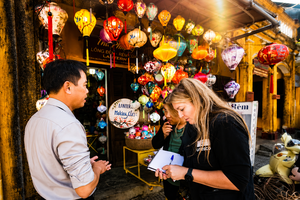
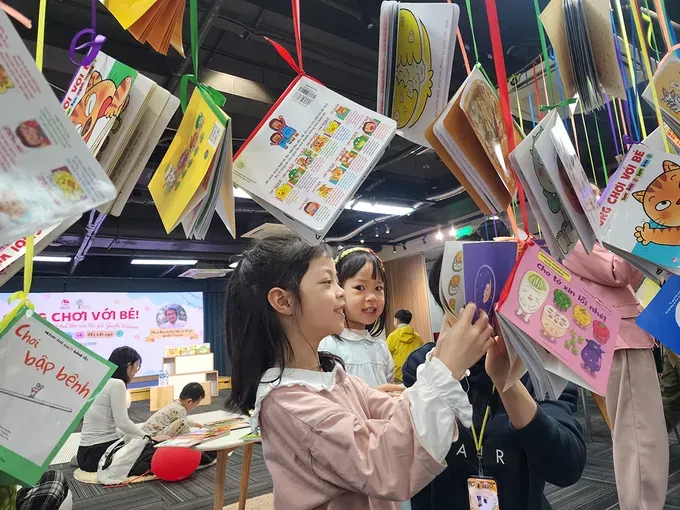
The event aims to celebrate the Vietnam Book and Reading Culture Day (April 21).
Building an ecosystem for books
From the current reality that Vietnam’s publishing sector largely remains confined to printing and distribution, with limited adaptation into films, games, or music, Chairman of Thai Ha Books, Nguyen Manh Hung, noted that the core issue lies not in resources but in organizational approaches. He cited experiences from Asian countries such as China, South Korea, and Japan, where the publishing sector has been elevated into a fully-fledged industry through long-term strategies and national-level investment.
When publishing is placed within a network of linkages with cinema, media, and other creative industries, the value of a book extends far beyond the printed page and can be multiplied across diverse formats.
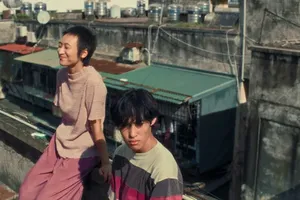
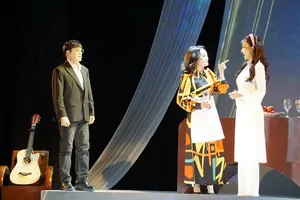
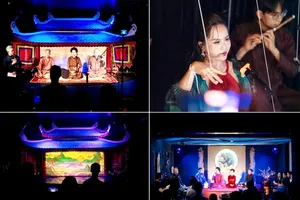
A case in point is “Truyen Kieu” (Tale of Kieu), a masterpiece of Vietnamese classic epic poetry by the great Vietnamese poet Nguyen Du, which has inspired a wide range of derivative works, from stage productions and films to paintings, embroidery, lacquerware, and mother-of-pearl inlay. All of these have contributed to expanding the value of the original work beyond the book itself. This is precisely how a book can become a source for generating multiple cultural products,” Mr. Nguyen Manh Hung emphasized.
Sharing this perspective, Director of Vietnam Women’s Publishing House Khuc Thi Hoa Phuong affirmed that books must be positioned at the core of the creative ecosystem, where stories can “live on” through films and a wide range of derivative products. Such a structure enables literary works to sustain long-term vitality and achieve broader cultural diffusion.
Echoing this view, seasoned publishing professionals emphasized that the issue no longer lies in a shortage of content, but rather in the lack of effective connectivity. When books are placed at the center and supported by a synchronized ecosystem, the lifecycle of a work extends far beyond the printed page, continuing to evolve across multiple creative formats, thereby expanding both cultural and economic value.
From a research perspective, former Director of the Institute of Culture and Development under the Ho Chi Minh National Academy of Politics, Nguyen Toan Thang, likened each book to a “seed” of intellectual and spiritual value. However, for that seed to germinate into other creative forms such as cinema or music, the publishing process must ensure high standards and rigorous quality control.
He underscored the pivotal role of editors as discerning “gatekeepers,” capable of refining manuscripts and enhancing their depth and clarity. In particular, he emphasized that books cannot fully realize their role if they remain confined to printing and distribution alone, as a book truly comes to life only when it is read, shared, and engaged with by the public.
Addressing the bottlenecks in cross-sector connectivity
Despite possessing a rich reservoir of source materials, domestic works have yet to generate strong resonance due to the absence of a cohesive systemic foundation. At the seminar, film producer Cao Phuong Diem highlighted existing gaps as well as opportunities from practical experience. While developing a project on the historical figure Hoang Thi The, a daughter of the leader of the Yen The Insurrection, Hoang Hoa Tham, her team had to travel to archival centers in France to access well-documented records.
This journey underscored the irreplaceable role of books and archival materials as foundational layers for all cinematic creativity. Film producer Cao Phuong Diem described the relationship between books and films as a symbiotic cycle: books provide substance and historical depth, while films breathe new life into stories through visual language and emotional expression.
The emergence of a film can, in turn, stimulate demand for reprints or the development of new books offering more immersive and experiential perspectives. The fact that several publishers have proactively approached film production teams to co-develop related book series signals that linkages within the value chain are gradually taking shape. As stories are retold through visual language, the distance between the past and contemporary audiences is significantly narrowed.
Sharing a similar view, writer Ha Thuy Nguyen noted that barriers also stem from lingering reader biases toward domestic publications. She underscored the need to accelerate digital transformation, as well as the classification and exploitation of data derived from books. When such knowledge is systematically organized, it can serve as a foundational resource for multiple sectors, helping to remove bottlenecks in cross-industry connectivity and paving the way for the sustainable development of the cultural industry ecosystem.
On the occasion of Vietnam Book and Reading Culture Day 2026 (April 21), a seminar titled “Developing Reading Culture in Enterprises in 2026” was held at the Ho Chi Minh City Press Center. The event was jointly organized by the Ho Chi Minh City Department of Culture and Sports, Saigon Businessman Magazine, and the Business Book Council.
At the seminar, participants underscored the critical role of reading culture in strengthening managerial capacity and fostering sustainable business development.
Discussions highlighted that in the context of intensifying global competition, enterprises must continuously enhance their internal capabilities to remain competitive.
According to Dr. Gian Tu Trung, in an increasingly competitive world, enterprises cannot sustain their position without strong capabilities. Reading, therefore, is considered one of the most effective means to improve knowledge.








)