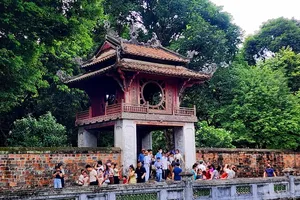
Idyllic locations such as the Lo 3 Village beach, the churches of Hoc Gao and Hoc Ram parishes in Dak Lak Province; the Lang Song Minor Seminary and Quy Hoa leper colony in Gia Lai Province; and the mountainous expanses of Bac Ai region in Khanh Hoa Province have meticulously forged an atmosphere that is simultaneously nostalgic and vibrantly alive for the blockbuster “Hen Em Ngay Nhat Thuc” (See You on Eclipse), directed by Le Thien Vien and grossing over VND100 billion (US$3.8 million).
Every single frame transcends being a mere backdrop; instead, it ingeniously transforms into an integral component of the narrative, actively shaping the characters’ deepest emotions and heartrending memories. In addition, the cinematic score has elicited profound tears from countless spectators with haunting tracks like “Xin Giu Con” (Please Protect Me), “Hen Uoc Xin Khuat Loi” (Unspoken Vows), “Chi Chung Do Thoi” (Just That Much), and “Xuan Thi” (Springtime).
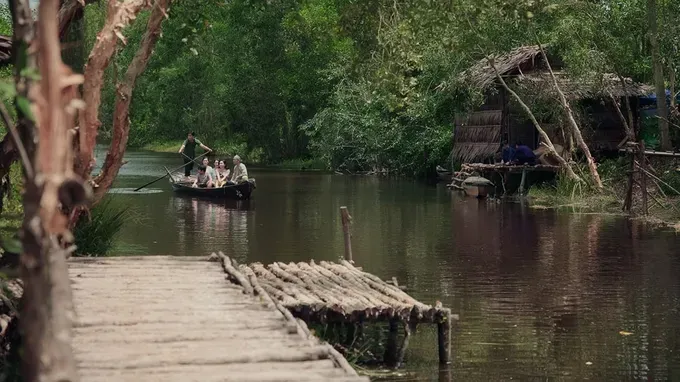
The innovative trend of Vietnamese cinema aggressively investing in immersive settings and original soundtracks (OSTs) is gaining formidable momentum. Previously, in “Ai Thuong Ai Men” (Who Loves Whom), director Thu Trang exerted immense effort to authentically recreate the bygone lifestyle of the Southwestern region through rustic, intensely nostalgic framing.
Subsequently, in the film “Tai”, directed by Mai Tai Phen, audiences were left thoroughly awe-struck by the sweeping, panoramic shots of vast riverine landscapes, verdant rice paddies, and bustling floating markets. Similarly, in “Quy Nhap Trang 2” (Corpse Demon 2), directed by Pom Nguyen, the topography of An Giang Province was brilliantly exploited, highlighting its spectacular panoramas and charmingly showcasing traditional fabric dyeing workshops steeped in rich Vietnamese cultural heritage.
In the near future, audiences will continue their expansive cinematic voyages through settings deeply infused with Southern folklore and Khmer culture in “Heo Nam Mong” (Five-Toed Pig), directed by Luu Thanh Luan. They will also witness numerous distinctive landmarks debuting on the silver screen from the Moc Chau region (Son La Province) such as Ta Phinh stone village, Mu Suong Valley, and Doi Cave in “Phi Phong: Quy Mau Rung Thieng” (Phi Phong: The Sacred Forest’s Blood Demon), directed by Do Quoc Trung.
Regarding the auditory dimension, “Cam On Nguoi Da Thuc Cung Toi” (Thank You for Staying Awake With Me), directed by Chung Chi Cong established an unprecedented record with 14 soundtrack songs, comprising 10 original compositions explicitly tailored for the film and 4 acquired tracks. These were masterfully delivered by acclaimed vocalists including Nguyen Ha, Phung Khanh Linh, Nguyen Hung, Cong Duong, and Nguyen Lam Thao Tam.
A robust lineup of tracks, namely “Vi Thuong Nhau Qua” (Because We Love Too Much), “Dua Tre Mua Dong Chi” (The Winter Solstice Child), “Di Dau De Thay Hoa Bay” (Where to See Flying Flowers), “Chi Con Goi Ten Nhau” (Only Calling Each Other’s Names), and “Doc” (Poison) have each brilliantly captivated their respective target demographics.
Concealed behind these breathtakingly beautiful frames and deeply resonant melodies is an extraordinarily demanding production journey. Production designer Bui Bao Quoc revealed that the “Ai Thuong Ai Men” crew exhausted 12 grueling days solely to construct the protagonist Hai Men’s residence. “Bereft of conventional access roads, all raw materials had to be laboriously transported via wooden boats and agricultural tractors. We were compelled to mobilize nearly 400 boat trips and over 50 tractor journeys to secure sufficient supplies,” artist Bui Bao Quoc recounted.
Similarly, for “Trum So” (Mr. Stingy), directed by Duc Thinh, the producers audaciously constructed an entire, bespoke village from scratch in the Phan Rang region of Khanh Hoa Province. The relentlessly harsh weather, specifically the severe blowing sand phenomenon, catastrophically prolonged the shooting schedule and significantly inflated production expenditures.
Likewise, the crew of “Phi Phong: Quy Mau Rung Thieng” invested exorbitant time and physical exertion to capture footage across treacherously rugged terrains in Moc Chau, constantly confronting extreme meteorological adversities such as severe frosts and devastating flash floods.
In the musical sphere, the strategic investment is equally uncompromising. Director Chung Chi Cong initiated an innovative open casting call to unearth the perfect OST for “Cam On Nguoi Da Thuc Cung Toi”, successfully attracting nearly 200 fresh submissions.
Meanwhile, numerous other film crews deliberately commission renowned singer-songwriters such as Phan Manh Quynh, My Tam, and Nguyen Hung or strategically select pre-existing, familiar songs that impeccably complement the cinematic narrative. Furthermore, the strategic release algorithms for these OSTs are meticulously calculated by the production teams to sustain public fervor and forcefully grab the audience’s undivided attention.
Substantial investment in immersive settings and sophisticated audio is undeniably imperative, perhaps even a mandatory prerequisite for contemporary success.
However, these two pivotal elements must be masterfully integrated into a harmonious, synergistic whole that encompasses the narrative structure, the screenplay, and the acting. Only through this holistic synthesis can they maximize their intrinsic value, rather than languishing as mere superficial spectacles. A genuinely triumphant cinematic masterpiece is born only when these intricate elements are flawlessly balanced.