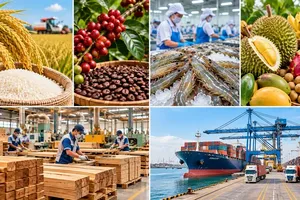
Over US$3 billion worth of Vietnamese exports to the EU fall under product categories affected by the Carbon Border Adjustment Mechanism (CBAM) - an environmental policy tool that puts a fair carbon price on goods imported into the European Union.
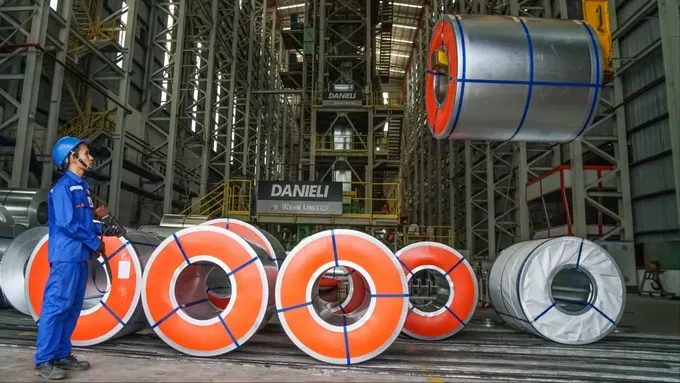
As carbon costs are factored into goods, high-emission products face severe price pressures, reduced competitiveness, and the risk of losing orders, turning the green transition into a vital survival effort for Vietnamese enterprises seeking to retain their market share.
Higher emissions yield severe price disadvantages
According to Tran Ngoc Quan, Commercial Counselor and Head of the Vietnam Trade Office in Belgium and the EU under the Ministry of Industry and Trade, the CBAM certificate price announced by the EU for the second quarter of 2026 stood at 75.28 euros per ton of CO2. Producing one metric ton of steel generates an average of roughly two metric tons of CO2.
At an export price of around EUR650 per ton, the carbon cost based on the aforementioned rate could account for approximately 23 percent of the product value if businesses fail to implement effective emission reduction solutions.
Although enterprises will not bear the full cost burden in 2026 because CBAM obligations are being phased in, starting at around 2.5 percent of covered emissions and gradually rising to 100 percent by 2034, competitive pressure is already evident.
Higher emissions bring larger carbon costs, while a lack of emission data meeting regulatory standards could subject goods to default EU values, pushing expenses even higher. Outside the EU, approximately 80 carbon markets and carbon tax mechanisms are operating globally, covering about 28 percent of global emissions.
Carbon factor is thus shifting from an environmental indicator to a key price component, serving as a new benchmark determining competitiveness among suppliers. This warns of a realistic danger: if Vietnamese goods lag behind competitors in reducing emissions, carbon disadvantages will turn into cost disadvantages, resulting in lost orders and shrinking market share.
From an investment perspective, Director Nguyen Ngoc Tung of the VinaCarbon Climate Impact Fund at VinaCapital noted that as carbon is priced, businesses are forced to balance the cost of continuing emissions against the cost of investing in emission reduction technology.
When carbon costs are integrated into product prices, investing in emission reduction is no longer merely a compliance cost, but a direct calculation deciding corporate pricing and competitiveness.
Allocation of green credit sources is proper
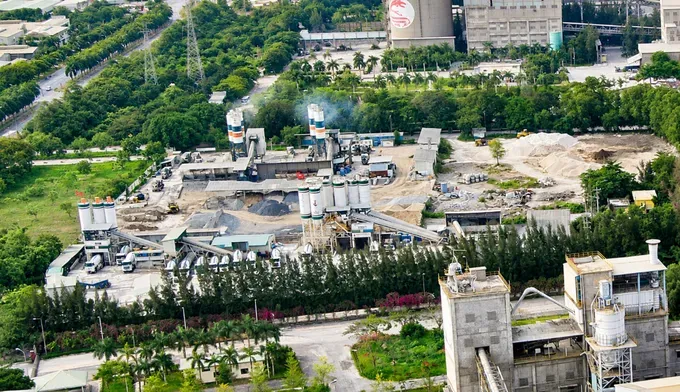
Pressure to cut emissions forces businesses to invest directly in production, despite significant transition costs.
Director Vo Thai Xuan Thuy of Marketing and Sustainability at Fico-YTL Cement shared that the company has developed EcoCem lines that reduce emissions by roughly 30 percent to 70 percent depending on the product, increased the use of alternative fuels, and plans to allocate around VND300 billion in 2027 for various transition solutions.
According to Director Le Xuan Nghia of the Institute for Consulting and Development (CODE) (or the Institute for Financial and Carbon Development Advisory), funding from domestic green financial markets to support corporate green transition is currently abundant. However, these capital flows have not yet been heavily allocated to production sector projects involving line modernization, energy efficiency, and direct emission reduction.
Meanwhile, Pham Lien Anh, Head of the Vietnam, Laos, and Cambodia Advisory Program on Economic Reform and Research at the International Finance Corporation (IFC), noted: "An inability to measure emissions accurately means difficulty identifying which stages require priority investment, proving reduced carbon volumes, and meeting market as well as financial institution requirements."
Facing this reality, the Government has moved to construct a regulatory framework and infrastructure for the carbon market. Nationwide, 2,166 facilities are currently subject to mandatory greenhouse gas inventories, representing roughly 30 percent of total national emissions.
In 2026, relevant authorities are expected to pilot emission quota allocation and trading with approximately 150 heavy-emitting enterprises in the thermal power, iron and steel, and cement sectors.
Ta Thanh Binh, General Director of the Vietnam Securities Depository and Clearing Corporation (VSDC), stated that the system for carbon quota and credit depository and settlement has been established and connected with relevant agencies. The Ministry of Agriculture and Environment is building an online reporting system to boost cross-checking capabilities and data transparency.
The pressing issue now is bridging the gap between carbon market infrastructure and actual business transition capabilities. Establishing emission factors and databases tailored to each product sector will provide enterprises with a solid foundation to determine priority stages for emission reduction while proving transition results.
In parallel, green credit capital and transition financial instruments should be directed more strongly toward supporting equipment renewal, energy conservation, and promoting raw material circular economy; specifically linking emission reduction goals to enhancing competitiveness for each export sector.
Only when enterprises can measure emissions, efficiently access capital, and invest in the correct production stages will product carbon footprints truly decline. This remains the key to controlling carbon costs, meeting market standards, and securing export orders.