Speaking to Sai Gon Giai Phong Newspaper's reporter, head of the Statistics Department under the Ministry of Finance, Nguyen Thi Huong, emphasized that the economic growth recorded in the first nine months of 2026 provides an important foundation for achieving the goal of double-digit economic growth this year.
According to Nguyen Thi Huong, economic growth in the third quarter was estimated at 9.95 percent year on year, bringing growth for the first nine months of 2026 to an estimated 9.01 percent compared with the same period in 2025.
The industrial and construction sector made the largest contribution to overall economic growth, accounting for nearly 50 percent, followed by the services sector at more than 45 percent and the agriculture, forestry, and fisheries sector at more than 5 percent.
This is also the first year that localities have been assigned growth targets by the Government. As a result, 12 of the 34 localities recorded growth of 10 percent or higher. This provides an important foundation for striving to achieve the double-digit economic growth target this year.
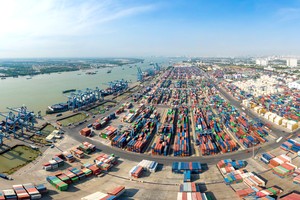
According to statistics for the first nine months of 2026, Vietnam’s total import and export turnover exceeded US$888 billion, with exports surpassing US$434 billion and imports reaching nearly US$454 billion. The goods trade balance recorded a trade deficit of more than US$19.4 billion during the nine-month period.
There are differing views on this trade deficit. However, in Ms. Thuy's view, it is a sign that the economy is preparing for a new growth cycle. Looking at the composition of imports, machinery, equipment, and raw materials accounted for more than 94 percent of total import turnover.
Foreign-invested enterprises also increased imports of equipment. This indicates that investment cooperation projects in high-tech sectors, such as chips and semiconductors, have begun to be implemented in Vietnam.
As for the “health” of businesses, nearly 224,000 enterprises were newly established or resumed operations nationwide during the first nine months of the year, averaging nearly 25,000 new market entrants each month. Meanwhile, 172,000 enterprises withdrew from the market, averaging more than 19,000 businesses exiting the market each month. Thus, the number of newly established enterprises remained higher than the number of businesses withdrawing from the market.

Ho Chi Minh City was not among the 12 localities that recorded double-digit growth in the first nine months of the year. Asked about this, she said that as an economic “locomotive” and a key pillar of the national economy, Ho Chi Minh City’s growth has significant implications for the country’s economy as a whole. She said several aspects of the figure should be taken into consideration.
Ho Chi Minh City’s GRDP growth in the third quarter reached 9.86 percent, the highest year-on-year growth rate recorded in the past 10 years. The city’s economic growth in the first nine months stood at 9.06 percent, also higher than the national growth rate.
One point to note is that Ho Chi Minh City has the largest economic scale among all provinces and cities nationwide. According to statistics at the end of 2025, following the merger, the city’s total GRDP was estimated at more than VND3 quadrillion (over US$120 billion), accounting for nearly 24 percent of the country’s GDP.
Therefore, each percentage point of economic growth in Ho Chi Minh City represents a much larger contribution than the same rate of growth in other localities. Calculations show that a 1-percent increase in the city’s GRDP would contribute about 0.55 percent to the country’s overall GDP growth.
Ho Chi Minh City still has considerable room and strong drivers for economic growth in the fourth quarter. These growth drivers include public investment disbursement, private investment, foreign direct investment, consumption, and high-tech industries.
In particular, the Urban Development Law took effect on October 1, establishing a preferential institutional framework and granting Ho Chi Minh City greater autonomy to address bottlenecks in infrastructure, finance, and governance, thereby creating new space for development.
To achieve the target of annual GDP growth of 10 percent or higher, fourth-quarter growth must reach at least 12.5 percent. This is a major challenge. Meanwhile, the average domestic Consumer Price Index (CPI) rose 4.52 percent year on year in the first nine months, while core inflation increased 4.26 percent, putting significant pressure on economic management in the final months of the year.
To achieve the double-digit economic growth target, it is necessary to remain steadfast in prioritizing growth promotion while maintaining macroeconomic stability, ensuring major economic balances and controlling inflation. This requires concerted efforts across the entire political system, with ministries, agencies, and localities working together.