Walking through traditional markets once regarded as bustling commercial hubs in Ho Chi Minh City now reveals a stark transformation. Physical foot traffic has visibly thinned, while many vendor stalls have established a second "storefront" on mobile screens.
Tucked behind market counters—alongside traditional scales, plastic bags, and cardboard crates—vendors now mount smartphones to record videos, host livestreams, answer messages, and finalize online orders.
Dwindling foot traffic forces traditional market vendors to pivot online
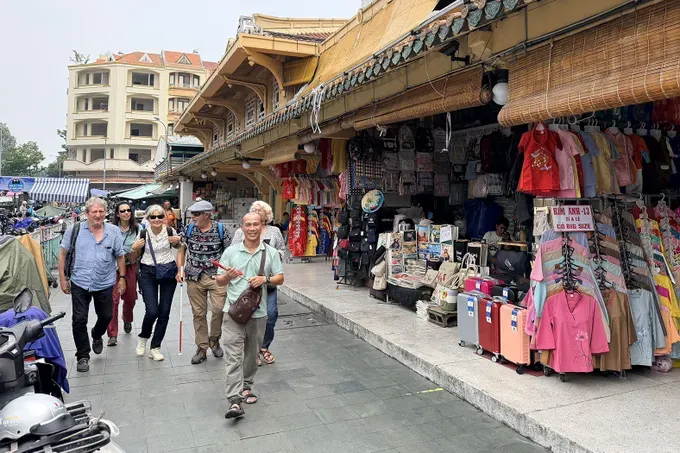
Shifting consumer habits have left many traditional markets across Ho Chi Minh City struggling with declining foot traffic. From central hubs such as An Dong, Tan Dinh, Ban Co, and Hoa Hung to markets in the city's eastern part, both walk-in shoppers and wholesale buyers have dropped significantly. Vendors report sales drops ranging from 50 percent to as much as 70 percent per stall.
Nguyen Thi Hong Hanh, owner of the Hong Hanh fashion stall at a market in eastern Ho Chi Minh City, said that despite opening early, she sometimes reaches 10:00 a.m. without making a single sale.
Her daily revenue, which previously averaged VND1 million to VND2 million (US$40–US$80), has plummeted to just VND100,000 to VND200,000, with some days yielding no sales at all. Meanwhile, monthly expenses such as stall rentals and utilities remain fixed. "My capital is tied up in inventory, and since I don't know what else to do, I am just holding on," Hanh said.
To boost purchasing power and attract new customers, a growing number of vendors are learning to sell online. At An Dong Market, Thai Trang, a clothing merchant, regularly guides her staff to arrange merchandise neatly in preparation for livestreaming sessions.
"Wholesale orders shipped to other provinces have fallen sharply compared to before. My family owns a garment manufacturing firm that supplies apparel to partners in Ho Chi Minh City and various provinces, but the lack of orders forced us to lay off over half our staff. We are trying every possible way to adapt, including seeking buyers on social media platforms like Facebook, TikTok, Zalo, and other online retail channels," Trang explained.
Nguyen Nam, a vendor at Hoa Hung Market, shared that she was initially hesitant to adopt new technology. However, with guidance from friends, she has learned to take photos of her merchandise and post them on social media.
"Selling goods nowadays requires adaptation. Putting products online has allowed customers from distant provinces to place orders, which has helped revive sales to some extent," she said.
However, vendors note that succeeding online requires investing in product visual presentation, updating prices continuously, responding quickly to messages, offering competitive pricing, and handling returns promptly. Delaying a response by just a few minutes, they warn, can cause customers to switch to another seller.
Municipal authorities, industry sector, and businesses join forces to support traditional markets
Numerous traditional markets across Ho Chi Minh City are actively seeking ways to revitalize operations, enhance visitor experiences, and expand their customer base, with tourism emerging as a highly potential avenue for growth.
Data from the Ho Chi Minh City Department of Industry and Trade indicates that following administrative boundary restructuring, Ho Chi Minh City now encompasses approximately 500 traditional markets. The municipal government is currently formulating a strategic development blueprint based on assessments of local demand, current operational conditions, functional utility, and potential commercial viability for each location.
Nguyen Nguyen Phuong, Deputy Director of the Ho Chi Minh City Department of Industry and Trade, noted that markets maintaining strong consumer demand will undergo research for renovation and modernization. For underperforming facilities, municipal authorities will evaluate options for consolidation, repurposing, or alternative adaptive reuse.
At Binh Tay Market, one of the city's major commercial hubs, management has already integrated international payment methods to facilitate seamless shopping for foreign tourists. Nguyen Ngoc Que Phuong, Director of the Binh Tay Ward Public Service Supply Center—the market's managing authority—highlighted that complimentary experiential activities, such as traditional lantern-making and Mid-Autumn mooncake crafting, have been introduced to create engaging cultural highlights for tour itineraries.
Looking ahead, Binh Tay Market plans to adopt digital solutions, deploying QR codes to provide visitors with immediate access to historical background, architectural layouts, product categories, and available services. Additionally, management is intensifying partnerships with travel agencies to incorporate market visits into guided shopping and sightseeing tours.
Tourism expert Phan Yen Ly emphasized that attracting visitors requires market spaces to remain clean and well-ventilated, with transparent price tags, verified product quality, and professional customer service. Modern travelers visit traditional markets not solely to purchase goods but to seek immersive cultural experiences; positive encounters encourage repeat visits and word-of-mouth recommendations.
Analysts note that traditional markets are increasingly recognized as cultural, culinary, and tourism hubs. Sites possessing distinct historical significance, heritage architecture, specialized trades, or signature culinary offerings can be reorganized to harmoniously blend commercial retail with experiential tourism.
The ultimate objective extends beyond mere survival; it aims to help each traditional market define a relevant role within the evolving urban landscape—meeting resident needs, elevating service standards, and maximizing commercial, cultural, and tourism value.