Despite HCMC’s aim to cut processing time, compliance costs, and business conditions each by 30 percent, enterprises haven’t felt proportional improvements, according to SPHACY Company CEO Vu Van Thanh. Conflicting agency guidance means businesses must constantly revise dossiers, which reportedly prolongs timelines and incurs extra costs, keeping the administrative burden heavy for local firms.
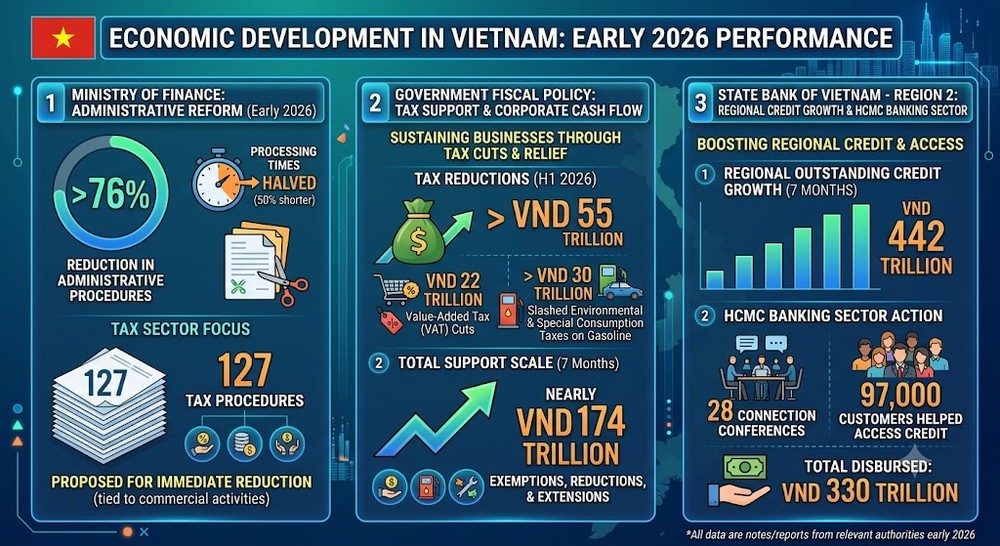
Authorities are, therefore, actively targeting these bottlenecks. Deputy Minister of Finance Cao Anh Tuan noted that in early 2026, they’ve slashed over 76 percent of administrative procedures and halved processing times. In the tax sector alone, 127 procedures tied directly to commercial activities have been proposed for immediate reduction.
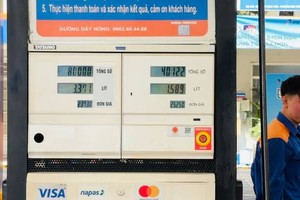
Alongside procedural reform, the Government is steering fiscal policy to sustain corporate cash flow. In the first half of 2026, tax reductions reportedly exceeded VND55 trillion (US$2.1 billion). This includes VND22 trillion ($843 million) saved through value-added tax cuts, and over VND30 trillion ($1.15 billion) from slashed environmental and special consumption taxes on gasoline. Overall, the total support scale for exemptions, reductions, and extensions over the first seven months hit nearly VND174 trillion ($6.67 billion).
Commercially, banks are rolling out flexible, collateral-free capital solutions for small and medium-sized enterprises as well as and startups. For instance, M Village JSC secured a VND-100 billion ($3.8 million) loan from Orient Commercial Joint Stock Bank (OCB), based purely on “soft assets” like cash flow and business models.
Director Vo Minh Tuan of the State Bank of Vietnam – Region 2 noted regional outstanding credit grew by VND442 trillion ($17 billion) in seven months. Through 28 recent connection conferences, the HCMC banking sector has helped 97,000 customers access credit, disbursing a total of VND330 trillion ($12.6 billion).
HCMC Statistics Head Nguyen Khac Hoang reported that in the first seven months of 2026, roughly eight enterprises withdrew for every 10 entering the market. This ratio has significantly increased since early this year, when 18 businesses folded for every 10 that opened.
These figures reflect a gradually stabilizing operational landscape. Given its massive purchasing power, HCMC has the right conditions to turn the domestic market into a launchpad for production, provided linkages between businesses, distributors, and consumers are properly organized.
For CEO Phung Quoc Man of A&M Flooring Company, navigating the market requires a dual approach. While many Vietnamese wood products meet strict international standards, he noted the domestic potential remains largely untapped.
Besides exports, authorities should prioritize Vietnamese goods in public investment projects and state-funded works. If production capacity is better connected with domestic purchasing power, businesses can secure enough orders to sustain employment and cash flow during global market fluctuations. For smaller firms, it’s crucial that supply-demand connections don’t just stop at bringing products to local display booths.
Meanwhile, the Ministry of Finance is gathering feedback on a draft resolution proposing a 30-percent corporate income tax cut across 2026 and 2027 for enterprises earning under VND10 billion ($383,000) annually. This policy will reduce budget revenue by over VND6.7 trillion ($257 million) over two years. While this move might cause a short-term state revenue drop, at the end of the day, it helps these smaller entities retain crucial profits to reinvest, expand production, and get the ball rolling again.
To supply retail chains, enterprises must concurrently meet stringent requirements for quality, packaging, logistics, and stable delivery. Consequently, policies should shift from merely “introducing products” to proactively “elevating supplier standards,” which means guiding businesses from initial evaluation to final contract signing.
In export arenas, promotional tactics must evolve. The Vietnam Pepper and Spice Association proposed forging direct links with major foreign distributors to bypass middlemen. Success would then be gauged by tangible contracts and supply chain integration rather than sheer conference attendance.
HCMC Department of Industry and Trade Director Bui Ta Hoang Vu noted that through late 2026, they’ll focus on clearing bottlenecks at industrial clusters to expedite land handovers. Market-wise, they will host the Vietnam Export Fair this October to court global buyers, alongside targeted campaigns to stimulate domestic consumption. Furthermore, they’ll spearhead alliances to slash logistics costs and ease the mounting pressure of soaring raw material expenses.
Deputy General Director Mai Son of the General Department of Taxation (Ministry of Finance) informed that the ongoing “tax code cleanup campaign,” launched in May 2026, actively targets over 617,000 tax codes of businesses that abandoned their addresses or ceased operations without proper invalidation.
Reality shows that the number of entities quietly suspending operations without finalizing their tax settlements is steadily trending upward. This creates significant administrative headaches for management agencies. Cleaning up these dormant codes effectively allows “clinically dead” enterprises to officially dissolve, paving the way for a much more transparent and favorable business environment.
Meanwhile, Trade Remedies Authority Deputy Director General Chu Thang Trung (Ministry of Industry and Trade) stressed the high, persistent risk of Vietnamese exports facing ongoing trade remedy investigations. It appears this trend will only intensify as Vietnam’s export scale rapidly surges on the global stage.
To actively counter this, the Ministry of Industry and Trade is sharpening its early warning system by diligently tracking specific commodities and markets to alert businesses promptly. The ultimate goal is to give firms ample time to prepare before incidents arise, rather than scrambling when they’re already under foreign investigation.
However, businesses themselves must proactively build robust internal compliance frameworks. The ability to supply accurate, transparent data is absolutely crucial when answering to foreign investigators.
Regarding market expansion, Export Promotion Center Deputy Director Nguyen Thi Thu Thuy (Vietnam Trade Promotion Agency) noted that future promotional efforts will shift decisively from broad matchmaking to highly targeted, market-specific connections. Recently, this precise approach has yielded concrete dividends.
At a major promotional event in Yunnan, China, over 30 Vietnamese agricultural firms successfully closed deals on the spot. Still, as a general rule of thumb, trade agencies merely set the stage; ultimate commercial success depends entirely on the enterprises’ own hustle and capabilities.
For economic expert Dr Le Duy Binh, supporting struggling firms shouldn’t rely on a rigid “one-size-fits-all” remedy. Policymakers must carefully distinguish between businesses exiting due to organic market shifts and those genuinely battered by the domestic business environment itself.
A recent survey by the Vietnam Chamber of Commerce and Industry (VCCI) clearly shows that besides daunting legal hurdles, companies heavily grapple with volatile input costs (accounting for over 59 percent), weakening consumer demand, and severe resource shortages.
Therefore, for entities stifled by the business climate, simply throwing in another financial package won’t get the ball rolling. In the end, authorities must rigorously cultivate a predictable, safe environment with minimal compliance costs.