With skillful hands, creative thinking, and a solid academic foundation, Vietnamese doctors not only perform advanced techniques and treat patients domestically but are also highly respected by the global medical community.
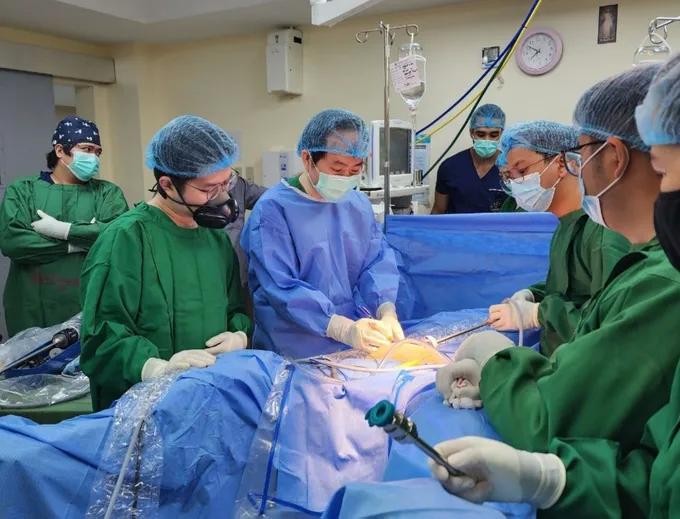
Professor Nguyen The Hoang, former Deputy Director of Central Military Hospital 108 under the Ministry of National Defense, was the second Vietnamese doctor elected an Academician of the World Academy of Sciences (TWAS) in 2025. This is a testament to the intellect, courage, and aspiration of Vietnamese scientists to reach international standards, and also opens up opportunities for extensive international cooperation in research and application of science and technology for public health.
But for Professor Nguyen The Hoang, that prestigious title is perhaps not as brilliant as the smiles of the patients he "reborn" to return to normal life.
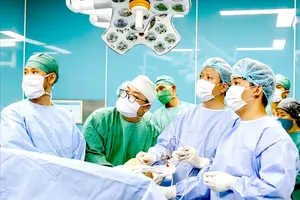
In 2008, the Rechts der Isar Surgical Hospital in Munich, Germany, achieved a remarkable feat by performing a simultaneous transplant of two arms for a patient who had lost both in a workplace accident. At that time, Dr. Nguyen The Hoang was among the five principal surgeons involved in this groundbreaking procedure while he was also pursuing his doctoral studies.
The triumph of the arm transplant surgery sent shockwaves through the medical community globally, as a Vietnamese doctor, with his adept hands and keen intellect, alongside esteemed colleagues from around the world, accomplished a miraculous feat. The patient later returned to work without any issues, serving as a vivid testament to the extraordinary success of microsurgical techniques.
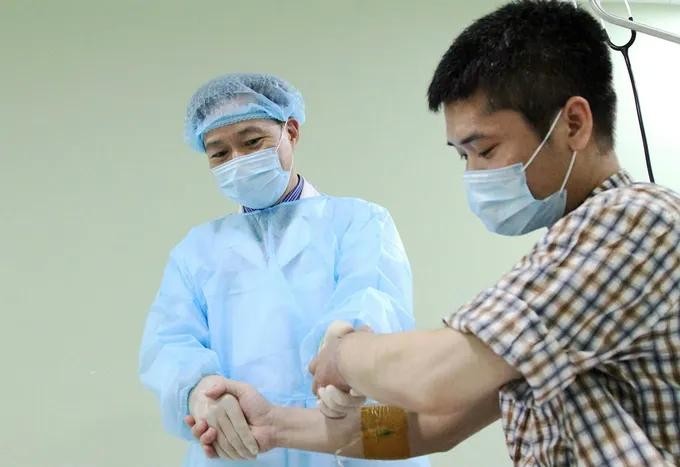
Returning to Vietnam after a long period of research, Professor Nguyen The Hoang carried with him a burning desire to help poor workers who had unfortunately lost limbs regain their full function. In 2020, at Central Military Hospital 108, Professor Nguyen The Hoang and his team successfully performed the first limb transplant, also the first limb transplant in Southeast Asia.
This was the world's first successful limb transplant using a living donor (using the intact, healthy portion of a severed limb that could not be reattached and had to be amputated to graft onto the corresponding amputated limb of the recipient). The recipient had lost one-third of their lower forearm in a work accident four years prior. After four years of waiting, the patient received a completely new forearm, fulfilling their dream. Next, simultaneous transplants of both forearms and arms from brain-dead donors were carried out in 2024.
As one of the pioneering doctors in Vietnam to obtain formal training in robotic surgery techniques, and with extensive experience from performing hundreds of surgeries, Dr. Nguyen Phu Huu, who serves as the Head of the Colorectal Surgery Department at Binh Dan Hospital, disclosed that in 2023, he received an invitation from the Philippine General Hospital to assist and provide training in robotic gastrointestinal (stomach) surgery. In the company of his colleagues from the Philippines, Dr. Nguyen Phu Huu successfully executed a complex surgery. This procedure involved a 50-year-old female patient diagnosed with mid-rectal cancer, who had previously undergone chemotherapy and colostomy surgery due to bowel obstruction.
An increasing number of countries in the region have dispatched healthcare professionals to hospitals in Ho Chi Minh City, such as the University of Medicine and Pharmacy, Cho Ray, Binh Dan, My Duc, Nhi Dong 2, and the Institute of Traditional Medicine for the purpose of learning and enhancing their expertise and skills.
According to numerous experts, Vietnam has a variety of diseases, including conditions rarely encountered in developed countries, which facilitates learning and the exchange of experiences. The collaboration in training not only aids Vietnamese doctors in improving their foreign language proficiency and staying updated with new knowledge but also enhances the reputation of the Vietnamese medical sector within the international medical community.
During his short visit to the Philippines, Dr. Nguyen Phu Huu conducted practical training for his peers at the Philippine General Hospital and delivered lectures on robotic surgery to numerous doctors from various hospitals across the Philippines. "Following these visits, I received considerable commendation from my colleagues, as the insights I shared were based on practical experiences that no textbook could provide. I humorously remarked that in Vietnam, we have thousands of surgeons who possess far greater skills. I take pride in that!" Dr. Nguyen Phu Huu stated.
Meanwhile, Associate Professor Tran Ngoc Son, Deputy Director of Saint Paul General Hospital in Hanoi, is renowned for mastering the “millimeters” of pediatric surgery. The story of Mr. Warren, an Australian citizen living in Bali (Indonesia), who traveled all the way to Vietnam with his 4-year-old daughter, thanks to the assistance of Associate Professor Dr. Tran Ngoc Son, demonstrates the prestige of the Vietnamese medical sector. Mr. Warren's daughter had a choledochal cyst, and the family had visited many major hospitals in Australia, Singapore, and France, but all advised open surgery.
Worried about his young daughter, Mr. Warren conducted an online search and came across an international article authored by Associate Professor Tran Ngoc Son regarding single-port laparoscopic surgery. In contrast to traditional laparoscopy, which typically involves 3-4 incisions, single-port laparoscopy requires only one small incision made through the navel. This presents a significant challenge, even for numerous global experts, due to the exceedingly limited operating space, the potential for instrument damage, and the necessity for precision at the millimeter level.
However, at the High-Tech Center of Saint Paul General Hospital, the surgery for Mr. Warren's daughter was a spectacular success, much to the astonishment of the patient's family. With just a small incision less than 2cm cleverly concealed at the navel, Associate Professor Dr. Tran Ngoc Son completely removed the cyst.
A week later, the little girl was able to run and jump without any scarring or persistent pain. With over 100 technical reports presented at international conferences, Associate Professor Dr. Tran Ngoc Son has made Vietnam a world leader in single-port endoscopic treatment of choledochal cysts in children. His reports and professional experience exchanges in the US and Europe have consistently received high praise from international colleagues.