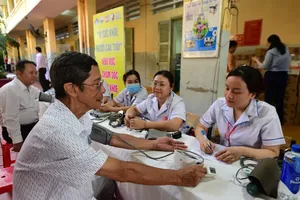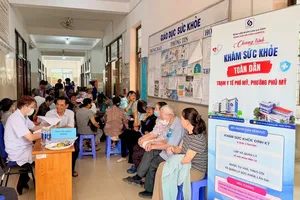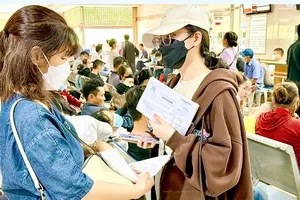
Over the past six years, every time she needed a health check-up, 64-years-old Le Thi Ngoc in Neighborhood No.11 of Xuan Hoa Ward had to go to the district medical center or higher-level hospitals. Being elderly and frail, traveling was difficult, and she often had to queue for half a day just to be examined and receive medicine.
Since hearing the news that skilled doctors have returned to the ward medical station to provide home healthcare, and that residents can contact them anytime for timely consultations based on their medical records, Mrs. Ngoc and her friends have been thrilled.
“Only when we have a severe illness requiring intensive treatment do we need to go to a higher-level hospital. For body aches or a mild cold and fever, we just contact the doctors for examination and care. Here, the doctors inquire thoroughly and are very enthusiastic,” Mrs. Ngoc exclaimed.
As the pilot locality for the “Continuous Healthcare Teams Attached to the Locality” model, Vice Chairwoman Luong Thi Hong Gam of the Xuan Hoa Ward People’s Committee stated that the local clinic is a national pilot model.
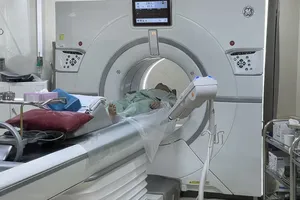
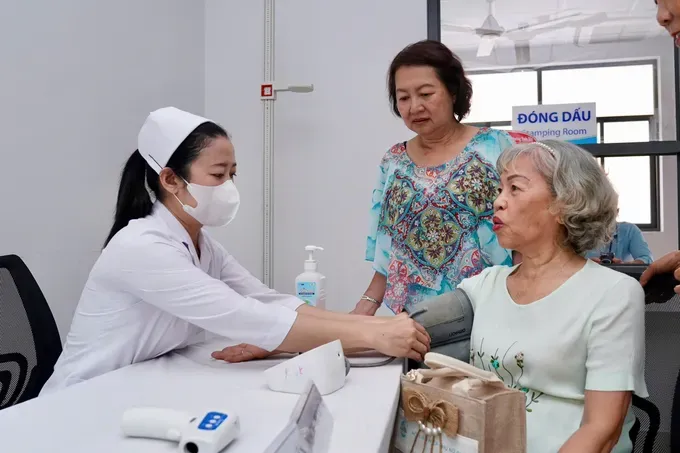
With a total investment of nearly VND28 billion (US$1 million), it is fully equipped with modern infrastructure. The station has a staff of 63, including 18 specialists in internal medicine, surgery, family medicine, ophthalmology, ear-nose-throat, odonto-stomatology, traditional medicine, and more, meeting the primary healthcare needs of local residents.
The ward has also piloted the deployment of six continuous healthcare teams attached to the locality, covering 24 neighborhoods. Each team is responsible for about 6,000 to 6,700 residents and comprises one doctor in charge of overall professional expertise, one nurse monitoring chronic diseases, one pharmacist advising on medication use, one physician/public health worker managing data and health communication, and six community collaborators directly connecting with each household.
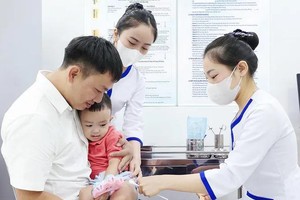
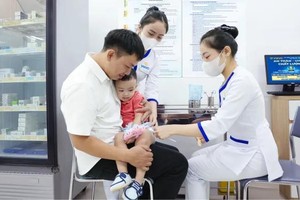
The advantage of this model is the early detection of diseases for residents thanks to the supervision of the healthcare teams. In the initial phase, the teams will prioritize high-risk groups such as the elderly and children under five years old before gradually approaching the remaining demographics.
“We are striving so that by the end of 2026, the healthcare teams will reach the target of having over 90 percent of residents in the pilot area equipped with personal electronic health records, and over 95 percent of those in high-risk groups having their records updated fully and continuously,” Vice Chairwoman Luong Thi Hong Gam informed.
Director of the HCMC Department of Health Assoc Prof Tang Chi Thuong, MD PhD, shared that while the previous operational model of medical stations was passive, waiting for people to come for examinations. It’s now being replaced by healthcare teams that actively approach and manage health by household, risk group, and life cycle stage.
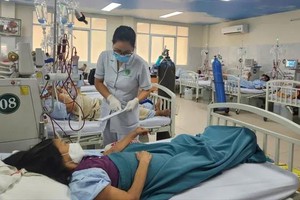
This is a necessary transition to overcome the prolonged limitations of grassroots healthcare, gradually consolidating people’s trust in medical stations, reducing unnecessary hospital bypassing, and easing the pressure on higher-level hospitals. At the same time, it serves as the foundation for building a sustainable healthcare system right from the community, where health is protected early, closely, and at the root.
“If implemented methodically and replicated appropriately, this model will not only improve the quality of primary healthcare but also contribute to realizing a larger goal of building a strong, proactive grassroots healthcare system that is truly for the people,” Director Tang Chi Thuong stated.
To improve the capacity of local clinics and healthcare teams so that people feel secure, the HCMC Department of Health has requested higher-level hospitals to step in and provide professional support.
Regarding the rights of residents when healthcare teams conduct home visits, the HCMC Department of Health said that in the next step, it will work with HCMC Social Security to sign contracts for medical examination and treatment with local medical stations, which will include payment for at-home healthcare.
People have many choices for their healthcare, such as going to public medical stations, private clinics, or hospitals. With this shift to a proactive stance on healthcare, it’s expected that over time, the healthcare teams will foster greater public trust in the service quality of local clinics.
However, since this is the first pilot model, the focus will be on learning by doing, evaluating, and drawing experiences after 3 to 6 months. The HCMC Department of Health will then introduce it to other wards for consideration to register in the pilot.
“Innovating medical stations is not a short-term step or a temporary movement. This is a strategic reform process that requires perseverance, synchronous coordination, and the determination of the entire system. But with consensus from the grassroots level and the involvement of the health sector, it’s expectable to believe that medical stations will truly become the ‘first medical touchpoint’ for the people, becoming more proactive, closer to the people, more continuous, and people-centered in all activities.”
Assoc Prof Tang Chi Thuong, MD PhD
)