The healthcare sector is steadily emerging as an exporter of medical expertise, quietly earning international trust through the strength of its professional capabilities and clinical innovation.
Surgical technique bearing name of Vietnamese doctor
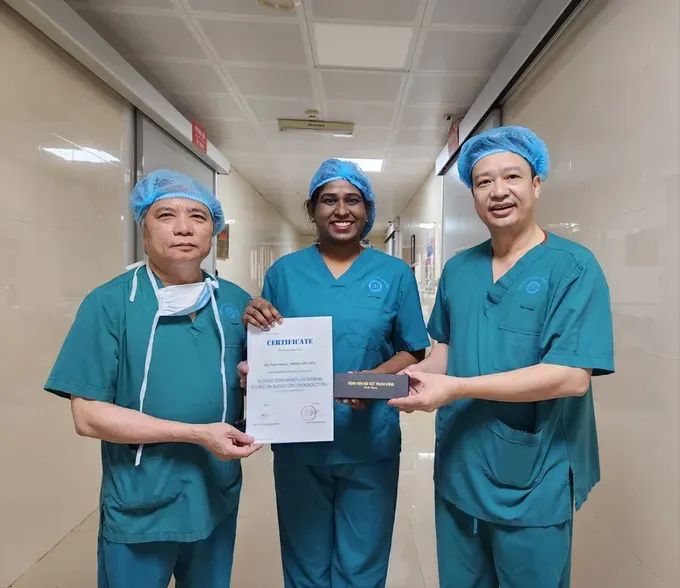
If one were to name a surgical technique bearing the name of a Vietnamese physician who has gained the widest international recognition, it would undoubtedly be the “Dr. Luong technique.”
After many years in the operating theater, Associate Professor Dr. Tran Ngoc Luong, former Deputy Director of the National Hospital of Endocrinology, never imagined that colleagues and peers at home and abroad would one day attach his name to a surgical procedure.
Associate Professor Dr. Tran Ngoc Luong’s research into endoscopic thyroid surgery began with a deeply human concern often voiced by his patients: “After the operation, I have a scar on my neck. I feel too self-conscious to go back to work.”
At a time when endoscopic thyroidectomy techniques were already available internationally, he set out to develop a procedure tailored to the specific conditions of his hospital and refined through his own clinical experience.
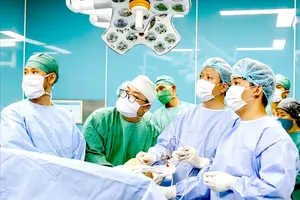
While existing global techniques were then considered highly complex and carried costs running into tens of thousands of US dollars per case, Dr. Luong introduced an innovative approach. By adapting standard laparoscopic instruments typically used for abdominal surgery, he performed thyroid operations at just a fraction — roughly one-twentieth — of the prevailing international cost.
His method avoided visible neck scarring by relocating incisions to the armpit or chest; reduced operating time; accelerated recovery; and proved applicable to a broad spectrum of thyroid conditions—a combination of clinical efficiency, affordability, and cosmetic benefit that would later distinguish what became known as the “Dr. Luong technique.”
The “Dr. Luong technique" has long since extended beyond Vietnam’s borders, as Associate Professor Dr. Tran Ngoc Luong is regularly invited by leading hospitals and medical centers worldwide to lecture and transfer the procedure.
Hundreds of physicians from Singapore, Malaysia, Australia, Portugal, India, and South Korea, among others, have been trained directly by him in endoscopic thyroid surgery.
International peers admire him not only for his technical mastery in the operating theater but also for his ability to simplify the complex.
A revolution in infertility treatment
At the end of 2025, My Duc Hospital publicly unveiled a new scientific achievement dubbed the “Saigon Protocol”—an infertility treatment regimen developed by the hospital’s medical team. The protocol, which is grounded in global advances in non-stimulated in vitro fertilization (IVF), reflects a synthesis of international innovation tailored to clinical practice.
The results of this new treatment approach were published in a leading journal of the American Society for Reproductive Medicine, presented at the Asia CORE 2025 conference held in Bali, Indonesia, and featured at numerous esteemed medical conferences and symposia around the world, marking a significant contribution to the field of reproductive medicine.
The “Saigon Protocol” offers several notable advantages. It reduces treatment costs, cutting spending on ovarian stimulation drugs by approximately 30 percent while eliminating the need for embryo freezing and subsequent frozen embryo transfer. The approach also minimizes discomfort, as it avoids injectable medications, enhances safety, shortens the duration of treatment, and improves both embryo quality and endometrial receptivity.
Taken together, these benefits allow women to undergo fertility treatment with less physical and emotional burden while increasing the viability and developmental potential of embryos.
Earlier, at the invitation of IVF Jinxin Xinan Hospital in Sichuan, China, two specialists from My Duc Hospital traveled to transfer the hospital’s non-ovarian stimulation in vitro fertilization technology, known as My Duc IVM (In Vitro Maturation).
Dr. Ho Ngoc Anh Vu, Head of the Center for Reproductive Support at My Duc Hospital, said the My Duc IVM approach is regarded as a breakthrough in infertility treatment. The technique has helped raise oocyte maturation rates, markedly improve embryo quality, and significantly increase success rates, opening what he described as a new direction in assisted reproductive technology in Vietnam and in the world.
Far from being confined to domestic practice, My Duc IVF has steadily evolved into a training hub for IVM techniques within the global medical community. Since 2019, specialists from the United States, Canada, Peru, Denmark, France, Belgium, Spain, China, Singapore, Malaysia, Thailand, Indonesia, and Australia, among others, have traveled to My Duc Hospital to observe and study Vietnam’s new-generation IVM treatment approach.
Vietnamese experts have likewise been regularly invited to present clinical data and share their experience with the new IVM protocol at major international medical gatherings, including the American Society for Reproductive Medicine (ASRM), the European Society of Human Reproduction and Embryology (ESHRE), the Asia Pacific Initiative on Reproduction (ASPIRE), and the Pacific Society for Reproductive Medicine (PSRM).
The hallmark of urethral reconstructive surgery
Having delivered presentations at numerous international scientific conferences on urethral reconstructive surgery, Dr. Do Lenh Hung, Head of the Urethral Reconstructive Surgery Department at Binh Dan Hospital, said overseas colleagues have expressed particular admiration for the hospital’s outcomes, notably a 98 percent success rate among first-time surgical patients, and have sought the transfer of the technique.
Dr. Do Lenh Hung has since been invited to provide technical training at Thammasat University Hospital in Thailand and Universiti Putra Malaysia in Malaysia.
“During one trip to Thailand, I performed four operations, including one especially complex case involving a patient who had lived with the condition for a decade. That surgery lasted six hours,” he recalled, underscoring both the challenges and the growing international confidence in Vietnamese surgical expertise.
“In Malaysia, I performed four surgeries, including one particularly challenging case involving an Indonesian patient who had undergone multiple prior operations. That procedure lasted four hours. Many assume that demonstration surgeries or technology transfers involve only straightforward cases, but in reality, we often face highly complex ones. Yet those situations also serve to sharpen the skills of Vietnamese surgeons while offering valuable learning opportunities for our colleagues abroad,” Dr. Do Lenh Hung said.
Most recently, Dr. Do Lenh Hung successfully treated an American businessman, identified as D.F., who was suffering from urethral stricture following an accident.
The patient had endured increasingly severe urinary complications, including difficulty urinating, urinary retention, incomplete emptying of the bladder, frequent urination, and recurrent infections. He had sought treatment at multiple facilities, including major medical centers in the United States, Thailand, and Singapore, but was left in despair after six unsuccessful surgeries and prolonged episodes of debilitating pain.
Acting on a recommendation from friends, D.F. traveled to Binh Dan Hospital, where Dr. Do Lenh Hung and his surgical team performed urethral reconstruction in just two hours — despite the significant challenges posed by prior scarring and six previous interventions.
Three weeks after the procedure, the patient’s urinary function had fully recovered, marking a successful outcome.
“We have treated many cases far more complex than this,” Dr. Hung said, underscoring the depth of experience his team has developed in managing severe urethral strictures.
According to Associate Professor Dr. Tran Vinh Hung, Director of Binh Dan Hospital, between 2023 and 2025, the hospital performed 1,096 surgical procedures for patients from 26 countries and territories. In addition, a substantial number of overseas Vietnamese have returned to Binh Dan Hospital for surgical consultation and treatment.
The hospital has also repeatedly dispatched experienced surgeons abroad to perform demonstration procedures, including in India, while transferring urethral reconstructive techniques to Thailand and Malaysia, conducting laparoscopic nephrectomy in Indonesia, and carrying out robot-assisted colorectal cancer surgery in the Philippines, reflecting its growing role in regional surgical collaboration and expertise exchange.
Vietnamese doctors being invited to teach abroad is not only a source of professional pride for the nation’s healthcare system but also an affirmation of a strategic commitment to high-technology medicine and, crucially, to investing in people—those capable of mastering advanced technologies and devising solutions suited to real-world conditions.
The Ministry of Health is now developing initiatives aimed at transforming healthcare into a spearhead “service export” sector, elevating the standing of Vietnamese medicine on the global map of knowledge and innovation. When a Vietnamese physician earns the respect of peers in developed countries, it is at that moment that the national brand is most powerfully affirmed, Deputy Minister of Health Tran Van Thuan said.