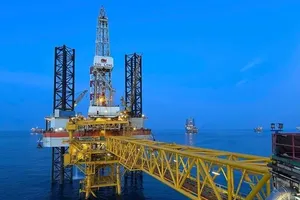
Ever since HCMC expanded its developmental spatial footprint, the city’s economic map has gained a prominent splash of color, the oil and gas industry. The municipal territory currently harbors 19 core member units belonging to the Vietnam National Industry – Energy Group (Petrovietnam), whose sweeping operations range comprehensively from exploration and exploitation to processing and technical services.
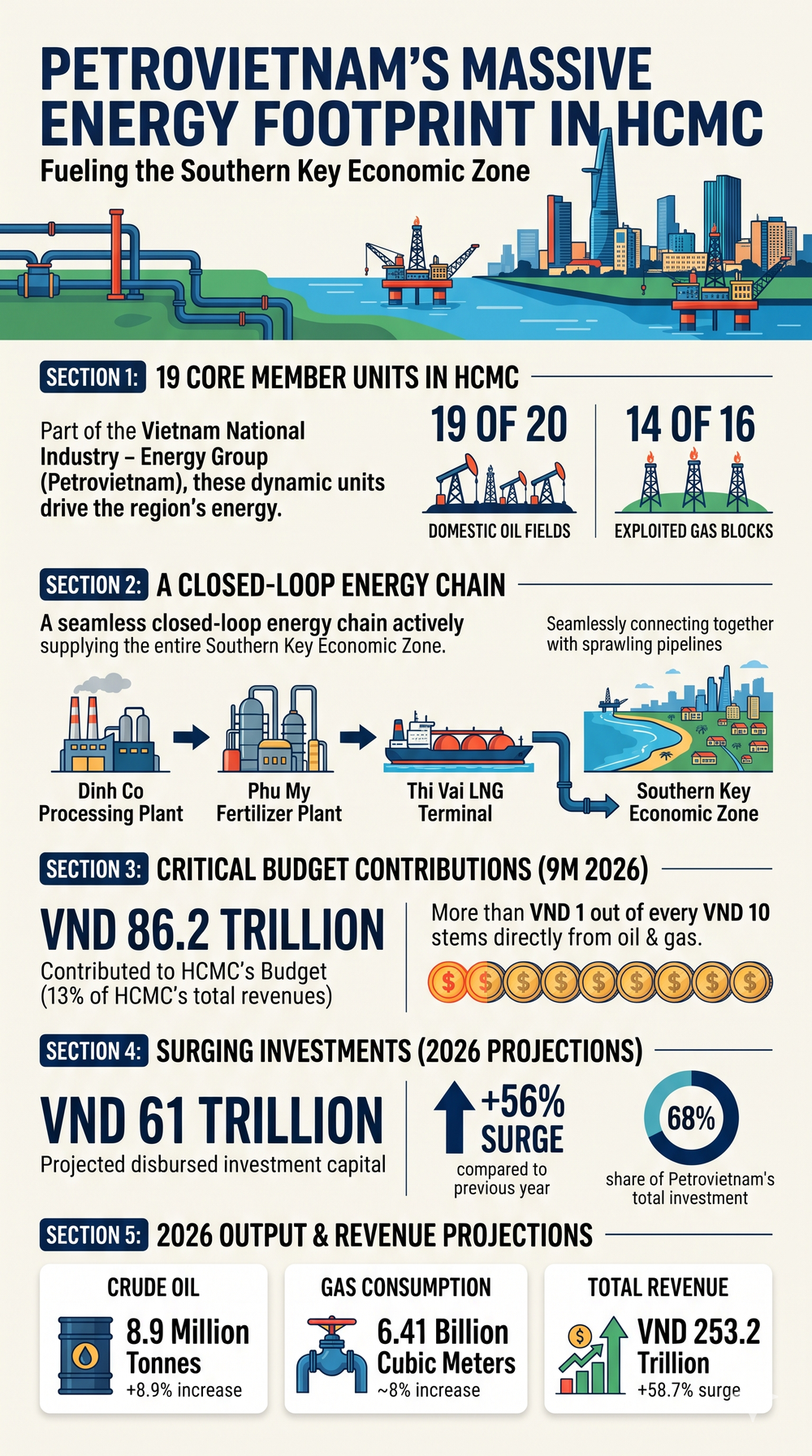
These dynamic units presently operate 19 of the 20 domestic oil fields, alongside 14 of the 16 gas blocks currently being exploited by the group. Seamlessly integrated with sprawling pipelines, Dinh Co Processing Plant, Phu My Fertilizer Plant, and the massive Thi Vai LNG terminal, this constitutes a closed-loop energy chain that actively supplies the entire Southern Key Economic Zone.
During the first nine months of 2026, Petrovietnam’s affiliated units contributed VND86.2 trillion (US$3.36 billion) straight to the budget, accounting for 13 percent of total revenues. In other words, for every VND10 the HCMC budget rakes in, more than VND1 stems directly from oil and gas.
In 2026, the disbursed investment capital flowing from these localized Petrovietnam units is projected to hit VND61 trillion ($2.38 billion), marking a staggering 56-percent surge compared to the previous year while capturing roughly 68 percent of the group’s total investment. Every single Vietnamese dong inherently ripples outward, heavily impacting construction, mechanics, transportation, and services, effectively generating additional jobs and lucrative orders for domestic enterprises.
Critically examining the 2016-2025 period, domestic oil extraction output dropped by an average of 6.6 percent annually, while gas plummeted by 4 percent. Back then, excluding oil and gas exploitation when calculating former Ba Ria-Vung Tau Province’s GRDP growth was deemed a highly pragmatic move, primarily because it genuinely helped accurately reflect the underlying health of the broader economy’s remaining sectors.
Fast forward to 2026, and the picture looks vastly different. Crude oil output is currently projected to reach 8.9 million tonnes, reflecting an increase of roughly 8.9 percent; meanwhile, gas consumption is slated to hit 6.41 billion cubic meters, up approximately 8 percent. Total revenue stemming directly from oil and gas exploitation is expected to skyrocket to VND253.2 trillion ($9.86 billion), posting a massive 58.7-percent surge.
For the first time in over a decade, the oil and gas sector has decisively returned to a robust growth trajectory. This naturally sparks a pressing question: Why is an industry that’s robustly growing again still being stubbornly excluded from the metric? Generally speaking, a statistical rule only truly remains convincing when it’s applied with unflinching consistency, both when an industry plunges downward and when it actively climbs upward.
Consequently, proposing to comprehensively include oil and gas exploitation in the 2026 GRDP growth calculation is fundamentally a narrative about statistical transparency, rigorously ensuring the simultaneous publication of dual growth figures, one factoring in oil and gas, while one explicitly excluding them.
Calculating accurately isn’t merely a trivial matter of whether raw numbers look pretty. Per capita GRDP, sheer labor productivity, and industrial structure intrinsically serve as the bedrock foundation for HCMC to definitively establish targets, flawlessly allocate public investment capital, and construct highly accurate budget estimates. When data is blatantly missing, policies become highly susceptible to skewing.
Furthermore, the industry’s intrinsic value isn’t strictly confined to mere revenue. Over 35,800 workers are currently employed across various Petrovietnam units situated in HCMC, with more than half proudly possessing a university degree. Their average income surpasses VND35 million ($1,360) per month, sitting roughly one-quarter higher than the city’s average.
The University of Petroleum, the Petroleum College, and the Petroleum Institute actively train roughly 11,000 to 18,800 individuals annually. This unwavering spirit of companionship is also vividly demonstrated through nearly VND380 billion ($14.8 million) dedicated to numerous HCMC social security programs from 2020 to 2026. In 2026 alone, over VND276 billion (approximately $10.8 million) was channeled to support vulnerable individuals and disadvantaged children residing across the area.
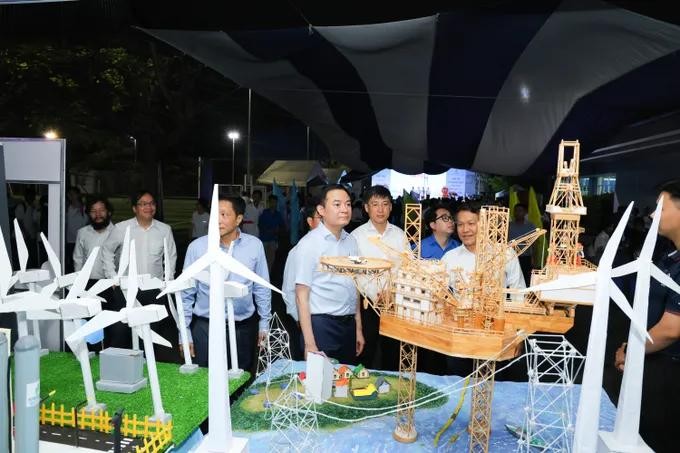
More crucially, Petrovietnam has definitively identified HCMC as a paramount strategic locale, pledging to inject hundreds of thousands of billions of VND throughout the 2026-2030 phase. The sprawling Long Son Eco-Energy Industrial Center heavily promises to generate thousands of green jobs. The robust offshore wind power logistics system in Phuoc Thang is actively unlocking an entirely novel marine technical services sector. Meanwhile, a cold storage facility cleverly utilizing freezing temperatures from the Thi Vai LNG terminal tangibly helps Chau Duc farmers preserve agricultural produce far more cheaply.
These strategic handshakes across five distinct domains of spanning smart cities, pristine energy, green supply chains, marine technical services, and robust innovation, vividly demonstrate that the oil and gas industry is radically transforming itself. It’s shifting from merely exploiting resources to actively generating energy to forge a significantly greener HCMC.
To successfully achieve these ambitious, highly sustainable growth targets within this novel phase, the city will need to mobilize and comprehensively acknowledge every single driving force actively serving development. Accurately recognizing Petrovietnam’s role, while carefully calculating its full contributions to holistic growth, concurrently serves as a highly pragmatic method for HCMC. It secures a firmer foundation for drafting remarkably realistic policies, thoroughly mastering its resources to ultimately allocate them exactly where they belong.