
Myriad of troubles
For Ms. N.T.H., a Hanoi-based construction materials business owner, the regulatory maze has been exasperating. She established her company in 2011 but suspended operations in 2016 due to ineffectiveness. In August 2026, upon hearing about tax authorities vigorously cleaning up tax identification numbers (TIN), she shockingly discovered a tax debt appearing after 10 years of inactivity. Authorities instructed her to fully discharge tax obligations before wrapping up bankruptcy. However, since her decade-old invoices are completely lost, finalizing the formalities is impossible, leaving her tax file suspended indefinitely.
Similarly, Mr. C.V.H. registered a media firm in HCMC in 2020. The Covid-19 pandemic abruptly halted operations before it generated a single dime. Recently, he’s received a notification demanding over VND40 million (US$1,540) for accumulated licensing fees alongside steep late penalties. Mr. H. noted some friends even squandered extra fees on consultants to bypass complicated red tape, yet it’s a harsh reality that not everyone can afford these staggering amounts.
As reported by several enterprises, tax-related administrative procedures are the primary reason corporate dissolutions get repeatedly bogged down. Hanoi business owner N.X.T. explained that despite the Enterprise Law allowing dissolution updates after 180 days of clearing debts, firms face a formidable hurdle of finalizing tax closures. Specifically, under Circular No. 90/2026/TT-BTC, the registration agency only permits legal termination when tax authorities strictly inspect and issue a “TIN invalidation notice” confirming zero back taxes.
Mr. N.X.T. emphasized this effectively morphs tax formalities into a critical bottleneck. An inactive business can’t officially conclude its legal lifecycle if tax procedures remain unfinished. Furthermore, this protracted inspection is applied in a blanket fashion. Even short-term businesses without revenue or violations must endure the exact same complex steps, creating massive paperwork backlogs and unnecessary compliance burdens.
For Deputy Secretary General and Head of the Legal Department at the Vietnam Chamber of Commerce and Industry Dau Anh Tuan, the framework’s rigid “pre-check” mindset for market exits severely contradicts its streamlined “post-check” market entry approach, ultimately making it exceedingly arduous for firms to formally declare bankruptcy.
Classifying to avoid blanket approaches
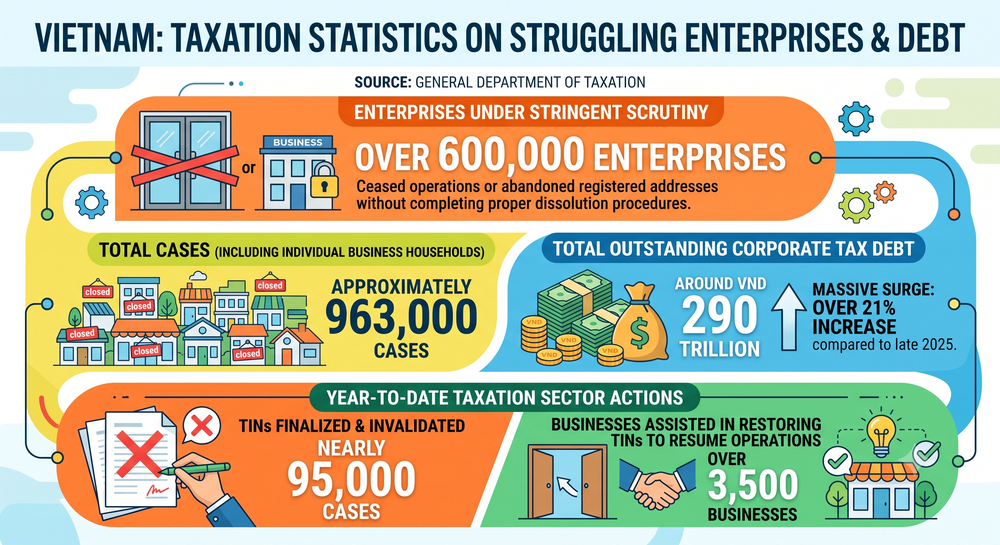
Statistics from the General Department of Taxation reveal that nationwide there’re currently over 600,000 enterprises under stringent scrutiny for ceasing operations or abandoning their registered addresses without completing proper dissolution procedures. If individual business households are factored in, this staggering figure swells to approximately 963,000 cases.
The total outstanding corporate tax debt currently hovers around VND290 trillion ($11.16 billion), reflecting a massive surge of over 21 percent compared to late 2025. From the beginning of the year until now, the taxation sector has finalized and invalidated TINs for nearly 95,000 cases while simultaneously assisting over 3,500 businesses in smoothly restoring their TINs to resume operations.
Currently, the tax agency is actively researching to submit a novel mechanism to the Government and the National Assembly aimed at untangling legal snags for businesses hopelessly stuck in the TIN invalidation process.
Chairwoman Nguyen Thi Cuc of the Vietnam Tax Consultants’ Association pointed out that the steep penalties and late payment fees incurred upon terminating a TIN are undeniably posing severe obstacles and mounting financial pressures for struggling businesses.
“A profound inadequacy in the TIN cleanup campaign is whether we should identically penalize an enterprise that intentionally flees and evades taxes as opposed to one that genuinely failed and ceased real-world operations but hasn’t finished its dissolution paperwork. If we apply a common approach to all these vastly different cases, the policy could trigger entirely unnecessary and damaging repercussions,” she passionately argued.
She also proposed that these existing hurdles should be swiftly resolved through a more tailored mechanism, incorporating specific qualitative criteria to distinctly classify each enterprise group when undertaking tax procedures for bankruptcy.

Deputy Director Pham Binh An of the HCMC Institute for Development Studies emphasized that fully dismantling bureaucratic bottlenecks requires proactively overhauling administrative workflows for corporate market exits. Concurrently, it’s absolutely imperative to deploy policies that “narrow down” genuinely backlogged dossiers struggling with late payment fines. This accelerated cleanup accurately reflects economic health, incentivizes market reentry, and generates sustainable state revenue.

Meanwhile, Director Le Kien Luong of Thien Huong Law Firm noted that prevailing legislation completely lacks a broad framework to conclusively resolve accumulated corporate debt. He argued that a groundbreaking mechanism is vital to decisively dismantle TIN cleanup bottlenecks. Specifically, authorities must drastically simplify red tape, permitting TIN invalidations without forcing taxpayers into recreating bygone tax declarations. Furthermore, administrative sanctions shouldn’t be cumulatively stacked; they must be strictly limited to single specific violations, alongside significantly expanded grounds for corporate debt forgiveness.

Addressing these concerns, Deputy Head Giang Van Hien of the HCMC Tax Department stated that cleansing TINs remarkably enhances overall investment transparency. The city’s tax sector is pouring all resources into completely processing these accumulated dossiers within this year. To thoroughly alleviate procedural nightmares, they’ve formally dispatched a structural proposal to the Ministry of Finance aimed at slashing the heavy cost burdens of dissolution procedures, ultimately allowing long-inactive enterprises to legally exit the market.
Dr. Nguyen Dinh Cung, Former Director of the Central Institute for Economic Management, insisted on paving an exit path for ineffective businesses.
While officially establishing an enterprise is remarkably straightforward, legally closing it unfortunately remains a path of agonizing torment for firms that can’t continue doing business. This issue is profoundly relevant as the draft Law on Support for Small and Medium-sized Enterprises faces National Assembly review late this year.
Current regulations, which permit dissolution only when debts are fully paid, inadvertently barricade legitimate exits for genuinely bankrupt enterprises. Consequently, a firm’s legal representative is unfairly locked out of launching new ventures and suffers harsh personal travel bans. Meanwhile, the administrative apparatus meaninglessly squanders its resources maintaining databases for hundreds of thousands of practically dead firms.
The most paralyzing chokepoint revolves squarely around tax finalization. Instead of risk-based management, tax authorities notoriously trigger exhaustive inspections dating back to launch. Furthermore, glaring inconsistencies in how local tax offices interpret rules easily pave the way for retroactive applications, aggressive debt collection, and progressively crippling late-payment fines, alongside agonizing headaches tied to social insurance or banking.
To fundamentally overhaul Vietnam’s market exit protocol, four breakthrough solutions are proposed:
- Authorities must deploy a reduced deregistration procedure tailored for defunct startups or micro-enterprises. This would allow a legal representative to submit an online asset pledge; the enterprise is then automatically struck off if no complaints surface after a 60-day public listing.
- The state should pivot to a “post-check” approach, permitting the reinstatement of deregistered firms within three to five years if tax fraud is unearthed, compelling representatives to bear full personal liability for dishonest declarations.
- It’s vital to standardize exit ban regulations. There must be formal workflows to lift travel bans for individuals who undeniably prove genuine financial destitution, alongside rapid border settlement mechanisms for petty debts so pre-planned duties aren’t hopelessly disrupted.
- Comprehensive reform of the 2014 Bankruptcy Law is severely needed to establish a streamlined, lightning-fast 3-to-6-month protocol for SMEs.
Only when comprehensively overhauling the market exit pipeline is genuinely treated as an urgent mission will the bold enthusiasm of the entrepreneurial community finally be fully unleashed.