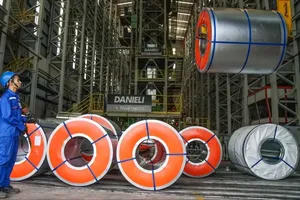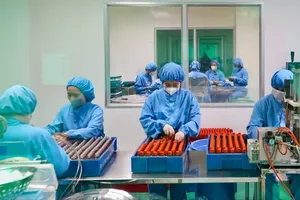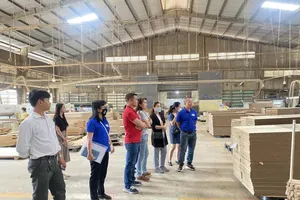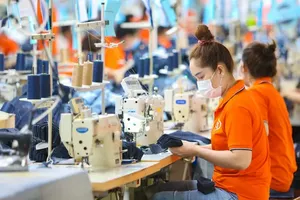
Vietnamese businesses are becoming increasingly integrated into global production chains, building a strong export base and expanding markets through a network of free trade agreements. The next step is to move into higher-value stages of production, increasing the share of value created and retained in the domestic economy.
According to Norihiko Yamano, an economist in the Directorate for Science, Technology and Innovation at the Organization for Economic Cooperation and Development (OECD), export turnover does not fully reflect an economy’s position in global value chains.
More important is the share of value actually created domestically.
In terms of scale, Vietnam has built a strong export base. Statistics show export turnover reached about US$476 billion in 2025 and is estimated at US$374 billion in the first eight months of 2026. However, measured by value added, there remains considerable room to increase the domestic share.
The OECD’s Trade in Value Added (TiVA) data show that foreign value added accounts for about 48 percent of Vietnam’s exports, higher than the OECD economies’ average of 30.4 percent. Meanwhile, the foreign direct investment (FDI) sector currently accounts for about 81 percent of export turnover, while domestic businesses account for about 19 percent. These figures reflect Vietnam’s deep integration into global production chains while also highlighting the significant room for domestic businesses to participate more extensively and increase the share of value created in the economy.
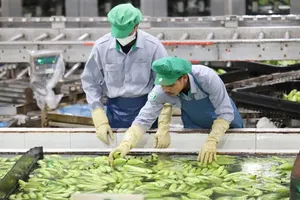
Being a businessperson, Chairman Do Ha Nam of the Vietnam Food Association said the bottleneck lies in the ability to create and retain value along the chain. Even in rice, Vietnam has advantages and owns many high-quality varieties such as ST25 and Jasmine, but the national brand remains insufficiently strong, meaning many products still have to compete on price.
Links between businesses and raw-material production areas also remain weak. Purchasing through multiple intermediaries increases costs and limits the ability to establish a direct chain from raw-material areas to processing and trade.
Head Van Nguyen of the Regional Agenda Program at the Center for Advanced Manufacturing and Supply Chains of the World Economic Forum (WEF) said the “rules of the game” in global supply chains are changing. Many global corporations are adjusting how they select production locations and partners. This shift creates new requirements for the position of Vietnamese businesses in supply chains, as advantages in labor costs and processing capacity are no longer sufficient to ensure long-term competitiveness.
Digital markets open new opportunities for Vietnamese businesses
With 17 free trade agreements (FTAs) in force, Vietnam is connected to markets accounting for more than 80 percent of global GDP. ASEAN alone has about 680 million people and a GDP of nearly US$3.9 trillion. The ASEAN Digital Economy Framework Agreement (DEFA) is expected to further expand the region’s digital economic space.
The market potential is therefore enormous, but the issue is not simply how much more Vietnamese businesses can sell. It is how many stages of the value chain they can participate in and how much value they can retain from those markets.
According to Nguyen Duc Huy, deputy director of the Ho Chi Minh City Center for the Fourth Industrial Revolution (C4IR HCMC), Vietnam needs to develop a domestic supplier network, strengthen technological and service capabilities, and gradually move businesses into higher-value-added stages.
The process must begin with businesses themselves by promoting smart manufacturing, applying digital technologies, improving supply-chain data transparency, enhancing connectivity with partners and maintaining consistent quality at scale.
According to Head Van Nguyen of the Regional Agenda Program at the Center for Advanced Manufacturing and Supply Chains of the World Economic Forum (WEF), opportunities from ASEAN and global digital markets will only generate real value when data, digital standards, technology and human resources can operate seamlessly across borders.
However, joining a supply chain is only the first step. To retain a larger share of value, businesses must gradually move from contract manufacturing and simple supply to stages with higher technological content, deeper processing and stronger brand value.
Assoc. Prof. Hoang Kim Anh of the Vietnam Association of Food Science and Technology (VAFoST) said businesses need to shift from competing on price to creating value through deeper processing, particularly for products derived from natural sources and those containing functional ingredients. As processing, technology and brand value increase, businesses can not only raise product value but also become better able to cope with cost fluctuations and strengthen their competitiveness.
Devendra Jain, Head of Artificial Intelligence and Frontier Technologies, World Economic Forum (WEF):
Boosting domestic value through technology
To raise the share of value retained within the economy, businesses cannot rely solely on increasing the proportion of locally sourced materials or expanding processing capacity. The greater potential lies in embedding technology, data, and artificial intelligence directly into production and supply chain operations. Integrated digital infrastructure and shared industrial intelligence platforms are emerging as the connective tissue linking manufacturing, logistics, data, and markets. When companies can unify these elements on a single platform, data becomes more than a management tool, it enables production optimization, demand forecasting, operational efficiency, and entry into higher-value segments of the chain.
For Vietnam, this broadens the meaning of localization. It is not only about producing more components and raw materials domestically, but also progressively mastering technology, data, operational capabilities, and value-added services. Once these “layers of value” are generated within the country, the retained share after each export order truly increases.
The Supporting Industries Development Program for 2026-2035 currently aims to strengthen production capacity and domestic content while supporting businesses in deeper participation in global value chains. Resolution No. 138/NQ-CP also calls for stronger links between the FDI sector and domestic businesses, support for meeting standards, technology transfer and greater use of domestic supply chains.
The remaining challenge is to make a strong shift from trade promotion and market expansion toward developing domestic suppliers, with priority given to credit for technological innovation and digital transformation; support for businesses to obtain international standards and certifications; investment in research and development; and technical workforce training.
FDI attraction policies also need to be more closely linked to domestic supply-chain development, encouraging lead firms to increase procurement from Vietnamese businesses, support product testing, train suppliers and transfer technology.
In this way, export growth would be reflected not only in turnover but also in the expansion of domestic businesses and the economy’s competitiveness.