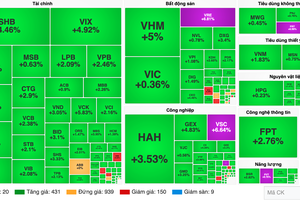
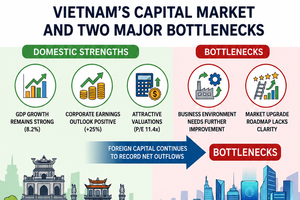
Against that backdrop, the VN-Index is expected to extend its upward trend in the new trading week, with technical targets at 1,890 and 1,945 points.
VN-Index tests 1,860-1,875 resistance zone
Vietnam's stock market traded for only two sessions last week because of the extended public holiday. Despite the shortened week, the VN-Index gained nearly 21 points from the previous week to close at 1,853.08, decisively breaking above the 1,850-point threshold.
The benchmark is now approaching the 100 percent Fibonacci Projection zone, corresponding to roughly 1,860-1,875 points.
The index remains above the middle line of the Bollinger Bands, while the Moving Average Convergence Divergence, or MACD, continues to widen its positive gap over the signal line. These indicators suggest that the VN-Index's short-term outlook remains constructive.
Analysts at ASEAN Securities said the index continued to maintain a relatively strong short-term uptrend. It is trading above both its 10-day and 20-day moving averages, reinforcing the bullish technical structure.
Other momentum indicators also remain positive. The Relative Strength Index (RSI) stands at 65, while the Money Flow Index (MFI) has climbed to 73, signaling sustained buying momentum and improving capital flows.
Technically, the VN-Index has rebounded from 1,720 to 1,850 and is now eyeing targets at 1,890, 1,945 and 2,035, with key support at 1,790. As the benchmark pushes higher, sector rotation and the strength of liquidity will be key to sustaining the rally.

Passive inflows unlikely to trigger an immediate market surge
Vietnam's market upgrade remains one of the most important potential catalysts for capital flows in the coming months. Even so, investors will continue to weigh the impact of elevated interest rates and geopolitical risks, particularly if tensions in the Middle East intensify again.
FTSE Russell released an updated FAQ on Vietnam's market reclassification over the weekend. The index provider maintained its list of 27 Vietnamese stocks that have passed the screening process under the FTSE Global Equity Index Series, or GEIS, and are eligible for inclusion in the FTSE Global All Cap Index.
Among them, VCB, VIC, and VHM are classified as large-cap stocks, while BID, HPG, and VPB fall into the mid-cap category.
The remaining 21 are small-cap stocks: FPT, GEX, HDB, HCM, MCH, MSN, NVL, STB, SHB, SSB, SSI, TCX, VCI, VJC, VNM, MSB, VRE, VPL, VIX, VND, and VPS.
Starting Sep 21, when Vietnam is officially upgraded to secondary emerging-market status, eligible Vietnamese stocks will be added to the FTSE GEIS and related indexes in several phases through September 2027.
FTSE Russell said the phased transition is intended to ensure an orderly reclassification process, allowing the market to absorb capital from index-tracking funds while maintaining requirements related to liquidity and Vietnam's non-prefunding settlement mechanism.
After each stage, FTSE Russell will assess how effectively passive funds can replicate the revised benchmark before moving to the next phase.
Vietnam's upgrade on Sep 21 will therefore not translate into its full expected weighting being added to FTSE indexes at once. Instead, passive inflows are expected to be phased in over roughly a year.
Ms. Nguyen Thi Hang Nga, Chief Executive Officer of Vietcombank Fund Management, said the number of Vietnamese stocks included in FTSE indexes and Vietnam's eventual index weighting would not depend solely on domestic market performance. They would also be influenced by movements in other markets within the same benchmark universe.
Ms. Nguyen Thi Hang Nga said actual capital inflows into Vietnam could exceed earlier estimates. However, much of the money is expected to come from passive investment vehicles, meaning its strongest effects may be concentrated around index-rebalancing periods rather than fundamentally altering the market's long-term trajectory.
The decision to divide implementation into four stages should also spread capital flows over time, limiting the risk of abrupt market distortions.
"Investors should still focus on the fundamentals and growth prospects of individual companies," she said. "Among the 27 stocks selected by FTSE, not every company necessarily meets the investment criteria of an actively managed fund."
As FTSE Russell moves ahead with changes to its indexes, Vietnamese market authorities are also stepping up trading surveillance.
The Vietnam Stock Exchange, or VNX, has issued enhanced monitoring rules for securities trading during FTSE Russell index-rebalancing periods, aimed at detecting unusual transactions, particularly possible price manipulation, attempts to influence closing prices, and insider trading. The regulations were introduced under Decision No.76/QD-HDTV dated Aug 28, 2026.
They apply to stocks listed on the Ho Chi Minh Stock Exchange during FTSE Russell portfolio-rebalancing periods. Regulators will pay particular attention to individual accounts and groups of related accounts showing signs of manipulating prices, influencing the closing price on the trading day immediately before index changes take effect, or using inside information to trade for profit.
Surveillance will be conducted in three stages: before the data cut-off date, during the information-disclosure period, and through the fifth trading day after the index changes become effective.
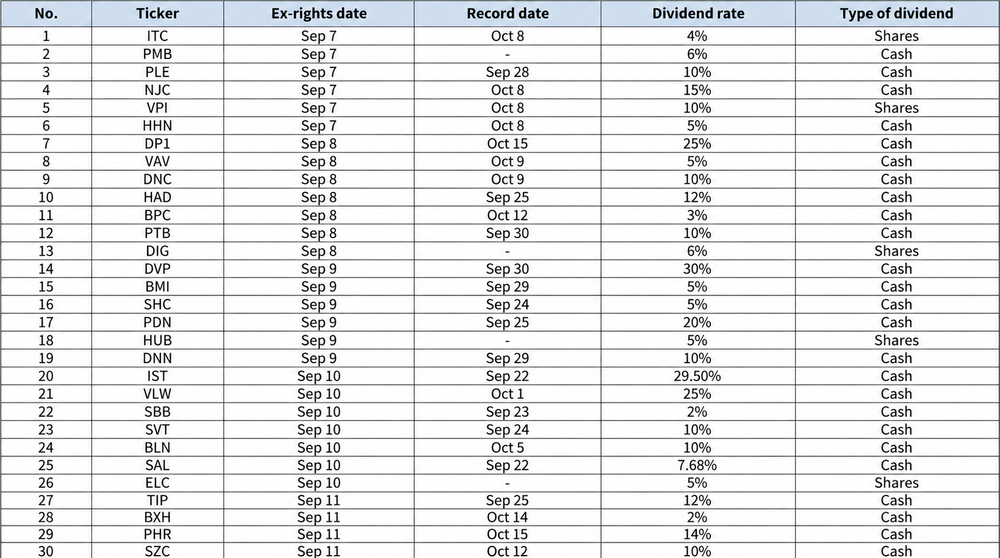
Thirty companies set dividend record dates
From Sep 7 to Sep 11, 30 listed companies are scheduled to set record dates for dividend payments to shareholders. Several are expected to distribute cash dividends of between 29 percent and 30 percent.