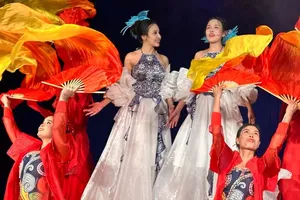
Recently, the Arts Council under the HCMC Department of Culture and Sports had to re-evaluate several theatrical plays and art programs following critical feedback from audiences and industry experts.
Right after its opening performances in mid-June, Idecaf Stage’s highly anticipated play “Dao hoa hau” (Island of Miss Beauty) was abruptly suspended following a barrage of feedback from industry professionals as well as theatergoers. The production utilized numerous suggestive lines easily alluding to highly sensitive elements. Currently, it anxiously awaits a meticulous re-evaluation and won’t get the ball rolling again until the Arts Council officially approves the revised script.
Around the same time, the Doi Drama Troupe’s “Ba gia ban nhang” (Old Lady Selling Incense) was similarly forced to halt performances for a mandatory post-inspection, despite selling out nearly all tickets to eager audiences. Prior to this, San Khau Moi’s production for children “Con Rong chau Tien” (Children of the Dragon and the Immortal) underwent rigorous re-evaluations twice to adjust its content, fundamentally ensuring the theatrical narrative was vastly more logical.
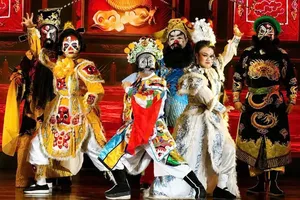
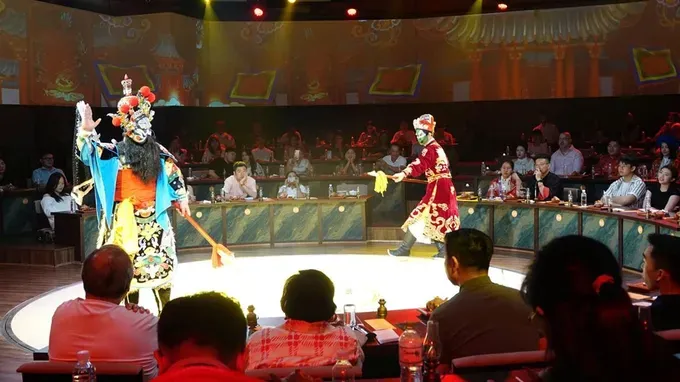
Similarly, HTM – Pomath’s “Ba oi day di” (Wake up, Dad!) failed its initial evaluation and was thoroughly overhauled. Notably, the VietCharm Culture & Dining Show temporarily shut down following intense audience backlash. Subsequently, it systematically scrapped inappropriate acts, replacing them with performances imbued with national cultural identity to align better with tourism.
“The root cause of this situation stems from two primary factors,” as stated by a member of the Arts Council. “Firstly, when crafting scripts, screenwriters and artists have desperately attempted to integrate trendy details and dialogue to attract younger audiences, inevitably leading to elements that are completely incompatible with the core narrative and plotline. Secondly, during the actual performance, some artists might spontaneously sprinkle in extra lines and comedic bits to generate a dramatic stage effect; however, if left unchecked, this can drastically alter the production’s original tone, occasionally resulting in inappropriate content that triggers severe audience backlash.”
The HCMC Department of Culture and Sports shared that to drastically elevate management efficiency in the near future, both scheduled and unannounced inspection activities will be executed with much greater frequency. The ultimate goal here is to promptly detect any glaring violations and handle emerging issues across various performing stages, especially targeting blockbuster plays that draw massive crowds.
For People’s Artist and Director Tran Ngoc Giau, executing a post-inspection means a theatrical production harbors suspected flaws that desperately need clarification, rather than authorities merely wanting to make life difficult for artistic units. Furthermore, this process definitely isn’t rigidly mechanical, where every single change is automatically deemed a violation.
Theatrical art obviously can’t remain entirely static; live shows inevitably feature spontaneous, improvisational interactions between artists and the audience. Nevertheless, as a solid rule of thumb, performers absolutely must adhere to specific criteria when altering content. They mustn’t disseminate blatantly false information, propagate elements violating fine traditions and profound cultural values, or spread distorted viewpoints regarding modern lifestyles.
According to Director Tran Ngoc Giau, public opinion serves as a crucial resource, partially contributing to the authorities’ decision to conduct rigorous post-show reviews. However, competent agencies don’t blindly chase after audience feedback; rather, they merely view it as a highly valuable reference point.
The inspection process must systematically follow correct legal steps during the content appraisal phase, flawlessly ensuring legitimate creativity is strictly respected.
For various seasoned directors navigating the rapidly evolving performing arts sector, post-inspections undeniably aren’t just punitive measures for control or sheer penalization; rather, they serve as a collaborative mechanism walking alongside artistic units to perfect and drastically elevate the overall quality of theatrical productions.
At the end of the day, the true essence of post-inspection isn’t to stifle creativity, but to help programs achieve significantly higher artistic value, carefully avoiding glaring shortcomings or agonizing mistakes that could severely derail the city’s broader cultural and artistic development, and most importantly, negatively impact the public’s perception as well as their insatiable demand to enjoy fine arts.