From an initial pilot model, Digital Citizen Stations in Ho Chi Minh City are proving increasingly effective by integrating multiple essential public services and healthcare utilities. The model not only helps residents save time and effort but also narrows the gap between the Government and residents right in their communities.
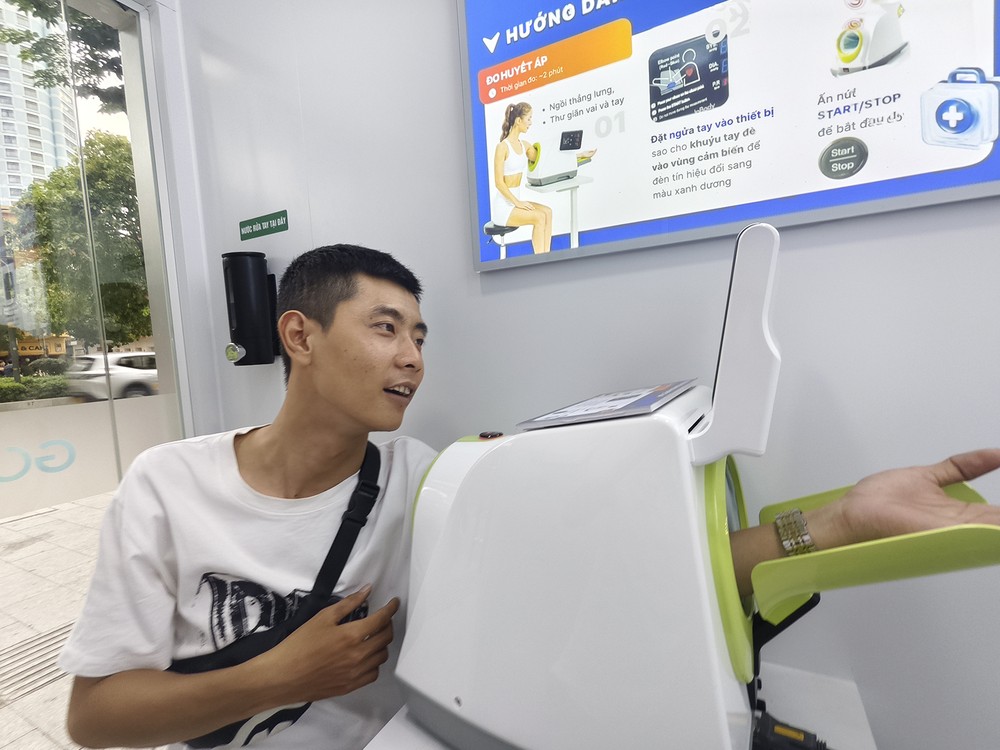
On September 6, the Digital Citizen Station at Nguyen Hue Walking Street, Ho Chi Minh City, was bustling with activity. As it was the weekend, large numbers of residents and visitors stopped by to use the station's integrated features. Some sought information on urban planning or checked traffic fines, while others used the search functions or took the opportunity to check their health indicators.
Nguyen Hoang Sang, 29, a resident of Phu Nhuan Ward and a technology motorbike driver, said that while taking a friend to the walking street, he stopped by the station. After checking his health indicators, he continued exploring planning information and other utilities integrated into the system, saying that bringing information from multiple fields together at one location saves residents time and is much more convenient than before.
Experiencing the digital medical equipment at the station for the first time, city dweller Bui Quoc Hoang, 23, said he directly checked his height, weight, muscle and bone percentages, and blood pressure. Although he had previously used similar measuring devices at a gym, the man said that placing the station in a crowded public area makes it easier for people to proactively monitor their health while going out, jogging or shopping, allowing them to adjust their diet and exercise routines.
Not only young people, but also many older residents are turning to the stations for regular health monitoring.
After his morning exercise session, Nguyen Dinh Thang, 75, a resident of Go Vap Ward, stopped by the Digital Citizen Station at Cityland Park Hills Urban Area. After just a few simple operations on the touchscreen, his height, weight, blood pressure and heart rate were clearly displayed. A technical representative at the site said the station had recorded as many as 251 people coming for health checks in a single day during its peak.
In addition to digital healthcare services connected to 12 hospitals and medical stations, Digital Citizen Stations also help residents complete and look up 201 administrative procedures, submit reports on public security and order, activate an SOS button connected directly to Ward police, schedule appointments with local police officers, check traffic fines and pay electricity, water, internet and tuition bills.
HCMC'S digital citizen stations attract over 83,000 visits
Speaking to SGGP newspaper, a representative of the Administrative Management Police Division for Social Order (PC06) under the HCMC Police said that as of September 4, eight Digital Citizen Stations were operating across the city, attracting more than 83,000 visits and uses. Of these, nearly 21,000 involved administrative procedures and payment utilities, while more than 62,000 involved health checks.
Statistics showed that the rate of completed transactions reached 99 percent, while the level of resident satisfaction exceeded 95 percent.
The model was initiated by the HCMC Police and piloted on October 8, 2025, at Diamond Island Building in Binh Trung Ward. The city has since expanded it to eight stations at key locations, including Diamond Island, Vinhomes Ba Son, Celadon City, Cityland Park Hills, Nguyen Hue Walking Street, and Binh Phu, Tan Hung and Hoa Binh Wards.
A notable feature of Digital Citizen Stations is that they operate continuously 24/7, including holidays and Tet, provide services completely free of charge, and do not discriminate against or restrict users. Residents are not required to own a smartphone. The system currently supports five languages: Vietnamese, English, Chinese, Korean and Japanese.
Notably, data from PC06 shows that the peak period for station use is between 8 p.m. and 10 p.m. This is when workers have finished their shifts and returned home, while public administrative service facilities and many traditional clinics have stopped receiving visitors.
Therefore, the stations' round-the-clock service directly addresses the practical needs of urban residents.
According to the PC06 representative, from the eight existing locations, the HCMC Police aims to expand the network to at least 168 Digital Citizen Stations across the city. The city is expected to complete 100 stations in 2026 and the remaining 68 by the second quarter of 2027, ensuring that every ward, commune and special administrative zone has at least one station.
Going forward, the model will continue to integrate new administrative procedures, connect healthcare data with the Electronic Health Record on VNeID, add a voice-guided virtual assistant and expand utilities for foreigners, contributing to more effective smart urban governance.