For Mr. Nguyen Thanh Van and Mrs. Dang Thi Thu Ha, residents of Hamlet No.4 in Long Son Commune in HCMC, the daily grind begins at roughly 3:00 p.m. They board their boat, navigating approximately 4km along the river to reach designated fishing ground near Long Hoa T-junction. As the tide ebbs, the couple deploys their stow nets.
By roughly 7:00 p.m., when the water reaches a standstill, they relentlessly exert remaining strength to haul the catch, an exhausting endeavor stretching until 11:00 p.m. Aboard their small, violently rocking vessel, the husband and wife manage to catch a brief wink of sleep. At precisely 2:00 a.m., they head back to shore, arriving just in time to sell freshly caught shrimp or fish at the early morning market.
This grueling routine has essentially sustained their family for nearly three decades. Today, as stow-net fishing faces a mandatory phase-out, they simply can’t hide their mounting anxiety. “Now that we’re getting up there in years, we honestly don’t know what else to do, so we’re desperately hoping for government assistance,” Mrs. Ha explained, highlighting her profound sense of uncertainty.
These days, Mrs. Mai Thi Kim Nhan’s family, residing in Hamlet No.1, shares the exact same lingering fears. Three consecutive generations of her family have historically scraped out a living on the Rang River using these traditional fixed nets.
At merely 10 years old, Mrs. Nhan was already trailing after her parents to learn the ropes of the trade. Fast forward to today, she boasts a 28-year devotion to this demanding profession. Stow-net fishing inherently provides the primary income sustaining her four-member household, consisting of the couple, her 65-year-old mother, and a son currently attending high school.
“Losing our lifelong trade is incredibly regrettable, but since the State has laid down the law, we’ll strictly comply,” Mrs. Nhan stated firmly. Her sole desire is to secure adequate financial backing so her family can seamlessly transition to a new livelihood. She calculates that if properly allocated a suitable water surface area, her household could pivot toward commercial oyster farming. Another entrepreneurial avenue Mrs. Nhan is pondering involves learning video production to launch an online retail business.
Throughout Long Son Commune, stow-net fishing across various rivers or canals has persisted for generations. The vast majority of locals have engaged in this grueling labor since well before 2017, with certain extreme cases tracing their origins back to 1975.
As of late September 2026, Long Son officially recorded 71 households operating within this sector, managing approximately 107 net arrays, either in barrel or staked configurations. These nets are haphazardly distributed across multiple waterways, while several installations sit precariously close to neighboring localities.
According to Mr. Nguyen Van Binh, a specialist at the Long Son Commune Economic Office, rigorous inspections revealed 100 percent of these nets currently encroach upon protective corridors of inland waterway traffic. The intricate system of stakes, mooring lines, or submerged netting stretching across the current significantly narrows the navigable channel. This obstructs traffic flow while posing severe safety hazards, especially for heavy-tonnage vessels operating overnight or enduring adverse weather conditions.
Under Circular No. 88/2025/TT-BNNMT issued by the Ministry of Agriculture and Environment, stow-net fishing officially falls into the category of strictly prohibited exploitation methods. The gradual curtailment or eventual eradication of this practice remains absolutely imperative to safeguard, rapidly restore, or sustainably foster local aquatic resources.
Guided by that strategic trajectory, the Long Son Commune Economic Office has heavily coordinated with Waterway Traffic Police Team No. 4, the Long Son Border Guard Station, local police, and hamlet chiefs to meticulously review affected households. Simultaneously, they’ve conducted extensive field surveys to pinpoint exact coordinates of each family’s fishing setups, ultimately aiming to meticulously evaluate the current logistical landscape.
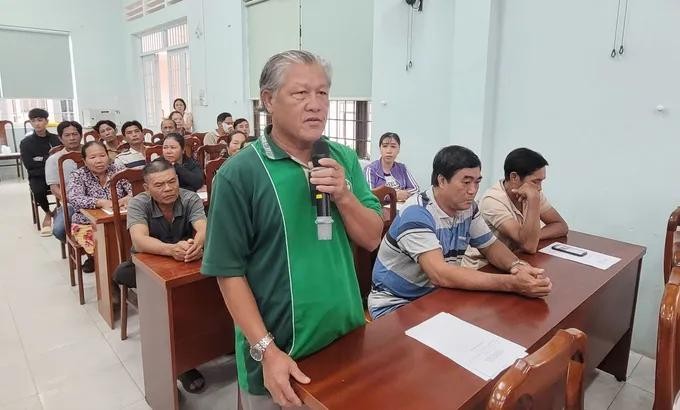
Confronted by the residents’ mounting anxieties, the Long Son People’s Committee astutely recognizes that shutting down these fishing operations will directly hammer locals’ daily lives. Numerous laborers run a shockingly high risk of sudden unemployment at an advanced age, severely hampering their ability to transition into entirely new professional fields. To forge a viable path forward, Long Son proactively hosted a comprehensive conference to meet with displaced fishers or genuinely listen to their heartfelt grievances.
During the gathering, citizens fundamentally agreed with the governmental directive, yet didn’t hesitate to pour out their profound personal struggles. Scores of families voiced their desire for a satisfactory compensation mechanism during their career transition, or alternatively, the allocation of suitable water tracts to pivot toward aquaculture.
Following this frank dialogue, Long Son is currently pressing ahead with individualized surveys regarding career transition needs, compiling residents’ aspirations to architect a robust vocational training blueprint. The locality plans to join forces with the HCMC Sub-Department of Rural Development to precisely identify most suitable vocational pathways for the affected workforce.
In parallel, the commune is determinedly ramping up public awareness campaigns to persuade citizens into strictly abiding by legal policies, whilst promising tight oversight if these supportive measures actually roll out in the foreseeable future.