More than 300 delegates gathered in Ho Chi Minh City on January 28 to discuss a big challenge facing Vietnam’s enterprise sector. Despite their large numbers, most businesses remain concentrated in low-value segments and are highly vulnerable to global market fluctuations.
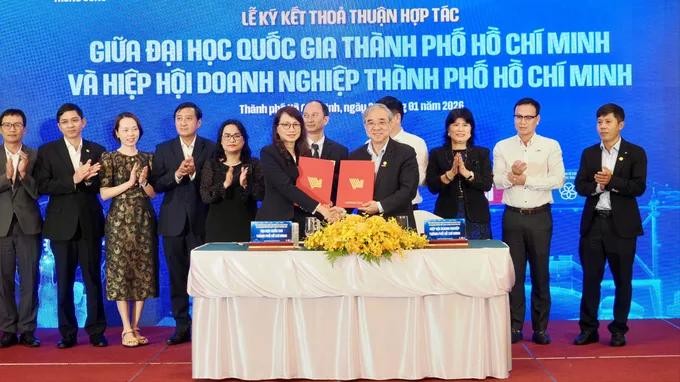
The scientific seminar, titled "Enhancing the Competitiveness of Vietnamese Enterprises in the New Era," was directed by the Central Commission for Policy and Strategy, the Central Commission for Propaganda and Mass Mobilization and the Ho Chi Minh City People’s Committee. The event was co-organized by Vietnam National University Ho Chi Minh City (VNU-HCM) and the Ho Chi Minh City Union of Business Associations (HUBA).
A paradox of growth vs. resilience
Experts at the seminar noted that while Vietnam boasts over one million active enterprises contributing more than 60 percent of the national GDP, the sector remains heavily skewed, with small and medium-sized enterprises (SMEs) accounting for 98 percent of the total.
Nguyen Ngoc Hoa, Chairman of HUBA, pointed out that despite the sheer volume of businesses, a solid competitive ground has yet to be established across the economy. "Most Vietnamese firms still operate in low-value-added stages, relying heavily on processing, low labor costs, and short-term market exploitation," he noted. He warned that this model limits capital accumulation and technological investment, leaving firms exposed to market, financial, or policy shocks.
The potential for Vietnamese firms to master core technologies is real, but currently limited to a small group of pioneers. Luong Viet Quoc, CEO of Real-time Robotics Company, highlighted the Unmanned Aerial Vehicle (UAV) sector as a prime example. Vietnamese firms are no longer just assembling parts; they are designing hardware, developing control software, and integrating real-time data processing.
"Many Vietnamese UAV lines are now fully capable of competing head-to-head with foreign products," CEO Luong Viet Quoc stated. However, he emphasized that without proper support mechanisms, the gap between these leaders and the majority of firms could lead to widespread exhaustion in the long run.
In the agricultural sector, Dang Huynh Uc My, Chairwoman of AgriS, observed that a slow transition toward integrated ecosystems, which combines agriculture, technology, finance, and ESG (Environmental, Social, and Governance) standards, has hindered product value and limited access to stringent international markets.
The consensus among delegates was that sustainable change requires systemic reform. Professor Vu Minh Khuong from the Lee Kuan Yew School of Public Policy (National University of Singapore) argued that competitiveness should no longer be defined by low costs but by operational excellence and strategic depth.
As the advantages of cheap labor and costs shrink rapidly, building a competitiveness measurement system based on international standards is an urgent requirement, said Professor Vu Minh Khuong. He noted that such a system would help businesses self-assess accurately and allow the State to design focused, rather than scattered, support policies.
Vuong Kiet Tam, a lecturer at the University of Economics and Law (VNU-HCM), suggested developing specific indices for local regions and industries. These would evaluate both the business environment and the "internal health" of enterprises, including productivity and resilience.
A call for institutional innovation
Closing the seminar, Huynh Thanh Dat, Deputy Head of the Central Propaganda and Mass Mobilization Commission, emphasized that traditional advantages are no longer sufficient. He noted that long-term pillars such as science and technology, innovation, modern governance, and business culture have not yet received adequate investment.
To move up the global value chain, Deputy Head Huynh Thanh Dat stressed that Vietnamese enterprises must pivot away from traditional advantages toward innovation-led growth to reduce vulnerability in an increasingly volatile global landscape.
Improving the capacity of businesses must begin with facilitating the flow of knowledge between universities, research institutes, and the market. When the mechanism for commissioning research and commercializing scientific and technological results is perfected, and businesses participate from the very beginning of the research process, only then can competitiveness be truly and sustainably enhanced,” affirmed Mr. Tran Cao Vinh, Deputy Director of the Vietnam National University Ho Chi Minh City.