Statistics from the Ministry of Education and Training show that there are currently about 22,000 international students studying at higher education institutions in Vietnam.
Arrive and stay
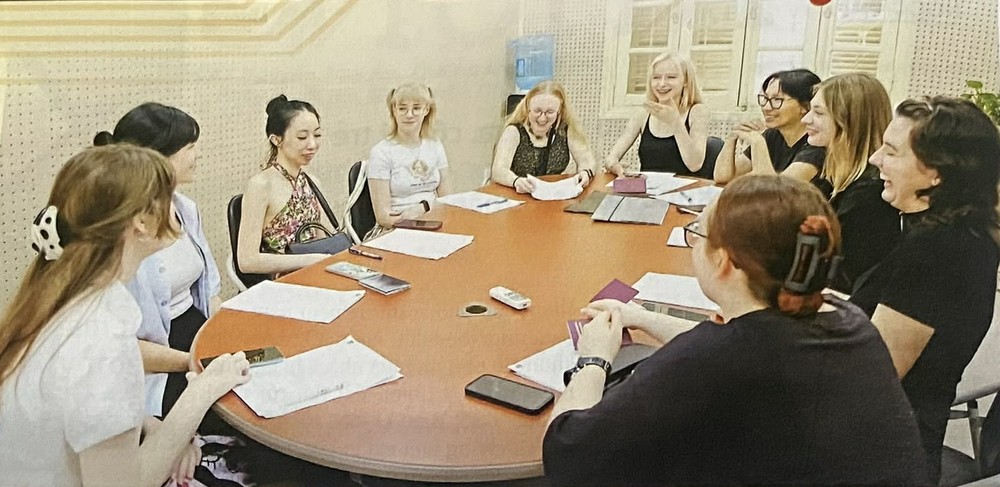
In the summer of 2025, as part of the British University Vietnam (BUV)’s Workplace Experience Program, eight students from the United Kingdom took part in a range of hands-on projects spanning marketing, tourism, game design, and other industries.
Among them was James Prentice, a final-year student from Scotland majoring in International Tourism and Events Management at Glasgow Caledonian University. After joining BUV’s workplace immersion program in 2024, he made a decision that surprised many: he chose to remain in Vietnam.
Following a three-month internship at the Imperial Citadel of Thang Long — a UNESCO World Heritage Site in the heart of Hanoi — he came to see Vietnam as what he described as a “land of opportunity” for international students seeking employment and long-term career development.
Struck by the richness of local culture, the country’s dynamic pace of life, and its expanding professional prospects, James made a bold commitment: he sold his car back home and returned to Vietnam in 2025, choosing to build his future there.
He is currently interning at Authentic Asia, a destination management company specializing in travel across Vietnam, Laos, and Thailand. In addition, he is studying Vietnamese and serving as a student ambassador for BUV, helping to promote Vietnam as an emerging hub for international talent.
A similar path has unfolded for Chen Lixin (born in 1997), a Chinese student with a deep interest in Vietnamese cinema and culture.
In 2022, Chen moved to Vietnam to pursue a degree in Vietnamese Language and Vietnamese Studies at the Faculty of Vietnamese Studies at Hanoi University (HANU). Having previously completed his undergraduate education in China, he said that, compared with many institutions he had explored, Hanoi University offered a more flexible framework better suited to international students—notably its policy of not requiring Vietnamese-language certification upon entry, a common barrier for foreign applicants at the initial stage.
During his first two years, Chen focused intensively on learning Vietnamese. He then sat for a competency assessment to meet graduation requirements before progressing to the final two years of specialized coursework.
Along his journey exploring Vietnamese culture — supported by the warmth of local students and the dedication of his lecturers — Chen Lixin sought to broaden his academic path even further.
In July 2025, he enrolled in a master’s program in Journalism and Media Management at the University of Social Sciences and Humanities under Vietnam National University, Hanoi. Balancing daytime undergraduate studies at Hanoi University with evening graduate classes, while also teaching Chinese, Chen maintains what peers describe as boundless energy.
Drawn by what he sees as a welcoming academic environment, reasonable living costs, and expanding professional opportunities, Chen has decided to build his future in Vietnam, choosing the country as the place where he intends to live and work in the years ahead.
The Faculty of Vietnamese Studies at Hanoi University is currently home to a growing number of international students, including many high achievers.
Among them is Lu Yunxia of China, whose research project advanced to the final round of the 2025 Euréka Student Research Award, organized by the Ho Chi Minh City Youth Union and Vietnam National University, Ho Chi Minh City. Her study examines patterns of social media use among young people.
It was the wholehearted support from friends in both countries and the dedicated guidance of his lecturers that enabled him to complete this research, Lu Yunxia said.
Stories such as those of James and Chen Lixin underscore a broader shift: Vietnam is no longer merely a destination for study but increasingly a place where international students choose to stay, work, and build lasting ties.
Minister of Education and Training Nguyen Kim Son has said that Vietnamese universities are appearing with increasing frequency in respected regional and global rankings.
According to the minister, several institutions in Vietnam have already secured places among the world’s top 500 universities and the top 300 in Asia across major international league tables.
Four universities, including Hanoi University of Science and Technology, Vietnam National University, Hanoi; Vietnam National University, Ho Chi Minh City; and the University of Danang, have been designated as key recipients of state investment through 2030, with the goal of placing them among Asia’s top 150 institutions.
When universities step onto the global stage
In the past, most foreign students coming to Vietnam did so under bilateral scholarship agreements between the Vietnamese government and partner countries.
More recently, however, a new trend has emerged: a growing number of international students are enrolling through full or partial self-funded scholarships. These range from short-term programs, such as summer schools and academic exchanges, to full-degree pathways at undergraduate and postgraduate levels.
One of the early adopters of a student internationalization strategy has been FPT University. Each year, the institution welcomes students from Europe and the Americas for exchange programs lasting approximately four months. International participants follow the same curriculum and academic content as their Vietnamese counterparts, reflecting efforts to align training standards and foster deeper academic integration.
In early 2025, the university hosted 200 international students from multiple countries for Spring Interfest 2025, a cultural exchange festival designed to offer immersive experiences in global cuisine, arts, and traditional games.
According to Mr. Le Truong Tung, Chairman of the University Council at FPT University, international exchange programs deliver tangible benefits for both overseas participants and FPT students. Studying side by side, he said, provides Vietnamese students with valuable opportunities to strengthen communication skills and adapt to multicultural working environments.
Associate Professor Dr. Nguyen Phong Dien, Vice Rector of Hanoi University of Science and Technology, said the university welcomes several hundred international students each year, primarily through exchange programs conducted with overseas partners—many of them in Europe—with study periods ranging from six to 12 months. The institution also runs long-term training programs for students from Laos and Cambodia and is continuing to accelerate its strategy to attract more international students in the years ahead.
Dr. Nguyen Thi Nhai, Deputy Head of the International Cooperation Department at Hanoi University, added that in 2025 the university received nearly 600 international students, further reinforcing its appeal within global academic networks and its standing as a reputable study destination in the region.
Vietnamese universities are attracting growing numbers of international students in part because the standing of the country’s higher education sector has evolved significantly.
No longer on the margins of global academia, many institutions have actively stepped onto the international stage, participating in global rankings as a means of strengthening their brands and enhancing academic credibility.
At the same time, universities have expanded international student exchange programs, introduced advanced curricula, increased the number of courses taught in English, and deepened research collaboration with overseas partners.
Opportunities amid global shifts
From the standpoint of international cooperation, Director General of the International Cooperation Department under the Ministry of Education and Training Nguyen Thu Thuy said that over the past five years, the ministry has signed more than 100 cooperation agreements with countries, international organizations, and major technology corporations. It has also concluded eight mutual degree recognition agreements with partners, including France, Russia, China, and Austria.
These agreements have helped enhance the value of Vietnamese qualifications, promote the mobility of highly skilled talent, and deepen both bilateral and multilateral educational partnerships.
Nationwide, there are currently nearly 500 joint training programs. On average, each university hosts about 39 long-term international students annually, while a growing number of professors and experts from South Korea, the United States, Japan, and France are engaged in teaching and research at Vietnam’s leading institutions.
Deputy Minister of Education and Training Nguyen Van Phuc said the ministry encourages internationally reputable universities to establish branch campuses in Vietnam, while urging domestic institutions to take a proactive approach in recruiting international students, coupled with strict quality assurance. Notably, the ministry will allow international students to be excluded from overall enrollment quotas, enabling universities to expand their international programs without breaching official caps on student intake.
Most recently, the National Assembly has enacted a series of special mechanisms and policies for the education and training sector, including measures designed to attract highly qualified professionals to teach and conduct research at Vietnamese universities.
These steps are expected to enable institutions to raise training standards in line with international benchmarks, a prerequisite for drawing greater numbers of international students to Vietnam.
The broader objective, policymakers say, is not only to attract global experts to the country but also to cultivate an open and compelling academic environment that encourages them to stay and contribute to the advancement of Vietnamese universities toward regional and international standards.
For decades, Vietnam has sent far more students overseas than it has received from abroad. Today, however, Asia is emerging as a new hub for international education — a shift that presents significant opportunities for Vietnam.
Aligning curricula with international standards and benchmarking against highly ranked global universities, creating favorable conditions for foreign institutions to establish branch campuses in Vietnam, and improving visa policies and health insurance provisions for international students are among the essential steps needed to meet the country’s workforce demands in a new era.
Along that path, Vietnam stands to enhance its prospects of becoming an increasingly attractive destination for international students.
Study Abroad at Home
A notable trend is taking shape: while many Vietnamese students continue to seek educational opportunities in developed countries, a growing number are opting to pursue internationally accredited programs within Vietnam itself, at costs typically equivalent to just one-third to one-half of studying overseas. This shift has helped fuel the rapid growth of internationally oriented universities operating in Vietnam.