These included Resolution 57 on breakthroughs in science, technology, and innovation; Resolution 59 on international integration; Resolution 66 on institutional reform; and Resolution 68 on the development of the private sector economy.
On August 22, 2025, the Politburo promulgated Resolution 71 on transformative reforms in education and training. Widely regarded as the “fifth pillar,” the resolution is designed to strengthen human capital, completing the strategic foundation for the nation’s long-term development.
Facing reality and shaping the future
According to Associate Professor Dr. Phan Thanh Binh, former Chairman of the National Assembly’s Committee on Culture, Education, Youth, Adolescents, and Children, Resolution 71 lays out clear and measurable targets that reflect the nation’s aspiration to rise.
By 2030, Vietnam aims to complete the digital transformation of governance and teaching nationwide. The resolution envisions eight universities ranked among Asia’s top 200, with at least one institution placing within the world’s top 100 in selected disciplines.
Looking further ahead to 2045, the goal is to build a modern, equitable, and high-quality education system that propels Vietnam into the world’s top 20 countries for education. At least five universities are expected to rank among the global top 100, alongside the development of a corps of leading intellectuals and elite professionals capable of serving as the driving force of a knowledge-based economy.
Resolution 71 is not merely a roadmap for the education sector; it stands as a declaration affirming the central role of human capital in national development. By elevating education to the status of a “fifth pillar,” the country completes the strategic foundation for a new phase of growth that inspires confidence in a future where knowledge and people will determine the nation’s standing in the 21st century.
To implement Resolution 57 of the Politburo, Prime Minister Pham Minh Chinh signed Decision No. 1131/QD-TTg on June 12, 2025, promulgating a list of strategic technologies and strategic technology products.
The list encompasses 11 groups of strategic technologies and 35 groups of strategic technology products. These include artificial intelligence (AI); digital twins; virtual and augmented reality; cloud computing, quantum technologies, and big data; blockchain; next-generation mobile networks (5G/6G); robotics and automation; semiconductor chips; advanced biomedical technologies; advanced energy and materials; rare earth elements, marine and subterranean resources; cybersecurity; and aerospace.
At the same time, the Prime Minister directed that, in line with evolving socio-economic development needs, the Ministry of Science and Technology take the lead, in coordination with other ministries and ministerial-level agencies, in proposing adjustments and additions to the list of strategic technologies and strategic technology products for the Prime Minister’s consideration and approval.
Boosting investment to develop human capital
From the perspective of World Bank economist Tran Thi Anh Nguyet, Vietnam has placed human capital and higher education on par with science and technology as top national priorities to drive development and economic growth.
Resolution 71 underscores that higher education institutions serve as the central pillars for training high-quality human resources and nurturing talent, while also acting as engines for scientific advancement and innovation.
However, Vietnam has yet to establish research institutions of global standing and continues to face a shortage of high-impact scientific publications, a significant barrier to building world-class innovation hubs and strengthening national innovation capacity.
She estimates that implementing a comprehensive program for science and technology, innovation, and higher education development would require a minimum investment of US$12 billion to US$17 billion over the 2026–2030 period. The projected funding would cover both capital expenditures for infrastructure and fixed assets, as well as recurrent operational costs.
Financial resources, she suggests, could be mobilized from the state budget, contributions from the private sector, and potential support from international development partners—signaling a call for coordinated, multi-sector engagement to power the country’s next phase of knowledge-driven growth.
According to Deputy Minister of Education and Training Nguyen Van Phuc, Vietnam currently has approximately 2.4 million university students enrolled across 242 higher education institutions, excluding academies and universities under the defense and public security sectors.
Universities, he emphasized, must do more than prepare graduates for the labor market. They are expected to generate new knowledge and spearhead the nation’s scientific and technological advancement. Without a highly skilled workforce, he noted, meaningful innovation cannot take root.
With that understanding, the Ministry of Education and Training has designated 13 higher education institutions to lead networks for excellence and talent development across nine priority technology fields spanning the country’s three regions. The move forms part of the Government’s broader roadmap to implement its project on developing a system of excellence and talent training centers in Industry 4.0 technologies through 2030—an initiative aimed at strengthening Vietnam’s competitive edge in the digital era.
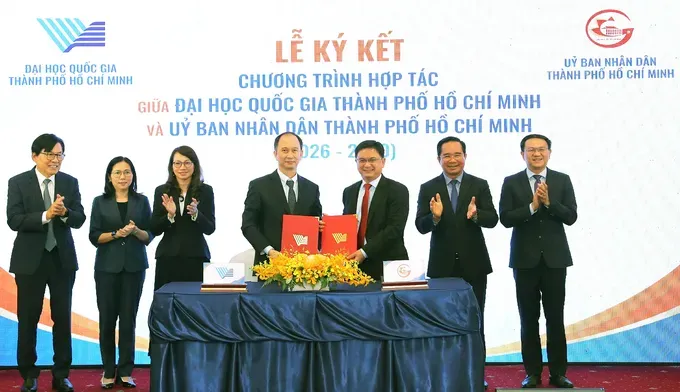
According to a concluding statement from a meeting of the Central Steering Committee for the Development of Science and Technology, Innovation, and Digital Transformation, four major universities—Vietnam National University, Hanoi; Vietnam National University, Ho Chi Minh City; Da Nang University; and Hanoi University of Science and Technology—will receive prioritized investment through 2030 to serve as flagship models for the higher education system.
The goal is for these institutions to rank among Asia’s top 150 universities and to attract at least US$50 million annually in research funding.
Specific targets have also been set. Each university is expected to generate 50 innovative startups or science and technology enterprises per year. During the 2026–2030 period, each institution aims to secure a minimum of US$50 million in investment for scientific research, technology development, and innovation; foster at least 10 successful startups valued at US$200 million or more; and increase the share of research funding and technology transfer revenues, including those derived from innovation activities, to at least 35 percent of total income, up from the current range of 11 to 27 percent.
The Resolution of the First Congress of the Ho Chi Minh City Party Committee for the 2025–2030 term sets out an ambitious human capital development agenda, underscoring education as a central pillar of the city’s long-term strategy.
The resolution calls for comprehensive and substantive reform of the education and training system, oriented toward standardization, modernization, and deeper international integration. It emphasizes accelerating the development and application of digital technologies and artificial intelligence (AI) in education, expanding integrated learning models, and broadening English-language proficiency across the system.
The city also plans to implement special mechanisms and policies to train, attract, incentivize, and retain talent in key sectors. A further priority is the creation of an internationally benchmarked ecosystem linking training, research, and entrepreneurship, alongside strategic land-use planning to support the expansion of higher education.
In addition, the resolution highlights the need to enhance the quality of teachers and education administrators, expand international faculty exchange programs, and strengthen the role of experts and scientists in advising and shaping Ho Chi Minh City’s education policies—reinforcing the city’s ambition to position itself as a regional hub of knowledge, innovation, and global connectivity.