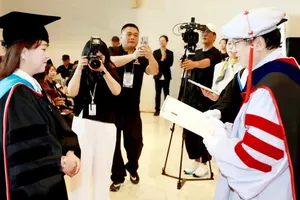
With a population of over 1.3 million but only two higher education institutions, nearly 10,000 students from the eastern part of Ho Chi Minh City (formerly Ba Ria - Vung Tau Province) have to travel hundreds of kilometers each year to the city center or other localities to continue their studies.
Limited universities leave eastern Ho Chi Minh City students struggling
Despite being an important maritime economic center of the Southeast region, the higher education system in the former Ba Ria - Vung Tau area was quite modest. Currently, the entire region only has two higher education institutions: Petro Vietnam University (belonging to the Vietnam National Industry - Energy Group) and Ba Ria - Vung Tau University (a private university, belonging to the Nguyen Hoang Education Group). The total enrollment for regular programs at both universities is only about 3,000 students per year. Meanwhile, with a population of over 1.3 million, nearly 10,000 high school graduates are from this area each year.
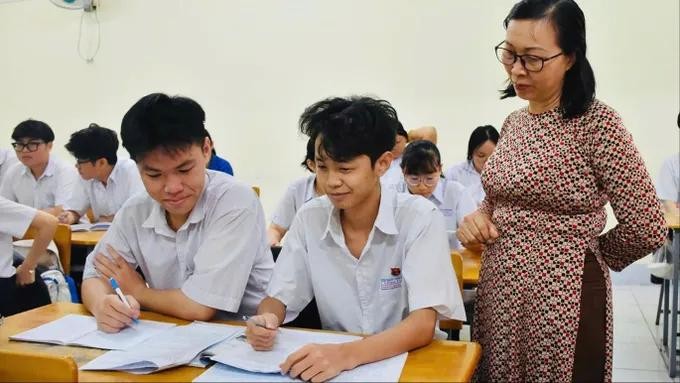
Nguyen Dinh Lam, former Vice Principal of Chau Thanh High School in Phuoc Trung Ward, said that his two children are studying at the Ho Chi Minh City University of Medicine and Pharmacy. Each month, the family spends about VND20 million on their children's living expenses and transportation. “Not every family can afford that cost. I once witnessed a former student, the runner-up in the high school graduation exam, having to give up her dream of studying medicine because of financial constraints, and her case is not unique,” Mr. Lam confided.
Le Kieu Hung, Vice Principal of Le Quy Don Specialized High School, noted that nearly all of the school’s students gain admission to universities each year. However, the majority must pursue their studies far from home, often traveling around 100 kilometers to institutions in central Ho Chi Minh City or other provinces.
Universities plan expansion toward eastern Ho Chi Minh City
Major institutions, including the Ho Chi Minh City University of Medicine and Pharmacy and the University of Transport, have proposed developing new training facilities in the former Ba Ria – Vung Tau area, aiming to ease pressure on the city center and align education with regional economic strengths.
Several universities are actively pursuing plans to expand their training facilities into the eastern part of Ho Chi Minh City, aiming to increase capacity and better serve the region’s growing educational demand.
The University of Medicine and Pharmacy at Ho Chi Minh City (UMP) announced that it has sent a letter to the city leadership and the Department of Finance requesting permission to survey and take over the Ba Ria - Vung Tau Administrative and Political Center to develop a training facility. The university currently has approximately 16,000 students, 6,000 staff members, and handles about 9,000 patient visits daily.
With a focus on expanding multi-disciplinary and multi-field training, modernization, and international integration, the addition of a new facility is essential. The university hopes that the former Ba Ria - Vung Tau facility will become a model medical university, combining training, practical hospital, research, entrepreneurship, and cooperation with businesses.
Universities training in maritime economics are also showing interest in this area. The Ho Chi Minh City University of Transport has just proposed taking over land and buildings in Vung Tau Ward to build a training facility.
Associate Professor Nguyen Xuan Phuong, Principal of Ho Chi Minh City University of Transport, emphasized that as part of its strategy to expand training capacity and develop specialized fields in marine economics, logistics, offshore energy, and marine services, the university requires an additional 40 hectares of land to secure sustainable long-term growth.
The university has proposed acquiring 2.81 hectares of land and existing buildings in Cluster 5 of the Bai Truoc area, with plans to establish a specialized marine training and research facility.
On February 25, the Standing Committee of the Ho Chi Minh City Party Committee issued a conclusion on the policy of researching and developing a plan to relocate and expand higher education institutions, colleges, vocational training centers, and some medical facilities out of the inner city.
The policy is designed to ease traffic flow and reduce population density in central Ho Chi Minh City, aiming to curb congestion in areas where training institutions are heavily concentrated. Specifically, the plan emphasizes reorganizing urban space rationally and sustainably, linked to the development of large-scale and modern university urban areas. The conclusion also clearly states that the research and proposed solutions must be consistent with the Ho Chi Minh City master plan approved by the Prime Minister.
Besides addressing the planning "problem," many opinions suggest surveying the learning needs of students in recent years to ensure that the establishment of training facilities is closely aligned with reality. Furthermore, training programs should be linked to the local economic pillars including industry, seaports and logistics, tourism and urban development, and services, contributing to the training of high-quality human resources for the region.