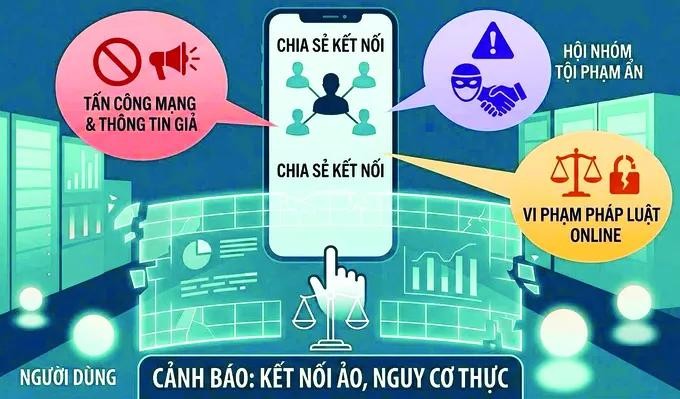
Many social media groups today are no longer merely spaces for connection and sharing but have increasingly become environments exploited by malicious actors to carry out illegal activities. In response, the Ministry of Public Security is seeking public feedback on a draft decree on the prevention and control of cybercrime and high-tech crime, which proposes identity verification for group administrators and enhanced accountability in managing online communities.
From social groups to crime hubs
Initially, social media groups were created to exchange information and share experiences related to education and daily life. However, as membership grew rapidly, some groups shifted toward sensational content, including the exposure of individuals’ private lives.
In certain groups, members readily engage in coordinated harassment (cyberbullying), leading to personal accounts being targeted, mass-reported, and subsequently restricted or suspended.
Beyond creating crowd pressure, some groups have become spaces for discussion and recruitment into illegal activities. While many began as support communities offering emotional assistance, their content in some cases gradually deviated, promoting mindsets such as “nothing left to lose” or “taking risks to change one’s life.”
From expressions of frustration, many individuals are drawn into discussions about “quick money” schemes, regardless of legal risks. In a Facebook group titled “Hoi Vo No Lam Lieu” (roughly translated as “Debt-Burdened Risk-Takers”), reporters observed numerous posts sharing methods to evade creditors, seek high-interest emergency loans, or participate in fast-profit schemes.
One anonymous account posted a message stating “need dirty money, dirty first clean later,” effectively luring individuals in financial distress. The post received over 70 interactions from users willing to engage despite potential legal consequences.
In other groups, even those appearing to focus on health, such as “Hoi Hien Tang, Hien Than Cho Nguoi Can” (Organ Donation Support Group), posts have emerged using coded language to facilitate illegal organ trading, for example phrases like “buying young mangoes aged 20 to 40".
Additionally, numerous groups dedicated to trading weapons have been created, where posts openly seek homemade firearms or weapons such as knives and machetes, often under anonymous accounts. For instance, a group named “Mua Ban Vu Khi Quan Dung Uy Tin” (“Trusted Military Weapon Trading”) has over 2,000 members, with frequent listings for modified firearms.
Ministry drafts decree to rein in cybercrime
The Ministry of Public Security is currently collecting feedback on a draft decree governing the prevention and control of cybercrime and high-tech crime. According to the drafting body, these issues are currently regulated under Decree No. 25/2014 on the prevention of crime and legal violations involving high technology. However, this decree has revealed certain limitations and requires revision to better reflect current realities.
The new draft decree stipulates that providers of internet, telecommunications, and social media services must establish and implement mechanisms to manage, monitor, and handle groups on their platforms to prevent their misuse for illegal purposes.
These service providers are also required to verify and authenticate the identities of group administrators, develop mechanisms for member verification and content moderation, and provide relevant group data upon request from competent authorities in accordance with regulations.
Group moderators must organize and manage activities in compliance with Vietnamese law; establish internal rules aligned with legal requirements, service provider policies, and national cultural norms and traditions.
At the same time, they are responsible for monitoring members and posted content, promptly removing illegal material, and reporting suspected criminal activities to service providers or competent authorities.
Furthermore, group participants must comply with group rules and platform terms of service and refrain from posting, sharing, or commenting on content that violates the law.