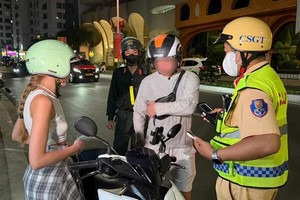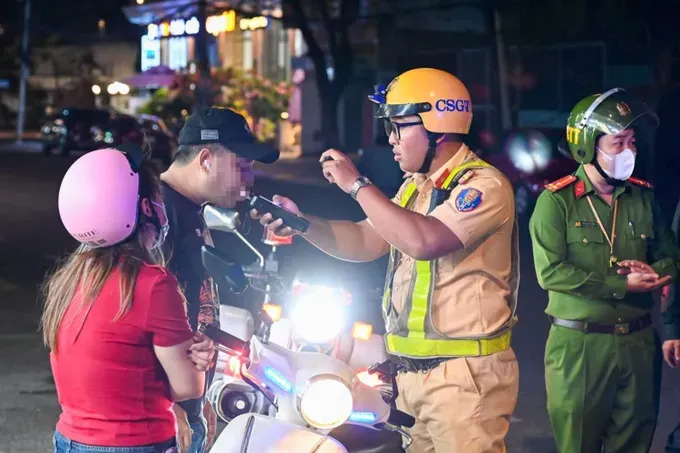
The draft proposes that People’s Public Security officers on active duty be authorized to impose on-the-spot fines for violations up to VND7.5 million (US$285), a stark contrast to the current VND500,000 ($19) limit. They are also granted the right to confiscate violating exhibits and vehicles valued at no more than VND15 million.
This implies that individuals committing certain infractions with fines under VND7.5 million can pay the penalty directly to the on-duty traffic police officer, thereby bypassing the necessity to visit a treasury, bank, or utilize the national public service portal.
The maximum financial penalty applicable by the Chief of Commune-Level Public Security Division is proposed to surge from VND2.5 million ($95) to VND37.5 million ($1,420). Similarly, the Chairman of the Commune-Level People’s Committee will also see their maximum penalizing threshold elevated to VND37.5 million for road traffic violations, precisely 7.5 times the current VND5 million ($190) ceiling.
The draft further broadens the jurisdiction for several other state officials, such as company-level mobile police unit commanders, police station chiefs, and team captains, featuring substantially amplified fine limits coupled with the authority to confiscate exhibits.
A notable novelty of the draft is the supplementation of penalizing authority regarding fraudulent acts in driving license examinations. Specifically, traffic police are empowered to penalize deceitful practices such as unlawfully altering or utilizing examination software, grading devices, or test vehicles; and illegally connecting computers within the theoretical examination room to external networks.
Importantly, these supplementary regulations don’t alter the fine levels for individual offenses but primarily broaden the scope of enforcement.
Do Tien from Thanh My Tay Ward of HCMC noted his attention to the proposal elevating the commune police chief’s penalty jurisdiction to VND37.5 million. As a force positioned close to the community and handling matters directly within the locality, granting them broader authority will facilitate the prompt resolution of violations.
Nevertheless, he suggested that for cases involving substantial financial penalties, a more rigorous procedure is imperative to ensure citizens receive comprehensive explanations and adequate time for consideration prior to execution.
Decree 168, effective since the dawn of 2025, has significantly contributed to elevating public consciousness regarding legal compliance. However, practical realities have manifested numerous unprecedented issues, such as “disguised” commercial transportation, vehicles operating contrary to regulations, and certain law-breaking activities lacking sufficiently stringent sanctions.
Also, since March 2025, as the Ministry of Public Security assumed additional responsibilities related to driving license testing and issuance, specific regulations concerning penalizing authority necessitate prompt and precise supplementation.
According to Lawyer Le Thi Lan Phuong from the HCMC Bar Association, amending and supplementing the Decree powerfully demonstrates the resolute determination to fortify state management efficacy amidst increasingly complex traffic violations.
However, the on-the-spot fine mechanism was originally engineered for straightforward, minor infractions utilizing an expedited protocol. When the on-the-spot penalty threshold is escalated to millions or even tens of millions of VND, it ceases to be a rapid processing measure; rather, it approximates an administrative decision exerting a profound impact on citizens’ assets and rights.
Devoid of a corresponding control mechanism, it can easily lead to severe risks such as procedural errors or the abuse of power during enforcement. Coupled with this is the psychological pressure inflicted upon citizens at the moment of penalization, compelling them to make rapid decisions under information-deficient circumstances.
It’s, therefore, imperative to engineer sufficiently robust “legal barriers,” such as mandating comprehensive audio and video recording of the entire on-the-spot penalization process, deeming this a legal prerequisite for the penalty decision. Additionally, establishing an expedited and accessible grievance mechanism that can be invoked immediately following the penalty is crucial to fiercely safeguard the legitimate rights of citizens.
Fiercely cracking down on unlicensed transport and illegal stops
The draft amendment to Decree 168 supplements numerous stipulations aimed at intensifying management operations. Notably, it mandates the compulsory installation of dashcams, cameras monitoring drivers and passenger compartments, alongside requirements for data transmission and retention to facilitate regulatory oversight. If the equipment malfunctions, lacks data, or manipulates data, stringent punitive actions will be applied.
The draft also pioneers rigorous regulations to protect children in traffic, explicitly prohibiting children under 10 years old or under 1.35 meters tall from occupying the front seat of an automobile (excluding single-row vehicles).
Disguised commercial transport practices, such as operating non-commercial passenger vehicles to transport individuals for a fee, or signing contracts and accepting reservations to transport passengers, as well as operating non-commercial freight vehicles to transport goods for a fee, are also subjected to supplementary penal sanctions. This is designed to decisively eradicate the persistent scourge of unlicensed passenger vehicles and illegal bus stops.

)