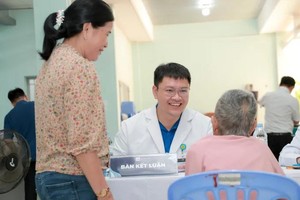
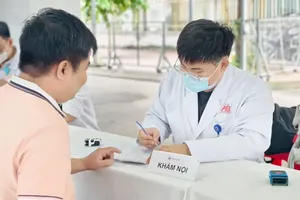
The Ho Chi Minh City Department of Health today announced that, as of the end of last week, 251,409 residents had received routine health checkups under the city's Universal Health Checkup Program.
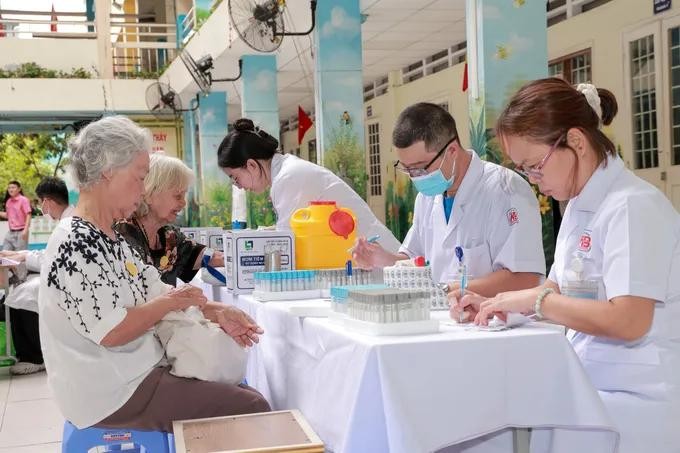
Overall, the final days of June and early July saw a marked acceleration in the program's rollout. On many days, more than 10,000 residents underwent health screenings. On July 2, the program reached a record 13,994 checkups in a single day, the highest daily total since the initiative was launched under the Ho Chi Minh City People's Committee's 2026 plan for routine health examinations.
The figures indicate that the program has entered an accelerated implementation phase.
However, given the city's population size, only about 1.8 percent of residents have so far received health checkups. While several localities have achieved coverage rates exceeding 20 percent of their populations, many others have screened fewer than 1 percent of residents, with some reporting rates below 0.1 percent.
The disparity highlights significant differences in implementation progress among localities and underscores the need for stronger efforts in the coming months.
According to data compiled by the Department of Health as of July 5, Con Dao Special Zone ranked first, with 35.4 percent of its population receiving health checkups, or 2,357 out of 6,658 residents.
Other leading localities included An Nhon Tay Commune (26.39 percent), Thanh An island commune (18.11 percent), Bac Tan Uyen Commune (14.87 percent), Vinh Loc Commune (11.70 percent), Tan My Ward (9.27 percent), Tan Nhut Commune (8.43 percent), Hiep Phuoc Commune (8.08 percent), Ba Diem Commune (7.88 percent), Xuan Thoi Son Commune (7.15 percent), Hung Long Commune (6.57 percent), Phuoc Thang Ward (6.44 percent), Tan Tao Ward (6.38 percent) and Binh Khanh Commune (6.24 percent).
Despite these positive results, implementation remains highly uneven. So far, 41 of the city's 168 wards, communes and special zones have health checkup coverage below 1 percent.
Among the lowest-performing localities, all with coverage below 0.3 percent, are Minh Thanh Commune, where only 10 residents have been examined (0.05 percent), An Long Commune with seven residents (0.09 percent), Binh Chau Commune (0.11 percent), Ban Co Ward (0.19 percent), Binh Gia Commune (0.19 percent), Xuyen Moc Commune (0.21 percent), Bau Bang Commune (0.23 percent), Binh Co Ward (0.24 percent) and Saigon Ward (0.26 percent).
According to Associate Professor Tang Chi Thuong, Director of the Ho Chi Minh City Department of Health, the universal health checkup program is not solely the responsibility of the health sector but of the entire political system.
He said each ward, commune and special zone should serve as a core driver of the program and regard residents' health screening results as one of the indicators of effective local governance.
When every locality accelerates implementation with strong determination, Ho Chi Minh City will have every basis to achieve its goal of providing health checkups for 100 percent of residents in 2026, Associate Professor Tang Chi Thuong said. He added that at the same time, the city will establish electronic health records for every resident and provide continuous health management throughout each person's lifetime, creating an important foundation for developing a modern healthcare system centered on prevention, data-driven governance and people-focused services.