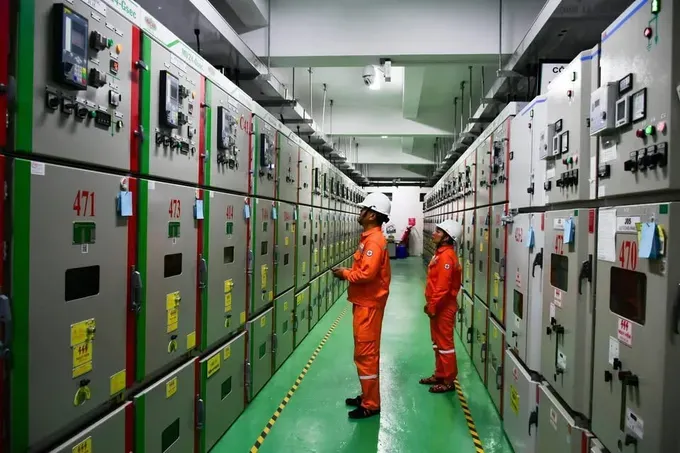
According to the National Power System and Market Operation Company Limited (NSMO) under the Ministry of Industry and Trade, from May 25 to 26, widespread and extremely severe heatwaves with soaring temperatures placed significant pressure on power system operations nationwide.
On May 25, the national power system’s peak capacity reached 57,120MW, up 13.5 percent compared with the same period in 2025. Electricity consumption totaled 1.171 billion kWh. In the Northern region alone, peak capacity hit 29,667MW, an increase of more than 1,700MW in just one day.
By noon on May 26, electricity demand continued to rise. National power capacity climbed to 57,590MW, while Northern Vietnam recorded an increase of nearly 900MW compared with the same time a day earlier.
To ensure a stable electricity supply, LNG-fired and FO oil-fired power sources are being mobilized at maximum capacity. Nhon Trach 3, Nhon Trach 4, and Phu My thermal power plants, operating on LNG, are generating a combined capacity of more than 3,000MW. Meanwhile, oil-fired generating units in Ho Chi Minh City and Can Tho have also been placed on standby or are supplying electricity during peak hours.
According to NSMO, these high-cost fuel sources are being mobilized to ensure sufficient system capacity while conserving water at hydropower reservoirs, particularly in the central region, as part of preparations for the dry season.
According to forecasts, on May 27, severe heatwaves with temperatures ranging from 38 to 40 degrees Celsius, and exceeding 40 degrees Celsius in some areas, are expected to persist across the Northern Delta region and from Thanh Hoa to Hue City. NSMO estimates that the Northern region’s peak power load during this evening’s peak hours could reach between 31,000MW and 31,500MW, approximately 7,000MW higher than levels recorded before the onset of the heatwave. Nationwide electricity consumption is projected to hit 1.221 billion kWh.
In line with Directive No. 10/CT-TTg dated March 30 issued by the Prime Minister on strengthening electricity conservation and promoting rooftop solar power development, the power system operator has called on residents and businesses to step up electricity-saving measures, particularly during peak hours, in order to ensure the safe and stable operation of the national power system.
On May 27, the National Center for Hydro-Meteorological Forecasting announced that the ongoing widespread heatwave is expected to end in the Northern region from May 29 and gradually ease in the Central region.
According to the meteorological agency, beginning May 28, a weak cool air mass from China is forecast to move southward. This cooler air mass will weaken the western low-pressure hot zone, causing the heatwave in the Northern region to narrow in scope and mainly affect the northern midland and delta regions, where maximum temperatures are expected to range from 35 to 37 degrees Celsius, with some areas exceeding 37 degrees Celsius.
Experts from the National Center for Hydro-Meteorological Forecasting said that during the severe and extremely severe heatwave from May 22 to 27, many localities recorded temperatures that broke historical May records.
Specifically, on May 25, the Uong Bi monitoring station in Quang Ninh Province recorded a temperature of 38 degrees Celsius, surpassing the previous May record set at the station in 2013. Meanwhile, the Hiep Hoa station in Bac Ninh Province registered 39.7 degrees Celsius, and the Bac Giang station recorded 39.4 degrees Celsius, both exceeding their previous historical highs.
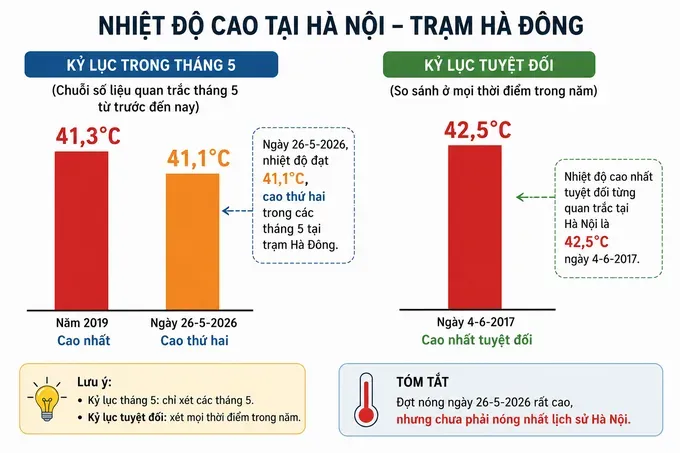
In Hanoi, the Ha Dong monitoring station recorded a temperature of 41.1 degrees Celsius on May 26, marking the second-highest May temperature ever observed at the station. According to the meteorological agency, the highest May temperature ever recorded at Ha Dong station was 41.3 degrees Celsius in 2019. However, the highest absolute temperature ever observed in Hanoi was 42.5 degrees Celsius, recorded on June 4, 2017.
The meteorological agency noted that Hanoi is currently one of the focal points of this heatwave. The capital is being affected simultaneously by a low-pressure hot zone, foehn winds, and the urban heat island effect caused by its high level of concrete urbanization. As a result, actual observed temperatures in Hanoi are frequently 1-2 degrees Celsius higher than in surrounding areas.
On the afternoon of May 27, the Northern Delta region, Phu Tho Province, and the area stretching from Thanh Hoa to Hue continued to experience severe and extremely severe heatwaves, with temperatures commonly ranging from 38 to 40 degrees Celsius and exceeding 40 degrees Celsius in some places. Other areas in the Northern region and the south-central coastal region recorded temperatures of 37-39 degrees Celsius, with some localities also surpassing 40 degrees Celsius.
Due to persistently high temperatures combined with low humidity levels, authorities have warned of a heightened risk of explosions, fires in residential areas, and forest fires. The situation is expected to ease from May 29 onward.