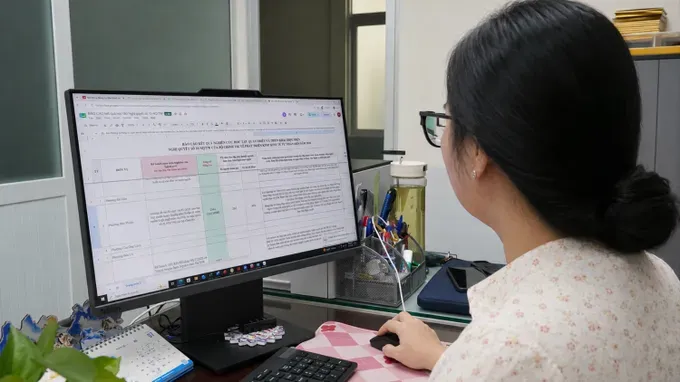
Logging into the internal operating information system of her Party agency, Deputy Head Bui Thuy Hien of the Party Building Committee of Ben Thanh Ward quickly browsed through the queue of pending documents. Within just the first few minutes of her morning, more than a dozen tasks appeared on her screen. Whether a document was newly incoming, approaching its deadline, or requiring onward transfer for further processing, the system updated everything in real time.
For Deputy Head Bui Thuy Hien, the digital transition has been a genuine relief. “Previously, after every study session or resolution briefing, we had to draft a separate report, but now we simply update the information into an electronic form and it’s done,” she explained while reviewing her workflow.
Since early 2026, numerous reporting requirements in the fields of propaganda and mass mobilization have been integrated into the monthly report of the Party Building Committee. Instead of compiling a standalone document for each individual topic, officials now fulfill many mandates using standardized electronic forms or by updating them directly on the shared database.
Furthermore, many formal documents are under both hard and soft versions so that grassroots units can promptly update and issue them right on the system, rather than having to retype everything from scratch as they did in the past. These procedural adjustments have significantly reduced both time consumption and workplace pressure for local officials.
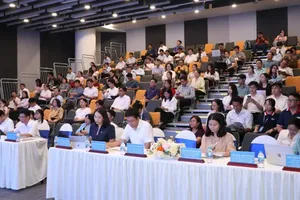
Similar positive developments have been noted across several other localities. During a propaganda work briefing conference in March 2026, a representative from Phu Tho Ward indicated that in the first quarter alone, the locality had received over 160 documents related to propaganda and mass mobilization, along with numerous reporting demands.
Following the conference, the Ho Chi Minh City Party Committee’s Commission for Propaganda and Mass Mobilization reviewed and integrated several periodic reporting requirements into the monthly report while deploying electronic forms for specific tasks, thereby helping reduce the burden of compiling separate reports at the grassroots level.
Likewise, each week, the Party Building Committee of Cau Ong Lanh Ward receives roughly 120 to 130 official documents spanning organizational affairs, propaganda, mass mobilization, and inspection work. Simultaneously, the Ward Party Committee Office must adhere to daily, weekly, monthly, and quarterly reporting regimes for Party-building activities. In addition, officials must frequently produce ad-hoc reports upon request.
Compared to the initial phase of organizational restructuring, the volume of documents and reports has dropped noticeably because higher-level authorities either curtailed them or merged multiple tasks together.
Even so, given the substantial workload they currently face, grassroots units still hope the city will continue reviewing and eliminating overlapping reports so that cadres and civil servants have more time to focus on their core professional responsibilities.
At a recent briefing conference between the Ho Chi Minh City Party Committee Standing Board, the Vietnam Fatherland Front Committee, and various socio-political organizations, Chairman of the Ho Chi Minh City Veterans Association Nguyen Minh Hoang shared that commune-level association chairpersons must still submit daily reports, even though many officials concurrently hold other roles. Maintaining a daily reporting regime invariably generates added pressure on grassroots staff.
Faced with this operational reality at the local level, Permanent Deputy Secretary Le Quoc Phong of the Ho Chi Minh City Party Committee instructed the Party Committee Office to urgently propose innovative solutions for reporting procedures, prioritizing the maximum exploitation of shared databases and the elimination of redundant reporting demands.
Under an operational plan for an automated reporting system designed by the Ho Chi Minh City Party Committee Office to serve Party bodies, wards and communes only need to update their data once a month using a standardized form.
From this repository, specialized Party committees will proactively extract, synthesize, and export reports corresponding to their specific functions and duties. Once updated, the data directly supports the governance work of local Party committees, mitigating the inefficiency of having to enter identical information multiple times across disparate systems.
Currently, the Ho Chi Minh City Party Committee Office is also deploying the construction of an automated reporting platform tailored for Party organs. For Deputy Chief Pham Van Hien of the Ho Chi Minh City Party Committee Office, the traditional bureaucracy has long been overdue for reform.
He noted that a single ward or commune must generate at least five monthly reports to send to different Party bodies, including the City Party Committee, the Organization Commission, the Commission for Propaganda and Mass Mobilization, the Internal Affairs Commission, and the Inspection Commission. Even though numerous indicators are shared across these reports, grassroots units are still forced to synthesize them on separate, individual forms.
The Party Committee Office has finished drafting the standardized forms and initiated data entry trials across several wards and communes. Meanwhile, engineers are continuing to refine the report-exporting functionality before rolling it out across the entire system.
According to Deputy Chief Pham Van Hien, once the system operates synchronously, the data updated by grassroots units will simultaneously support the leadership and management of local Party committees while fulfilling the synthesis requirements of municipal Party organs. This streamlined approach will help slash the time spent on data compilation and input, while boosting the consistency and accuracy of official information.