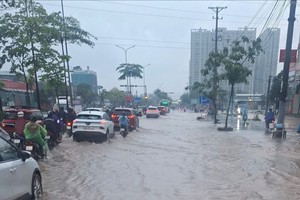
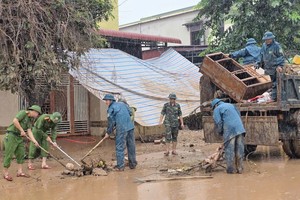
From September 14 through the morning of September 16, haze was observed continuously in many parts of southern Vietnam, including Ho Chi Minh City, An Giang and Ca Mau.
At the Ministry of Agriculture and Environment’s regular press briefing on the morning of September 16, a reporter from Sai Gon Giai Phong (SGGP) Newspaper raised questions about the causes and impacts of the phenomenon.

Director of the National Center for Hydro-Meteorological Forecasting, Mai Van Khiem, provided the information based on an analysis of meteorological observation data. In assessing signs associated with haze, meteorological authorities focus on factors such as visibility, wind speed, and temperature inversion in the near-surface atmosphere.
Data from surface observation stations showed that visibility in some areas of the Southern region had decreased in recent days, but only slightly to moderately. At the same time, winds across the region were weak. This was also a contributing factor limiting the dispersion of airborne dust particles, thereby reducing visibility.
Weak winds reduce the ability of substances in the air to disperse, which can result in hazy conditions, Mr. Khiem explained.
Temperature inversion in the near-surface atmosphere is another factor considered when assessing haze and the ability of airborne substances to disperse.
Based on observation data from Tan Son Hoa Station in Ho Chi Minh City, meteorological authorities recorded a mild temperature inversion over the past two days. However, Khiem noted that the phenomenon was “not particularly pronounced."
These conditions may have contributed to the hazy conditions observed across southern Vietnam in recent days, but they have not reached the threshold for the phenomenon to be classified as fog.
Further assessment of environmental parameters needed

To more fully determine the causes and extent of the phenomenon, Mai Van Khiem said additional surveys and assessments of environmental parameters in various localities over the past several days are needed.
Responding to an additional question from an SGGP Newspaper reporter about the haze, deputy director of the Department of Environment under the Ministry of Agriculture and Environment, Nguyen Thi Thien Phuong, said multiple factors need to be considered, including hydro-meteorological conditions, humidity, local weather conditions and temperature inversion. The phenomenon could also be linked to emissions, she added.
According to Ms. Nguyen Thi Thien Phuong, a more accurate assessment requires analysis and cross-comparison of hydro-meteorological parameters with environmental indicators, including fine particulate matter such as PM (Particulate Matter) 2.5 and PM10, as well as other parameters.
Regarding air quality, monitoring of the Air Quality Index (AQI) in southern provinces in recent days has shown no unusual developments. The deputy director said AQI readings in southern provinces have remained in the orange category, indicating poor air quality, and have not reached hazardous levels. The Ministry of Agriculture and Environment will continue to monitor, assess, and conduct further analysis.




)