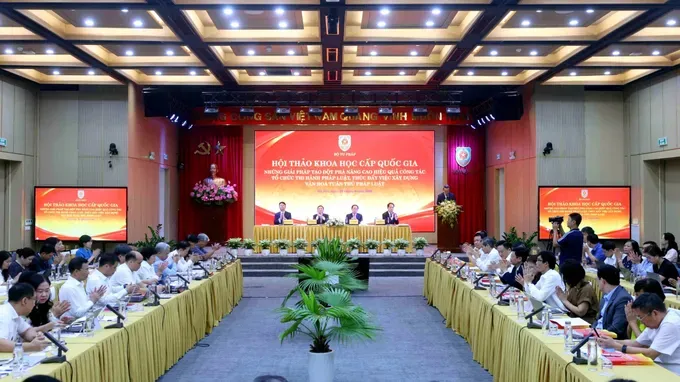
Speaking at a national scientific conference titled “Breakthrough Solutions to Improve the Effectiveness of Law Enforcement Organization and Promote a Culture of Legal Compliance,” held this morning at the Ministry of Justice headquarters, Deputy Prime Minister Le Tien Chau stressed the need to improve the quality of legal regulations at their source.
The event was attended by Deputy Prime Minister Le Tien Chau, National Assembly Vice Chairman Nguyen Khac Dinh, leaders of ministries and agencies, representatives from several provinces and cities, as well as experts, scientists, and administrators.

In his opening remarks, Deputy Prime Minister Le Tien Chau emphasized that every policy must have clear objectives, be feasible, and fully account for the necessary human resources, funding, and infrastructure during the drafting stage. He also called for closer integration between lawmaking and law enforcement, using implementation outcomes as input data to verify quality and support continued legal revisions and improvements.
The Deputy Prime Minister urged the use of digital data and artificial intelligence (AI) as foundations for breakthroughs. He called for accelerating digitalization and synchronizing the entire lifecycle of legal normative documents, ensuring interconnected and integrated data systems while eliminating fragmentation between the drafting and enforcement stages.

Measurements of law enforcement performance, he said, must serve as a basis for determining accountability, promptly correcting implementation shortcomings, and removing inappropriate regulations.
According to Deputy Prime Minister Le Tien Chau, the focus must shift from requiring people and businesses to “comply” toward creating an environment in which it is “easy to do the right thing” where they “want to do the right thing” and where voluntary legal compliance becomes habitual.
Presenting the keynote report, Justice Minister Hoang Thanh Tung said Vietnam's legal normative document system is extensive, with 45,793 documents currently in force or scheduled to take effect, yet the organization of law enforcement remains a weak link.
Citing General Secretary and State President To Lam's assessment that implementation and execution remain the “bottleneck of bottlenecks”, Justice Minister Hoang Thanh Tung called on conference participants to focus on analyzing and proposing solutions to strengthen Party leadership at all levels, build a streamlined and synchronized legal system, establish proactive policy response mechanisms, and end delays in issuing detailed implementing regulations.
The minister also proposed shifting from governance based on administrative procedures and plans to implementation governance based on data, outcomes, and accountability. He called for clearly defining the responsibilities of ministry and agency heads, as well as chairpersons of provincial people's committees. At the same time, he advocated applying digital technology and AI to modernize legal dissemination and education through two-way interaction.
Justice Minister Hoang Thanh Tung stressed that investment in law enforcement is an investment in development. He said funding provisions, technical infrastructure, and the capacity of frontline enforcement personnel should be comprehensively reviewed and strengthened.
The conference's findings will contribute to a thematic report by the Ministry of Justice Party Committee for submission to the Central Steering Committee on Institutional Improvement and Law Enforcement, while also serving as reference material for ministries, agencies, and local authorities.