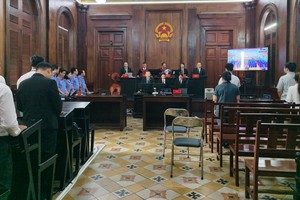
The recent event where the Investigation Agency of the Supreme People’s Procuracy decided to prosecute two former leaders of the legal proceeding agencies in formerly Tra On District of Vinh Long Province for “failing to pursue criminal liability of a guilty person” continues to affirm a core principle: all violations must be handled strictly, with absolutely no off-limits zones and no exceptions.
As a rule of thumb, the greater the power, the heavier the responsibility; the more crucial the position, the more precise the requirements for integrity, objectivity, and legal compliance. In judicial operations, this principle carries special meaning because every single procedural decision doesn’t just impact an individual’s fate. It also deeply reflects the prestige, bravery, and strictness of the entire legal system.
When judicial power is flagrantly abused or utilized for the wrong purposes, the ensuing consequences will inevitably lead to wrongful convictions and the negligent omission of criminals. This ultimately diminishes the effectiveness of crime prevention and actively creates a toxic psychology of doubt within society.
The specific charge of “failing to pursue criminal liability of a guilty person” is stipulated right in the Penal Code to rigorously safeguard the proper operations of judicial agencies. When a competent official clearly knows there are sufficient grounds for criminal prosecution but intentionally fails to execute it, the core nature of this act isn’t merely a violation of public duties. It actually challenges the fundamental principle of equality before the law.
The act that the Investigation Agency of the Supreme People’s Procuracy prosecuted the former leaders of the proceeding agency in Tra On District, hence, demonstrates that the law simply doesn’t accept any “blank spaces” when it comes to controlling state power.
What needs to be emphasized is that prosecuting violating officials doesn’t equate to outright denying the pivotal role, position, and prestige of law enforcement agencies.
Actually, resolving to determinedly eliminate individuals who abuse their power and blatantly violate the law is the exact method needed to fiercely protect the honor of the vast majority of dedicated state officers and soldiers. To maintain true justice, a strong judiciary must possess enough bravery to self-discover, self-correct, and decisively handle any acts that actively harm the pursuit of justice.
When the above case was publicly announced, a flurry of unverified comments surfaced across cyberspace, spiraling into extreme deductions. For some online observers, there are hasty opinions aggressively concluding that this is a glaring manifestation of “degeneration” within the judicial system.
It appears some people are eagerly weaponizing the wrongdoings of a few individuals to completely deny the crucial role of the entire law enforcement force. Furthermore, certain accounts deliberately splice information, deeply distort the case’s ongoing developments, and forge misleading assessments aimed at eroding the public’s trust in the proceeding agencies.
It must be realized that individual wrongdoings don’t inherently equate to the nature of the entire system. In any given nation, there is simply no governing apparatus absolutely immune to localized violations.
Therefore, the fact that competent agencies proactively investigate, expand the case, and prosecute those who once held leadership positions isn’t a sign of institutional weakness. On the contrary, it’s a rock-solid testament proving that the power control mechanism is highly effective, and the law is being enforced in a fair, highly objective manner without any exceptions.
Amidst today’s information explosion, every citizen isn’t just a passive receiver but can easily become an active transmitter of news. Consequently, each individual’s responsibility when accessing, sharing, and commenting on these sensitive cases becomes more important. All personal assessments need to be grounded in official information sources, the definitive conclusions of competent authorities, and strictly within the framework of legal regulations.
It’s advisable to remain vigilant against deceptive claims deliberately exploiting the incident to deny the broader policy of building a socialist law-governed State. The true nature of these arguments is of equivocation fallacy, deliberately equating the isolated wrongdoings of a few individuals with the inherent nature of the regime itself.
In reality, the very act of investigating, prosecuting, and strictly penalizing violating officials reflects a sky-high political determination to purify the apparatus. This thoroughly strengthens discipline, restores order, and particularly ensures that all power remains strictly controlled by the law.
The people’s unwavering trust in the law is inherently forged from transparency, objectivity, and strictness when handling violations. Every case accurately resolved according to the law, every violating official disciplined according to regulations, and every manifestation of power abuse promptly thwarted all massively contribute to consolidating society’s profound faith in justice.