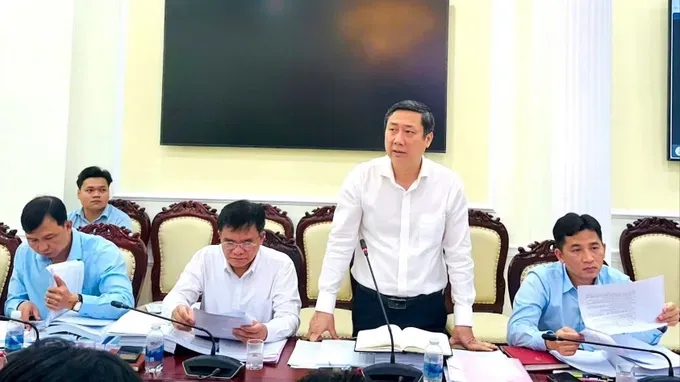
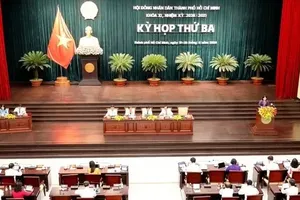
The meeting was held to prepare documents for submission to the Ho Chi Minh City People’s Council for consideration and decision at its eighth session.
The meeting was chaired by Mr. Nguyen Cong Danh, Head of the Economic and Budget Committee of the Ho Chi Minh City People’s Council.
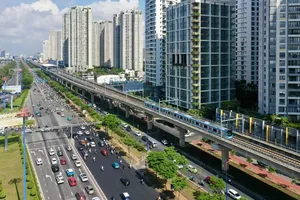
Among the items under review was a proposal to extend Metro Line 1 to connect Ho Chi Minh City with Dong Nai Province and Long Thanh International Airport. Spanning more than 41 kilometers, the project is being studied for implementation under a public-private partnership (PPP) model. It is expected to form a modern rail transport corridor, helping to ease pressure on road traffic, diversify transport modes, and promote inter-regional economic development.
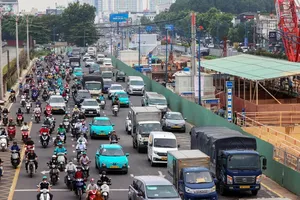
The Economic and Budget Committee of the Ho Chi Minh City People’s Council also reviewed the proposed construction of Thu Thiem 4 Bridge, a Group A project with an estimated total investment of more than VND5.063 trillion (US$195 million). The bridge will link Thu Thiem New Urban Area with the southern part of the city and is expected to ease traffic congestion on Nguyen Tat Thanh Street and Khanh Hoi Bridge while also creating momentum for the development of an international financial center and broader urban revitalization efforts.
In the logistics and port sector, the Economic and Budget Committee of the Ho Chi Minh City People’s Council reviewed a proposal for the Cat Lai–Phu Huu inter-port road, which will connect to Ring Road 3. The 5.9-kilometer route carries an estimated total investment of about VND 8.782 trillion (US$337.7 million). Early investment in this dedicated corridor is expected to ease traffic bottlenecks at the Cat Lai–Phu Huu port complex, shorten transport times, and enhance the competitiveness of the city’s and region’s import-export logistics chain.
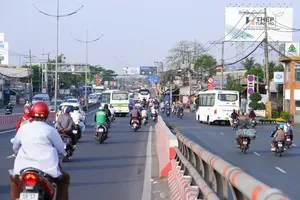
In the city’s western area, the proposed upgrade and expansion of Vinh Loc Road, stretching 7.1 kilometers with its right-of-way widened to 30 meters and a total investment of more than VND6.87 trillion (US$264.3 million), was identified as playing a key role in removing traffic “choke points,” restoring two-way traffic flow, and laying the groundwork for transit-oriented development (TOD) linked to future urban rail lines.
Following its review, the Economic and Budget Committee of the Ho Chi Minh City People’s Council basically agreed in principle with the proposals. The projects were described as major transport initiatives of large scale and wide impact, directly affecting people’s daily lives and the city’s urban spatial development strategy.
The committee therefore requested the lead agencies and relevant bodies to supplement and refine the dossiers and submissions, providing clearer legal grounds, supporting information, and data. Particular emphasis was placed on land compensation and site clearance, as well as phased capital allocation plans, to ensure feasibility and effectiveness.










)




