In recent days, Vo Chi Cong Street and connecting routes leading from Ho Chi Minh City to the Ho Chi Minh City – Long Thanh – Dau Giay Expressway have experienced persistent traffic congestion, making travel increasingly difficult for commuters. A reporter from Sai Gon Giai Phong (SGGP) Newspaper spoke with Mr. Vo Khanh Hung, Deputy Director of the Ho Chi Minh City Department of Construction, about measures to address the problem.
Expediting the Expansion of the Ho Chi Minh City – Long Thanh – Dau Giay Expressway
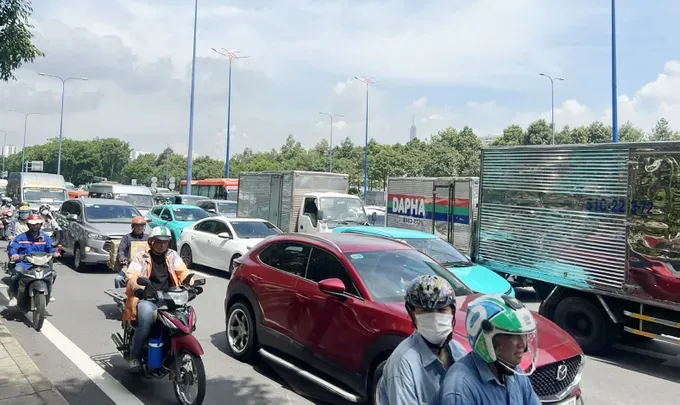
According to Deputy Director of the Ho Chi Minh City Department of Construction, Vo Khanh Hung, congestion stems from multiple factors, including the construction of the An Phu Interchange and the expansion of the Ho Chi Minh City – Long Thanh – Dau Giay Expressway. However, these are only short-term contributing factors. The primary cause is the rapid increase in traffic volume, which frequently exceeds the expressway's design capacity.
Notably, during peak hours and weekends, the heavy influx of vehicles creates bottlenecks at the toll plaza, slowing traffic flow and causing congestion to spill over onto connecting roads such as Vo Chi Cong Street. At times, severe congestion on the expressway has prompted traffic police to temporarily close access ramps from Vo Chi Cong Street to the expressway, resulting in traffic backups on other roads throughout the area.
To ease traffic pressure, the Ho Chi Minh City Department of Construction has coordinated with the Directorate for Roads of Vietnam (DRVN), the expressway operator, the traffic police, and relevant agencies to review and adjust traffic management measures, strengthen traffic control, optimize traffic flow, and minimize disruptions caused by ongoing construction projects.
In fact, the adoption of the electronic toll collection (ETC) system has significantly reduced the time required for vehicles to pass through toll plazas compared with manual toll collection. However, electronic toll collection does not mean vehicles can maintain high speeds. Motorists are still required to slow down when passing through toll plazas to ensure safety, facilitate lane merging and diverging, and enable the recognition system to operate reliably. Naturally, when traffic volume surges, the simultaneous deceleration of large numbers of vehicles reduces the road's traffic-carrying capacity.

To address this issue, the city will continue coordinating with relevant agencies to review and optimize traffic management, maximize the efficiency of ETC lanes, apply intelligent traffic management technologies, and study the adoption of more advanced toll collection models when conditions permit.
The location of toll plazas and the toll collection method are among the factors affecting the traffic-carrying capacity of the expressway. However, relocating toll plazas or changing the toll collection model does not fall under the authority of Ho Chi Minh City. Such decisions are the responsibility of the expressway's managing authority and are governed by the provisions of the investment contract.
The city will continue working closely with relevant ministries, agencies, and the expressway operator to conduct a comprehensive assessment and propose appropriate solutions if adjustments are found to be effective in alleviating congestion while ensuring compliance with the legal framework and safeguarding the legitimate interests of the investor.
Over the long term, the city has identified a comprehensive solution that includes accelerating the expansion of the Ho Chi Minh City – Long Thanh – Dau Giay Expressway, completing the ring road network and key transport links to the eastern gateway, and improving traffic management to enhance the corridor's traffic-carrying capacity and meet the steadily growing travel demand of residents and businesses, said Mr. Vo Khanh Hung.
Multi-lane toll collection to eliminate traffic bottlenecks

According to Ms. Nguyen Thi Hoai Phuong, Deputy Director of Vietnam Expressway Services Engineering Joint Stock Company (VECE), the operator responsible for the management, operation, and toll collection of expressways under Vietnam Expressway Corporation (VEC), toll plazas on several expressways have been operating under a multi-lane free-flow entry system (without barriers or toll islands) combined with single-lane exit toll collection with barriers since March 2, 2026, following approval by the Department of Roads of Vietnam.
However, the electronic toll collection (ETC) system on the Ho Chi Minh City – Long Thanh – Dau Giay Expressway remains in Phase 1, under which vehicles pass through single-lane toll booths with barriers at both entry and exit.
She explained that the toll collection arrangement on the Ho Chi Minh City – Long Thanh – Dau Giay Expressway differs from that of other expressways because the Long Thanh Interchange, which connects with the Bien Hoa – Vung Tau Expressway, was opened to traffic before the interoperable toll collection system had been fully completed. As a result, barriers are still required at both entry and exit points to prevent toll revenue leakage.
The expansion of the Ho Chi Minh City – Long Thanh – Dau Giay Expressway is currently progressing on schedule and is expected to be completed by the end of the year. Once completed, together with the fully integrated toll collection system on the Bien Hoa – Vung Tau Expressway, traffic congestion along the corridor is expected to be significantly alleviated.
Regarding the location of the Long Phuoc Toll Plaza, Ms. Phuong explained that when the site was originally selected, local authorities encountered difficulties with land clearance. As a result, they had to choose the current location for the toll plaza.








)