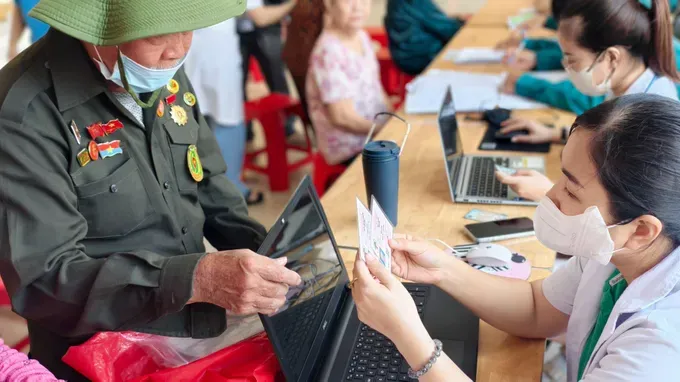
The municipal healthcare system is now accelerating screenings targeting students and workers.
According to data released by the Ho Chi Minh City Department of Health on August 17, a total of 2,590,623 people have undergone health checkups, screenings, and digital health data synchronization across the city.
Across the metropolis, 36 out of 168 wards, communes, and special administrative zones have achieved a participation rate of 30 percent or higher in the citywide universal health screening drive.
Phuoc Thang Ward leads the city at 71.79 percent, followed by Con Dao Special Zone (61.1 percent), An Nhon Tay Commune (56.25 percent), and Thanh An Commune (48.52 percent). Several other localities have surpassed the 40 percent milestone, including the communes of Nhuan Duc, Long Hai, An Thoi Dong, Xuan Thoi Son, Long Son, Phuoc Thanh, Binh My, and Binh Khanh, alongside Tan Tao Ward.
Conversely, 12 localities remain below the 10 percent threshold, including Tan Hoa Ward (7.94 percent), Ben Thanh Ward (8.04 percent), Thuong Tan Commune (8.26 percent), Tan Son Ward (8.31 percent), An Nhon Ward (8.39 percent), Vinh Hoi Ward (8.70 percent), Cau Ong Lanh Ward (9.35 percent), Ban Co Ward (9.68 percent), Phu Loi Ward (9.71 percent), Vinh Tan Ward (9.76 percent), Binh Duong Ward (9.90 percent), Phu Thanh Ward (9.96 percent).
Municipal authorities view these figures as a prompt for the lagging administrative units to accelerate campaign efforts in the coming weeks, aiming to clear the 10 percent baseline before aligning with the municipal average.
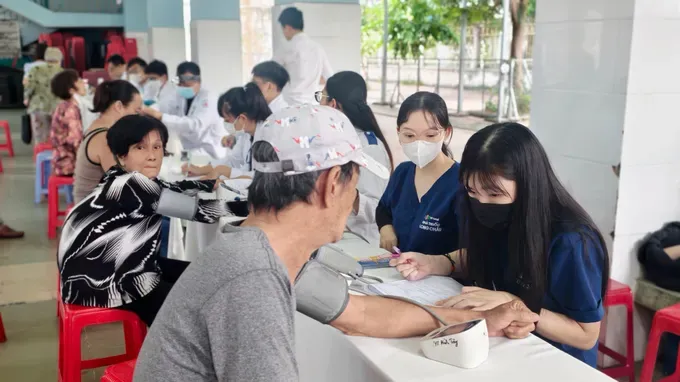
According to Associate Professor Dr. Tang Chi Thuong, Director of the Ho Chi Minh City Department of Health, while community-based health checkups will continue, the campaign's next phase will pivot toward two major demographics: students and workers. Because these cohorts can be efficiently screened in bulk across schools, public agencies, and private enterprises, their participation will play a decisive role in driving the overall momentum of the program.
To date, municipal statistics show that 515,673 out of 2.6 million students have completed health checkups, achieving 19.83 percent, whereas only 336,560 out of 6.5 million workers have been screened, representing just 5.18 percent of the workforce.
The start of the new academic year offers a strategic window to accelerate health screenings. The health and education sectors must coordinate closely to ensure individual schools complete student checkups promptly and fully synchronize results with the Electronic Health Record system, Associate Professor Dr. Tang Chi Thuong said.
For the workforce, immediate priority should be given to formal sector employees across government agencies, institutions, enterprises, and industrial zones. Local authorities need to proactively liaise with businesses and medical facilities to conduct on-site screenings, offering flexible scheduling—including shift-based and off-hours sessions—to accommodate workers, he added.
Associate Professor Dr. Tang Chi Thuong further noted that real-time monitoring via the Community Health Management Platform revealed that 38 wards and communes have yet to log any data from residents' previous medical examinations.















)