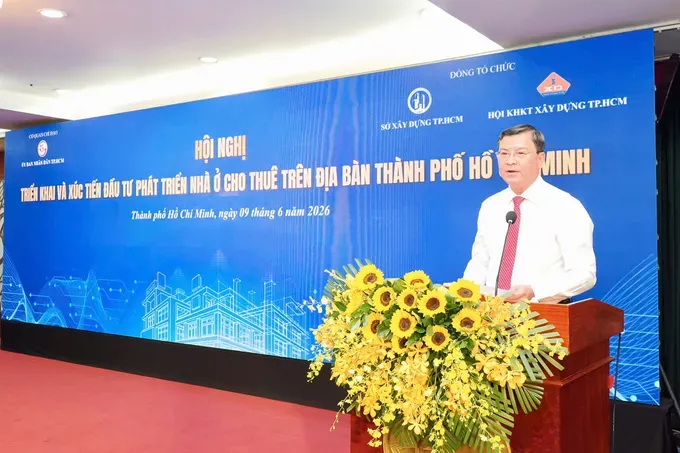
The Ho Chi Minh City Department of Construction, in coordination with the Construction Science and Technology Association, held a conference on June 9 to discuss and promote investment in rental housing development across the city.
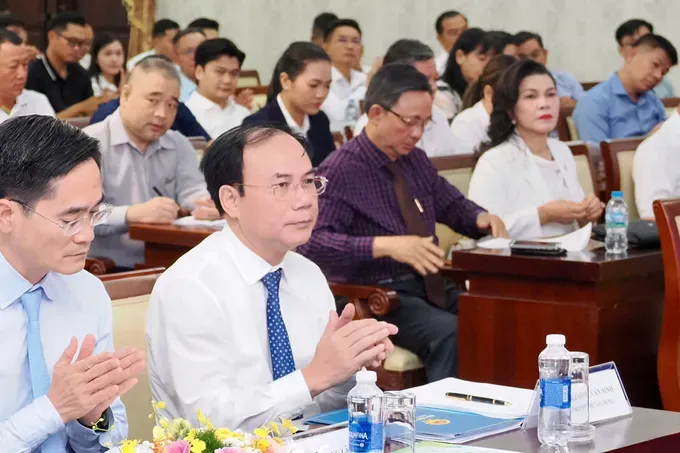
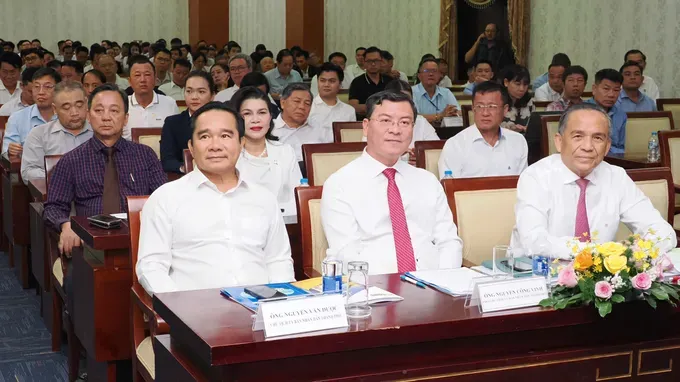
The event was attended by Nguyen Van Duoc, Member of the Party Central Committee and Chairman of the Ho Chi Minh City People’s Committee; Deputy Minister of Construction Nguyen Van Sinh; experts; and representatives of real estate enterprises.
Insufficient incentives
Addressing the conference, Nguyen Cong Vinh, Vice Chairman of the Ho Chi Minh City People’s Committee, said demand for rental housing is rising as the city’s population approaches 14 million, including large numbers of experts, workers, students and migrant laborers. However, many residents are still unable to afford homeownership, resulting in a growing demand for reasonably priced rental housing that offers stable living conditions and well-developed infrastructure.
He cited conclusions by Party General Secretary and State President To Lam in Notice No. 64-TB/VPTW dated May 22, 2026, which called for a shift in housing development policy from focusing primarily on homes for sale to promoting both homeownership and rental housing. By 2030, rental housing should become a strategic pillar of national housing policy.
During the 2026-2030 period, Ho Chi Minh City aims to develop an additional 181,257 social housing units, including approximately 50,000 rental social housing units. The city is also considering converting part of its resettlement housing stock and surplus public assets into rental housing to optimize resources.
Vice Chairman Nguyen Cong Vinh noted that the rental housing market still lacks long-term credit mechanisms and sufficiently attractive incentives. The conference therefore served as a platform for government agencies, banks and businesses to discuss breakthrough solutions related to land, financing and management models to create a modern and sustainable rental housing ecosystem.
Demand for one million social housing units
According to Khai Quoc Binh, Deputy Director of the Department of Construction, the city estimates total demand for social housing at around one million units, while its target for the 2021-2030 period is 199,400 units.
Between 2021 and 2025, the city completed 17,902 social housing units, equivalent to 98 percent of the target assigned by the Government. Since the beginning of 2026, one additional project with 580 units has been completed, three projects have broken ground and 14 projects with a combined 11,600 units are under construction.
The city has reduced administrative processing times by at least 50 percent and introduced interest-rate support programs through the Ho Chi Minh City Finance and Investment State-Owned Company (HFIC).

For the 2026-2030 period, Ho Chi Minh City must develop another 181,257 social housing units. During 2026-2027, priority will be given to completing 78 projects, providing approximately 73,800 units through a "green lane" mechanism designed to expedite administrative procedures.
The city currently manages a public rental housing stock comprising 13,668 rental rooms and apartments, along with accommodation for 40,980 students.
Authorities plan to implement additional rental housing projects through public investment and seek approval to classify them as urgent projects to accelerate procedures and begin construction sooner. The Housing Development Fund will also be tasked with developing or acquiring rental housing properties across the city.
Ho Chi Minh City plans to add rental housing projects to the list of developments eligible for support under Resolution No. 09 of the City People’s Council. The maximum loan amount eligible for interest-rate support would increase from VND200 billion (US$7.6 million) to VND300 billion (US$11.2 million) per project.
In addition, the city proposes covering 100 percent of technical infrastructure construction costs within project boundaries, capped at VND10 billion (US$379,803) per project. Rental subsidies would also be provided to eligible tenants of social housing projects developed by private investors.
Officials acknowledged that current social housing development remains insufficient to meet actual demand. Targets for the next phase are roughly ten times higher than those of the previous period, requiring special mechanisms such as low-interest loans of 3-4 percent, accelerated approval procedures for urgent projects and additional tax and land-use incentives.

The city is also drafting special policies for rental housing development as part of the proposed Special Urban Law to be submitted to the National Assembly and Government. Among the proposals is granting the city authority to adopt policies that differ from existing national regulations, including powers related to planning, rental pricing, tax exemptions and land-use fee reductions during the 25-30-year operational period of rental housing projects.
The proposal also seeks to classify social housing and rental housing projects as urgent developments, allowing authorities to appoint investors directly without requiring investment policy approval, thereby shortening project timelines.
At the conference, Vo Khac Thai, Permanent Vice Chairman of the Ho Chi Minh City Labor Federation, said that surveys indicate that approximately 33,520 workers currently need access to housing, with more than 90 percent expressing interest in rent-to-own housing options for long-term stability.
To address this demand, the Ho Chi Minh City Labor Federation has signed agreements with seven enterprises to develop approximately 125,000 rental and rent-to-own housing units for workers between 2026 and 2030, while also coordinating worker housing projects with synchronized infrastructure development.