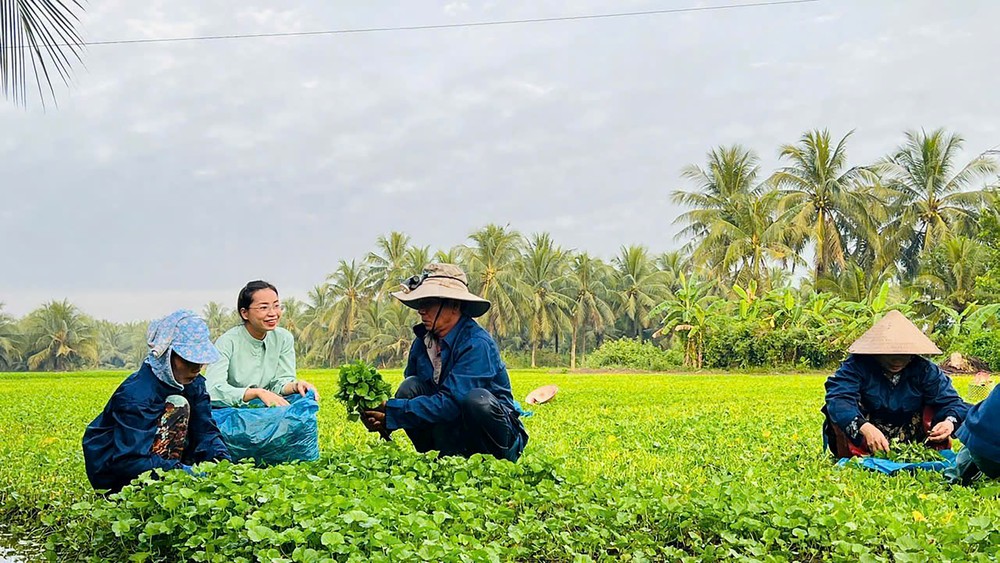
Ho Chi Minh City is steering its agricultural sector toward green and high-tech farming while promoting the role of the private sector in developing agriculture, rural areas, and farmers’ livelihoods. A growing number of successful models are already delivering tangible benefits to the rural economy. The commercial hub is systematically rolling out advanced mechanization, organic farming frameworks, and digital traceability systems across its rural subregions to transform local farmers into agritech specialists.
Fruitful returns from agricultural innovation
Few would have imagined that everyday herbs such as pennywort, fish mint, and perilla produced by a young startup could one day penetrate some of the world’s most demanding markets.
That is the story of Nguyen Ngoc Huong, 37, Director of Thien Nhien Viet Import-Export Company headquartered in Tan An Hoi Commune. The 37 year old female director recalled that years ago in Ho Chi Minh City, when almost no one considered turning pennywort leaves into powder as a substitute for fresh vegetables and selling it for millions of dong per kilogram, many people viewed her startup project as “abnormal.”
Despite the skepticism, she persisted.
Together with her colleagues, she chose to develop a closed-loop model combining “farm – processing – direct distribution". Unlike traditional methods that rely on sun drying or heat processing, both of which significantly reduce nutritional value, her company adopted freeze-drying technology, helping preserve the original flavor and nutrients of the produce.
Starting with pennywort powder as its flagship product, the company later expanded into fish mint powder, moringa powder, perilla powder, lotus leaf powder, and green tea powder.
In late 2019, Thien Nhien Viet officially exported its first shipment of 10,000 products to the Netherlands. Within just one year, orders doubled. Today, Quang Thanh pennywort powder products are available in several European countries and have entered markets including the United States, Japan, South Korea, and other Asian nations.
By 2026, five vegetable powder product lines manufactured by her company had been recognized as four-star OCOP products by Ho Chi Minh City. The company currently cooperates with more than 10 farming households across nearly 20 hectares of linked cultivation areas and provides jobs for more than 30 workers.
Another success story is Lieu Thi Kim Phuong, 40, originally from Ho Chi Minh City and a graduate of Nong Lam University. In 2018, recognizing the market potential of Dendro orchids in Vietnam, she boldly launched a startup focused on breeding new orchid varieties.
By late 2020, Vuon Lan Viet Agricultural Cooperative had been established in Phuoc Long Ward under her management with the goal of expanding the Dendro orchid cultivation model to more growers.
Mrs. Phuong has since successfully bred more than 200 orchid varieties, particularly among Dendro sunlight, color, and flashing-pattern lines.
Beyond its original 11 members, the cooperative has attracted additional partners from provinces including An Giang and Dong Thap.
Transferring technology to farmers
From a once-struggling rural area, Minh Thanh Commune has undergone a major transformation to become the green belt in the northern area of Ho Chi Minh City. Large-scale farms and greenhouse melon plantations are gradually replacing traditional farming methods.
One of the commune’s standout modern farmers is Bui Thien Truc. Across nearly 100 hectares owned by his family, Truc currently cultivates 13 hectares of green-skin pomelos, 10 hectares of durian — producing around 70 tons annually — 3 hectares of jackfruit, 20 hectares of rubber trees, along with mangoes, plums, and other crops.
By applying VietGAP production standards, his products have gained strong recognition for quality, opening up opportunities for commercial partnerships and exports. His farm now generates annual revenues worth tens of billions of dong.
Chairman Nguyen Van Ngo of the Minh Thanh Farmers’ Association said the commune is actively working with professional agencies to organize training courses on digital agriculture, guiding farmers on how to sell products through e-commerce platforms and establish cultivation area codes.
The goal is for every farmer to become an expert on their own field, Chairman Nguyen Van Ngo said.
Regarding future plans for green and high-tech agriculture, Ho Chi Minh City Vice Chairman Bui Minh Thanh said the city will accelerate mechanization, high-tech applications, and advanced farming techniques while expanding organic farming zones, circular agriculture, and smart agriculture models.
The city also plans to strengthen traceability systems for key crop products to improve connectivity among stakeholders across the agricultural value chain.
At the same time, the agricultural sector will continue issuing and managing cultivation area codes while expanding the use of biotechnology, high-tech agriculture, and advanced production processes to improve productivity and quality.
The broader objective is to establish a network of high-tech agricultural zones serving as centers for research, experimentation, demonstration, and technology transfer.