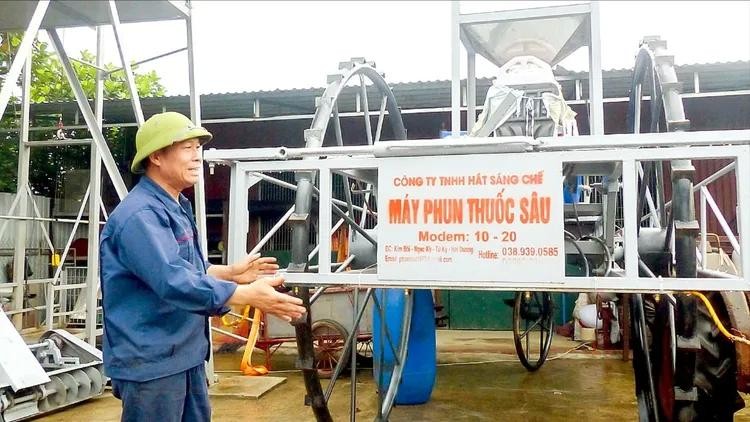
Amidst the wind-swept fields of Tan Ky Commune, Hai Phong City (formerly part of Tu Ky District, Hai Duong Province), the nickname Hat Sang Che (Hat Inventor) of Mr. Pham Van Hat has long stood as a symbol of rural intellect and resilience.
Despite lacking an engineering degree and possessing only a 7th-grade education, the barefoot inventor born in 1972 in Tan Ky Commune has created a significant impact in the agricultural machinery sector. He is the creator of the "Made in Vietnam Seeding Robot," which is now utilized in 15 countries, in addition to numerous innovative mechanical devices that have freed tens of thousands of farmers from arduous labor.
In the wind-swept fields of the commune, Mr. Pham Van Hat began his story with a gentle smile, saying that many were wondering how a farmer with a 7th-grade education became an inventor. In truth, there is no magic. It was a coincidence, or more accurately, being pushed to the brink by poverty that sparked his creative determination.
Before rising to fame, Hat was a "barefoot tycoon" who tasted bitter failure. He recalled that in 2007, utilizing his sharp business sense, he poured VND1.5 billion (US$56,956), which was a massive sum at the time, into a 10-acre safe vegetable farm. He admitted this was perhaps too far ahead of the market. People weren't yet interested in high-priced clean vegetables. By 2010, the venture collapsed, leaving him with a VND4 billion loss.
Empty-handed and burdened by daily interest loans amounting to VND800 million, he stood on the threshold of despair. Instead of giving up, he decided to travel to Israel to work, pay off his debts, and witness firsthand how agriculture flourished in a desert land. In 2010, Hat boarded a flight to Israel to work as a manual laborer.
His responsibilities included preparing the soil and distributing fertilizer for a vegetable farm.

Under the relentless sun, transporting heavy bags of fertilizer across numerous hectares proved to be arduous work.
He saw the problem and proposed a fix. Watching his employer’s tractor, Hat confidently suggested building an automatic fertilizer spreader that attaches to it. The new machine will replace the 20 workers currently doing this job by hand.
The Israeli owner expressed doubt, even requesting the Vietnamese Embassy staff to confirm the identity of this boastful employee. Ultimately, they supplied the materials for Hat to experiment with.
After just three days and nights of continuous work without rest, farmer Hat successfully developed his initial fertilizer spreader, achieving perfection by the third iteration.
The practical outcomes were even more remarkable: the machine not only substituted for 20 workers; its efficiency was comparable to that of nearly 40 manual laborers.
From that moment on, Hat’s role changed. The seventh-grade-educated Vietnamese farm worker was treated by his Israeli employers as a senior engineer. He was removed from field labor and reassigned to an air-conditioned office to focus on research and machine development. His salary rose 2.5 times. He also received a US$10,000 spot bonus, and his employers registered patents for several of his inventions.
Refusing a VND30 billion offer, the barefoot inventor protects Vietnamese innovation first
In 2012, at the peak of a flourishing career in Israel, Mr. Hat made the unexpected decision to return to Vietnam. The move was labeled "foolish" by friends, as he still faced a VND4 billion debt back home. "I realized that being a hired hand in a foreign land wouldn't lead to true wealth. More importantly, I wanted my intellect to serve my own people first," Hat shared regarding his homecoming.
Upon his return, his mechanical workshop was nothing more than a dilapidated corrugated iron shack. Ignoring malicious rumors accusing him of "stealing foreign technology," he quietly focused on inventing machinery. His first breakthrough in the domestic market was the "Seeding Robot."
Pointing to a machine being prepared for export, Hat said, “Imported models use six chips, eight relays, and large air compressors, drawing 6 kW of power and costing more than VND100 million. My machine uses no chips. It runs on mechanical systems, consumes just 400 W, and delivers near-absolute precision for VND30 million–VND35 million.”
Moreover, it's incredibly durable; farmers can leave it out in the elements for years, and it will still run perfectly with just a bit of oil." This simplicity and efficiency propelled the seeding robot across borders to 15 countries, including stringent markets like Japan, the United States, Canada, Germany, and New Zealand.
Driven by soaring revenue, Hat cleared his VND4 billion debt within just three years and expanded production. With a natural gift for innovation, he has invented or improved over 60 types of machinery spanning agriculture, fisheries, and forestry, including paddy excavators (10 tons/hour capacity), gladiolus bulb harvesters, herb diggers, pesticide sprayers, and microgreen harvesters. Hat Sang Che Company has since become a trusted name, creating local jobs and serving as an incubator for "wild" yet practical ideas. Each device is "tailor-made" to meet the specific soil conditions and farming habits of local peasants.
Looking beyond agriculture, Hat shifted his focus to urban safety. Alarmed by fatal fires in mini-apartments and karaoke bars, he began developing a device designed for emergencies in high-rise buildings.
Unlike rope ladders that require knotting skills and steady composure, the device runs entirely on mechanical principles and does not rely on electricity. It has no height limit and can be used by the elderly, children, and people with disabilities. In a five-story test, it lowered 30 people to the ground in 1 minute 26 seconds.
The system quickly drew international attention. Hat said a Japanese partner after evaluating 14 global models, he gave his product high marks. A Chinese company later approached him with an offer of VND30 billion for exclusive design and technology rights.
Hat declined the Chinese company’s proposal, saying that VND30 billion is a large sum, but he refused because he wants this device to protect Vietnamese people first. Moreover, he also wants to show the world that Vietnamese ingenuity stands on its own. Money can come later. The lives of Vietnamese farmers and national pride are not for sale.
He has since filed for an exclusive patent and is seeking domestic investors to scale production.