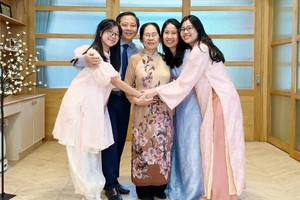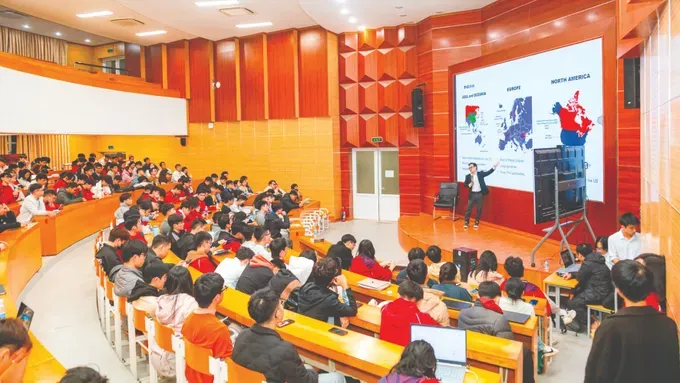
Dr Tran Quoc Thien, a member of the Executive Board of the Global Vietnamese Young Intellectuals Network and founder of PhD.Hub, is currently studying and researching at the University of Texas at Austin (UT Austin). He had just landed in New York from Austin, invited by the Vietnamese Ministry of Foreign Affairs to attend an audience with the State President. The Quang Nam-born scholar maintains a remarkably simple demeanor, with a plain shirt and a compact backpack.
At 34 years old, Tran Quoc Thien holds a PhD in Civil Engineering and a Master of Science in Materials Science, currently conducting post-doctoral research, which is an ideal academic profile. However, his story truly begins with PhD.Hub, a platform that has linked hundreds of thousands of Vietnamese people in their pursuit of global educational opportunities.
The narrative unfolds from small details, yet as one digs deeper, the portrait of this successful young Vietnamese man emerges not just through a list of achievements, but through layers of memory, from poverty, relentless effort, to quiet choices to pay it forward.
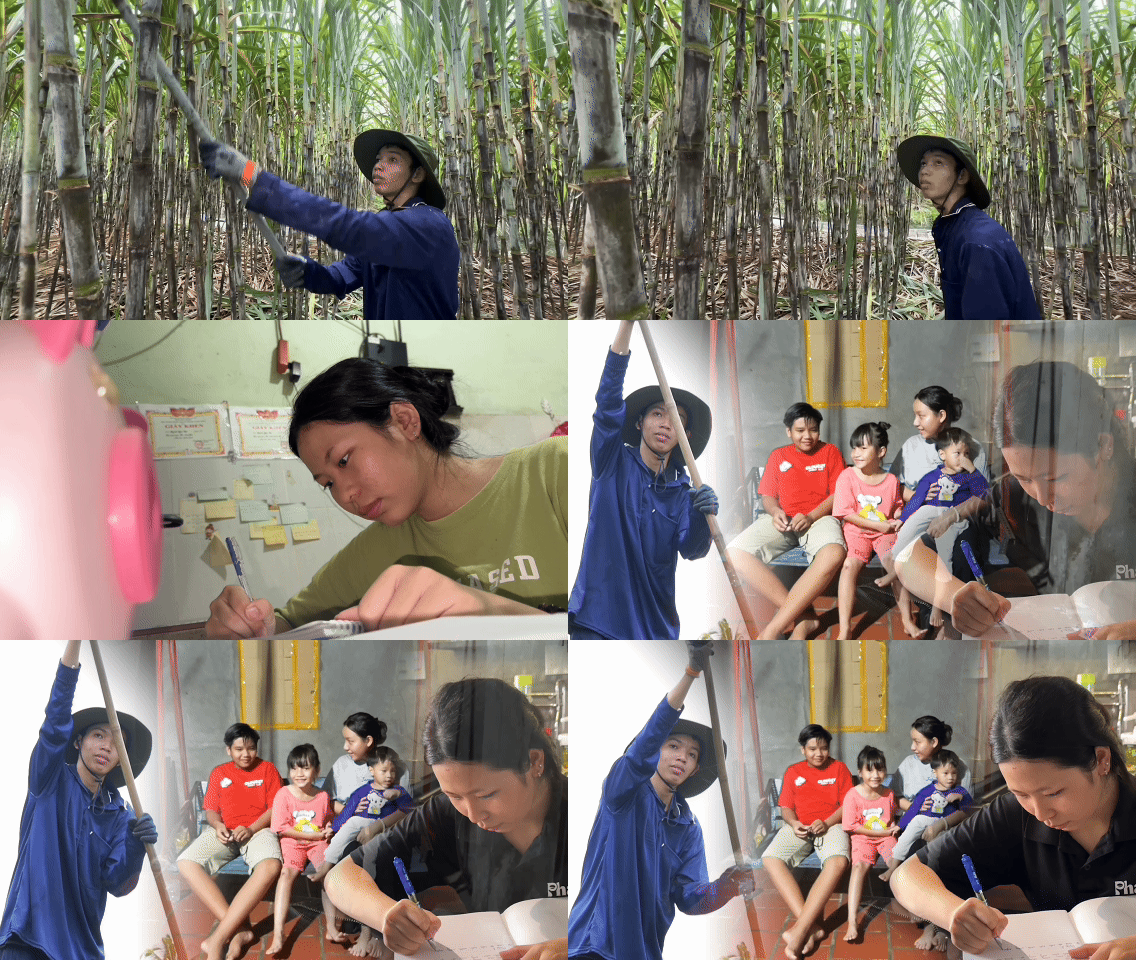
Born and raised in the suburbs of Da Nang City under difficult circumstances, Thien tasted loss early. Orphaned by his father and witnessing his mother shoulder the family’s burden alone, his childhood memories are tied to a simple dream of not having to go hungry. Those experiences nurtured in him a deep empathy for young people standing at the crossroads of life.
PhD.Hub was born from such a straightforward thought. Initially, it was just a small social media group where Thien shared scholarship information, advice on finding professors, and tips for preparing applications and academic activities. There was no grand growth strategy or scale target, yet every post and answer attracted more young seekers.
From a few dozen members to a few hundred, PhD.Hub has now become a community of nearly 130,000 members, including students, PhD candidates, and Vietnamese-born professors working in various developed nations.
Interestingly, everything operates on a voluntary basis, yet an “unwritten law” does exist: those who have received help should return to assist others when they can. This has created a closed circle of kindness where knowledge is disseminated in the most natural way possible.
Dr Tran Quoc Thien is busy with his research but still dedicates time daily to the community. Not every message from a young person gets an immediate reply, as he reads very carefully and thinks for a long time to ensure his response constitutes true companionship. Some conversations last months. Some applications are refined down to the smallest detail. Some dreams are even salvaged by a well-timed word of encouragement.
Beyond sharing knowledge, Thien established the PhD.Hub Foundation scholarship fund from his personal savings, totaling about VND300 million (US$11,800). While the amount isn’t massive, it targets the exact bottlenecks young people face, namely exam fees, application fees, and visa costs.
Thien recalls a 40-year-old member with an unremarkable profile who, through community support, secured a scholarship at a top US university. “You’ve changed my life,” he messaged before departing. Similarly, an ethnic minority student escaped an arranged marriage, worked through school, and graduated valedictorian. The PhD.Hub Foundation funded her visa and airfare for a master's abroad, clearing her final hurdle.
Such success stories are common at PhD.Hub. For Thien, the mission is transforming knowledge acquisition from a passive, individual struggle into an active, community-driven effort. He believes mobilizing social resources to nurture talent effectively reduces pressure on the state budget. By fostering this collaborative ecosystem, Thien ensures that financial or social barriers don’t extinguish the academic dreams of determined Vietnamese youth.
For Thien, the story of the academic community is just one part of his journey of gratitude. Sitting in the modern space of New York, looking out at concrete structures rising in the heart of the megacity, Thien suddenly grows quiet. He poses a question: How can we build without sacrificing the environment? Given Vietnam’s rapid urbanization and status as a top global cement exporter, this puzzle is increasingly urgent.
This concern is a consistent thread in Thien’s research, leading him to choose the “greening” of construction materials. Along with his colleagues, he’s developing a new experimental method to measure the CO2 re-absorption capacity of concrete from the air at a much lower cost than traditional methods. This approach opens opportunities for research in labs with limited conditions, especially in developing nations.
Thien chooses to solve specific problems. To him, the value of research lies in its ability to open a path and add options for the future. When mentioning applications in Vietnam, his voice becomes more enthusiastic.
“Going far is so that one can return, in some way,” he says softly. This simple sentiment is perhaps the most complete explanation for the journey of a young man who left his homeland to study, only to return through “the bridges of knowledge,” extending opportunities to many more.
In a vast world, every bridge can start from very small things. But when nurtured with kindness and persistence, they don’t just help people go further; they bind a sturdy, tight-knit community together.