After more than a year of operating the two-tier local government, at most public administration service centers of localities within HCMC, citizens’ feedback is recorded immediately after completing transactions. The evaluation results are then utilized to monitor service quality and provide an additional basis for assessing officials.
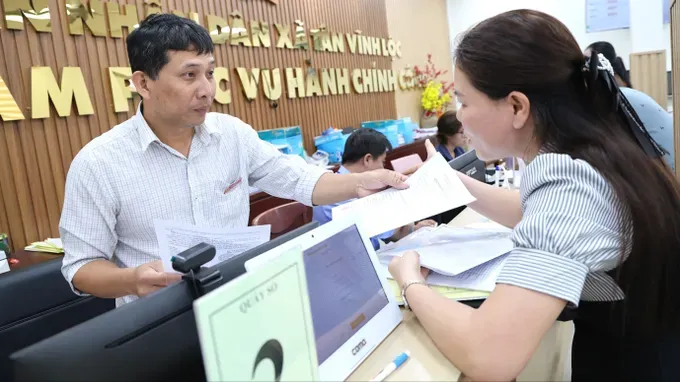
For Ms. Nguyen Thi Hanh, a citizen who had just completed the procedure to apply for a house number at the Tan Vinh Loc Commune Public Administration Service Center, providing feedback was seamless as she used a tablet placed at the counter for evaluation. With criteria regarding processing time, staff attitude, facilities, and overall satisfaction, she selected “Good” and “Very Good”. “I was guided very enthusiastically by the officials, with a friendly and open service attitude,” she noted.
The new version of the satisfaction evaluation system has reportedly been deployed at the Tan Vinh Loc Commune Public Administration Service Center since June 2026. Data is compiled in detail for each transaction, each counter, and each official. As informed by Deputy Director Dinh Phuoc Nghiep of the center, the citizens’ evaluation results serve as a foundational baseline to assess civil servants’ capabilities, thereby praising high performers and promptly rectifying cases with low ratings.
Similarly, at the An Lac Ward Public Administration Service Center, evaluating citizens’ satisfaction is flexibly implemented through three channels of direct survey forms, QR code scanning at the counter, and via the National Public Service Portal.
For Director Nguyen Thi Tuyet Nhung of the center, unsatisfactory feedback is viewed as a vital data source to identify limitations, not merely a “minus point.” If the root cause stems from a poor attitude, improper demeanor, or incomplete guidance, the official will be reminded and required to rectify the issue. In cases of recurrence or failure to meet task requirements, it’ll be reported to competent authorities for correction.

HCMC is currently innovating evaluation methods for cadres, civil servants, and public employees toward meticulously quantifying work results. Agencies, units, and localities are required to fully update their targets and tasks onto the performance evaluation software. Core tasks like public investment disbursement, site clearance compensation, and budget collection must be concretized into specific targets and tasks, serving as a basis to evaluate officials’ task execution results on a quarterly basis.
During recent meetings, HCMC People’s Committee Chairman Nguyen Van Duoc has repeatedly demanded that evaluations must be substantive, honest, and objective, without favoritism or egalitarianism; output results must be intrinsically linked to emulation rankings and supplementary income to get the ball rolling. Directors of departments and sectors, as well as chairpersons of commune, ward, and special zone People’s Committees, must bear direct responsibility for the progress, quality, and outcomes of their assigned tasks.
According to Dr Tran Thi Thu Ha, Head of the Administrative Law Department at HCMC University of Law, when tasks, products, and timelines are clearly defined, the responsibilities of each agency and unit inherently become clearer. The responsibility of the head must manifest consistently throughout the operational quality of the agency or unit. This requirement becomes even more crucial as the Law on Urban Development expands decentralization and the delegation of power.
From clearly determining responsibilities in task execution, the subsequent requirement is to rigorously control the enforcement of delegated authority. Dr Le Thi Thu Hien from the Academy of Politics Region II argued that robust decentralization must be accompanied by strict power control. Every decision must have clear grounds, adhere to proper jurisdiction, and follow the right procedures.
Furthermore, the responsibilities of the advisor, the decision-maker, and the inspector must be meticulously delineated. Regarding land, planning, investment, finance, and the use of public resources, the demands for openness, transparency, and accountability must be elevated even further.
Power control must also be tied to protecting officials who dare to think, dare to act, and dare to take responsibility for the common good. It appears an unclear mechanism easily leads to a mentality of fearing mistakes, dodging duties, and lacking control, as well as carrying the inherent risk of power abuse.
For Dr Nguyen Van Dao from Van Lang University, it’s necessary to clarify responsibilities in every decision-making stage regarding who advises, who appraises, who decides, who supervises, and who ultimately bears the final responsibility.
According to Dr Dao, a correct decision must not only fall within proper authority and follow due process but also possess clear, transparent, and verifiable grounds. The digitization of processing workflows also needs a strong push to comprehensively record the resolution process, establishing a foundation to determine responsibilities when necessary.
“Effective power control isn’t about making officials hesitant when deciding, but rather creating an environment where cadres can proactively act while ensuring every decision is grounded, responsible, and verifiable,” he noted.