Building on municipal directives and Prime Minister Decision No. 876/QD-TTg issued on July 22, 2022, Ho Chi Minh City is advancing a large-scale green transport transition. The initiative seeks to control vehicle emissions, gradually replace fossil-fuel vehicles with electric and green-energy alternatives, and restructure urban transport in a modern, sustainable manner to help achieve net-zero emissions by 2050.
Strategic zoning and phased implementation
Under the proposed plan, the city's territory is divided into four distinct zones: Con Dao Special Zone; Can Gio Area, comprising Binh Khanh, An Thoi Dong, Can Gio, and Thanh An communes; a Low-Emission Zone (LEZ) planned for high-traffic inner-city areas; and all remaining areas of Ho Chi Minh City. This regional division is calculated based on vehicle density, population concentration, emission levels, and infrastructure investment capacity.
Con Dao was selected for early implementation due to its manageable vehicle volume, while Can Gio is oriented toward becoming an ecological urban model. The Low-Emission Zone will enforce stricter environmental standards to progressively curb pollution in the central area. In remaining areas, the transition will proceed gradually, matching socio-economic conditions and infrastructure readiness.
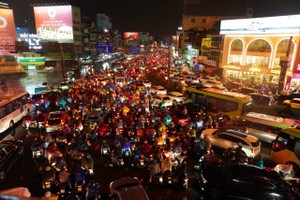
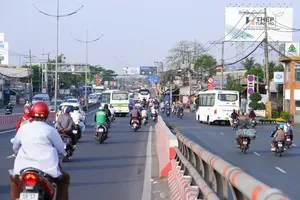
Ho Chi Minh City currently hosts approximately 15 million residents and nearly 12.82 million road vehicles, including 11.5 million motorcycles, 1.28 million automobiles, and nearly 600,000 commercial transport vehicles such as buses, taxis, contracted vehicles, passenger coaches, and trucks. Given this massive volume, local transport constitutes a major emission source, generating fine particulate matter (PM2.5) and greenhouse gases.
Consultants warn that unmanaged vehicle growth will severely pressure environmental quality, public health, and sustainable development. Consequently, transitioning to electric and green-energy vehicles is regarded as a vital long-term solution to cut emissions and improve air quality.
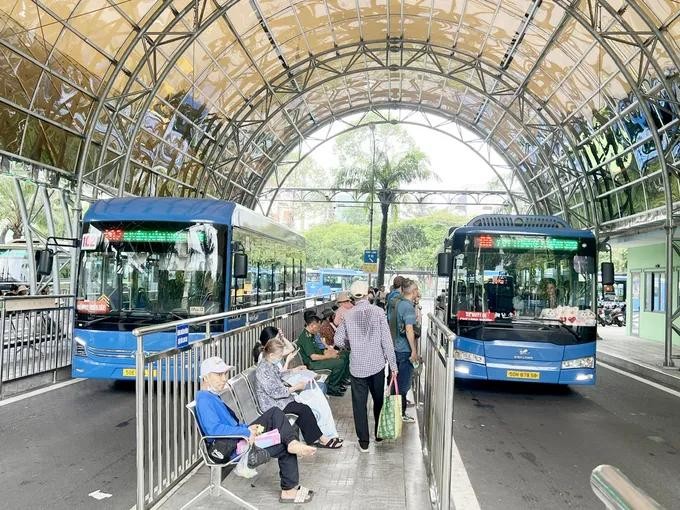
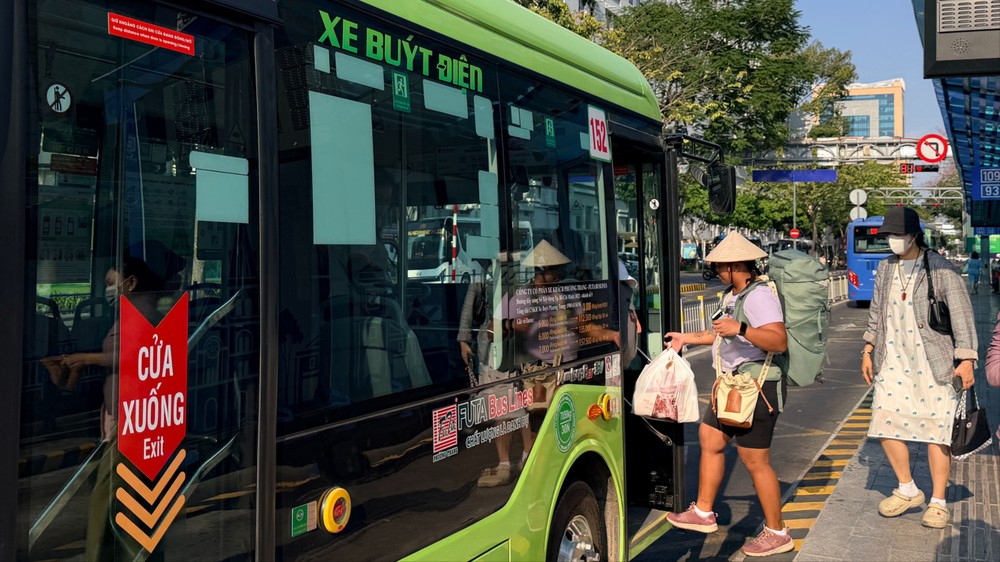
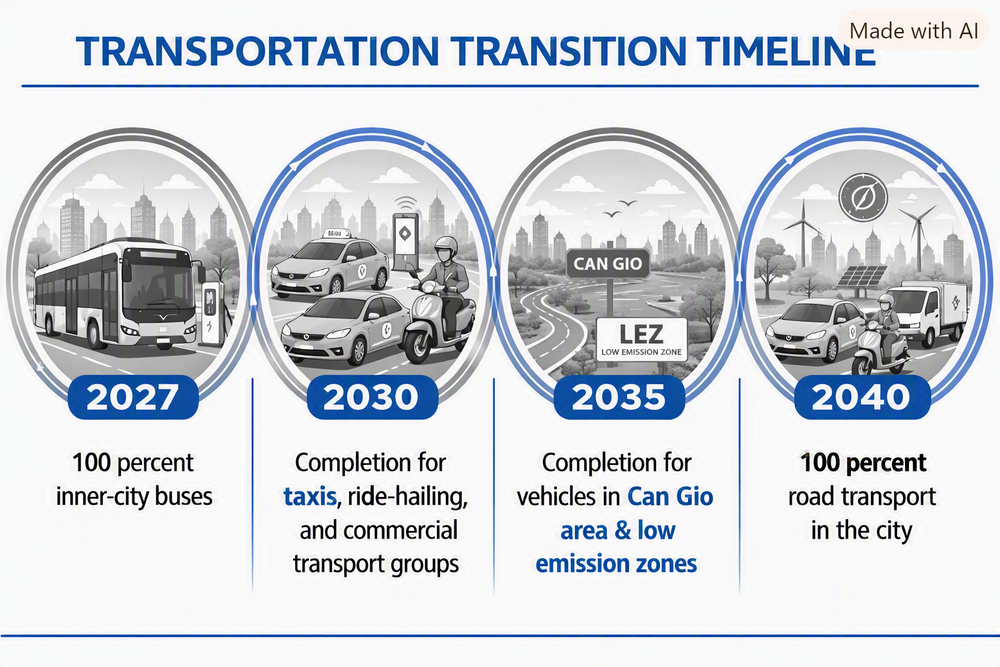
Ho Chi Minh City plans to prioritize public transit and commercial fleets first. Buses are designated for early conversion due to their high operating frequency and significant emission-reduction impact. Following buses, taxis, contracted vehicles, ride-hailing services, and commercial trucks will undergo transition. For private motorcycles and automobiles, the city will avoid immediate mandates, opting instead to gradually raise emission standards alongside financial incentives and infrastructure development.
Infrastructure as a decisive factor
A cornerstone of successful transport electrification is energy infrastructure. Pham Ngoc Cong from Da Nang University of Technology noted that attractive policies alone will fall short without accessible charging networks and battery-swapping stations.
The proposal outlines the development of over 18,000 charging poles and more than 33,000 battery-swapping cabinets citywide. Specifically, the low-emission zone is prioritized to receive over 3,300 fast-charging poles and roughly 8,900 swapping cabinets. To ease fiscal pressure, the draft proposes socializing infrastructure investment by offering businesses a 5-year land rental exemption for charging stations on public land, alongside preferential loan access.
Additionally, the city plans to construct an integrated management system encompassing emission testing, surveillance cameras, air quality monitoring, and a digital platform to process citizen support requests transparently.
Chairman Le Trung Tin of the Ho Chi Minh City Passenger Transport Association stated that the transition to green transport requires a pilot phase before large-scale implementation. He supports the proposal to prioritize high-traffic inner-city areas, as well as Can Gio and Con Dao.

International experience shows that many cities prioritize emission controls in their core areas. Singapore employs congestion pricing for vehicles entering the city center to reduce traffic jams and pollution, while Thailand has lowered the excise tax on electric vehicles (EVs) from 8 percent to 2 percent to encourage adoption. In Norway, various incentives regarding taxes, road tolls, parking, and dedicated lanes have contributed to a significant rise in EV usage.
Accordingly, Ho Chi Minh City needs to formulate appropriate policies to support residents and businesses, focusing on tax incentives, investment in charging stations and integrated infrastructure, and assistance for the transition from gasoline-powered vehicles to EVs.

Associate Professor Dinh Van Hiep, Director of the Institute of Transport Planning and Engineering, noted that the ultimate goal of green transport is to reduce reliance on private vehicles and gradually make public transport the primary mode of travel. Alongside restricting gasoline vehicles and raising usage costs for high-emission vehicles in designated areas, it is essential to create sufficient incentives such as economic benefits, convenient infrastructure, and high-quality public transport to encourage the public to choose green vehicles. Residents could use private vehicles for the first leg of their journey, park at transit hubs, and then continue via metro, electric bus, electric taxi, or shared mobility services.
Furthermore, transit hubs must be planned in alignment with the public transport network, featuring adequate parking space and reasonable pricing policies, such as reduced parking fees for metro and bus users. Thus, green transportation entails more than just replacing gasoline-powered vehicles with electric ones; it involves transforming travel patterns, where personal vehicles serve as connectors while public transport gradually handles the bulk of mobility needs.

Tran Nguyen Minh Tri, a resident of Hoa Hung Ward, Ho Chi Minh City, believes that the policy of gradually restricting gasoline vehicles and transitioning to electric ones in the city center is appropriate and helps reduce environmental pollution. However, to encourage residents to make the switch, the government needs to implement effective support policies, particularly for first-time electric motorbike buyers or those trading in gasoline vehicles for electric models.
With the right support policies in place, he believes that residents will be more motivated and increasingly supportive of the shift toward green transportation.