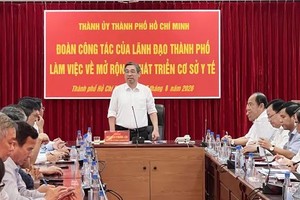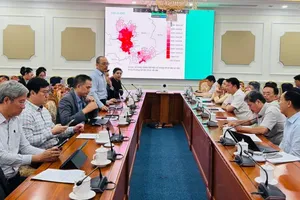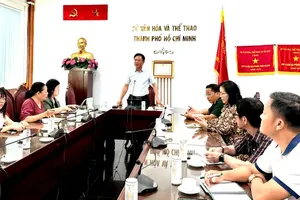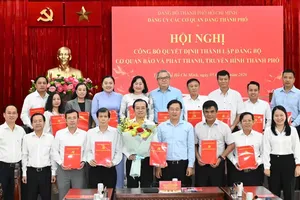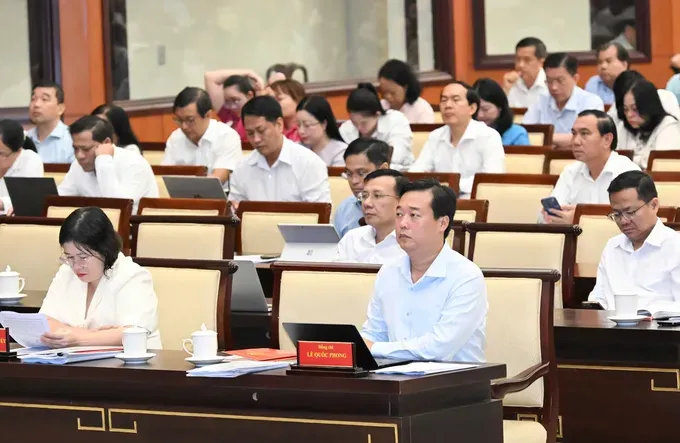
On August 7, the Standing Committee of the Ho Chi Minh City Party Committee held a conference to disseminate and implement the Resolution of the Third Plenum of the 14th Party Central Committee. The conference was held both in person and online.
Attending the conference were Standing Deputy Secretary of the Ho Chi Minh City Party Committee, Le Quoc Phong; Deputy Secretary of the Party Committee and Chairman of the Vietnam Fatherland Front of Ho Chi Minh City, Nguyen Phuoc Loc; Deputy Secretary of the Ho Chi Minh City Party Committee, Van Thi Bach Tuyet; along with members of the Standing Committee of the Ho Chi Minh City Party Committee, members of the municipal Party Committee, and leaders of agencies and municipal departments.
GRDP growth targeted at least 11 percent annually in 2026-2030
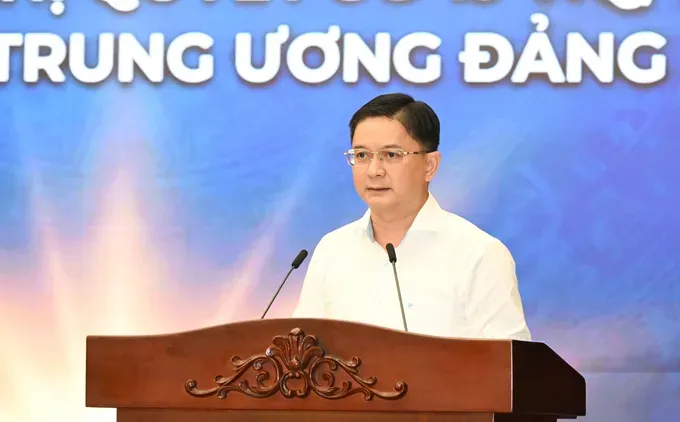
At the conference, Vice Chairman of the Ho Chi Minh City People's Committee Nguyen Manh Cuong, presented a draft action program of the Ho Chi Minh City Party Committee to implement resolutions adopted at the third Plenum of the 14th Party Central Committee.
The action program covers the implementation of Resolution No. 19-NQ/TW on renewing Vietnam's development model; Resolution No. 20-NQ/TW on building and developing Vietnam into a strong maritime nation; Resolution No. 21-NQ/TW on viewpoints and orientations for amending the Land Law and related laws; and Conclusion No. 75-KL/TW on environmental protection and proactive response to climate change in the new period.
Mr. Nguyen Manh Cuong stressed that the issuance of the action program aims to promptly institutionalize and concretize the Party Central Committee's policies, create strong momentum for renewing the development model, and meet the requirements for rapid and sustainable development in Ho Chi Minh City in the new period.
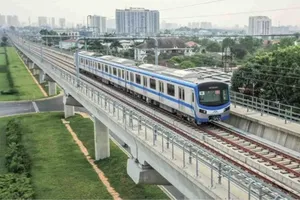
For the 2026-2030 period, the city targets annual GRDP growth of at least 11 percent; GRDP per capita of at least US$14,500; the digital economy accounting for around 40 percent of GRDP; completion of approximately 255 km of urban railway; the establishment of at least five socialist-oriented wards and communes; and an HDI (Human Development Index) of around 0.9. The city also aims to address flooding, environmental pollution, and traffic congestion and eliminate drug-related issues.
For 2031-2035, the city aims to maintain annual GRDP growth of at least 11 percent. By 2035, GRDP per capita is expected to reach at least US$27,000, with the digital economy accounting for around 60 percent of GRDP. The model of socialist-oriented wards and communes will be expanded, while the HDI will be maintained at a minimum of 0.9.
For 2036-2045, the city targets maintaining annual GRDP growth of at least 11 percent. By 2045, GRDP per capita is expected to reach at least US$89,000, while the HDI will remain at a minimum of 0.9. The city aims to complete the interconnection of its urban railway network and achieve net-zero emissions.
Regarding the city's development model, Vice Chairman of the Ho Chi Minh City People's Committee Nguyen Manh Cuong said that by 2035, Ho Chi Minh City aims to basically complete its transition to a self-reliant, innovative, humane, sustainable, and integrated development model, with seven component models established comprehensively across various sectors.
Under the new model, the city will shift towards growth driven by science and technology, innovation, digital transformation, and high labor productivity. It will promote the development of the green economy, digital economy, data economy, circular economy, and low-carbon economy, while leveraging leading enterprises to participate more deeply in global value chains and innovation networks.
Under the model of a modern, smart, sustainable, and climate-resilient ecological environment, Ho Chi Minh City will develop the green and circular economies; protect and restore ecosystems; manage natural resources and the environment on digital platforms; and proactively adapt to climate change and strengthen disaster prevention and response.
Under the model of democratic, modern, smart, transparent, effective, and efficient local governance, Ho Chi Minh City will shift from administrative management to development-oriented governance based on the rule of law and data. The city will accelerate decentralization and delegation of authority, coupled with accountability and power control, while using public satisfaction as a key measure of governance effectiveness.
Ho Chi Minh City rolls out seven breakthrough solution groups
Vice Chairman of the Ho Chi Minh City People's Committee Nguyen Manh Cuong said that to achieve the above targets, the city will focus on implementing seven groups of breakthrough solutions.
Among them, Ho Chi Minh City will strengthen the leadership capacity of Party committees at all levels and reform personnel work, using key performance indicators (KPIs) and levels of satisfaction among residents and businesses as measures of effectiveness, while attracting and making effective use of high-quality human resources.
The city will shift from administrative management to development-oriented governance; complete the Law on Urban Development and regulations on decentralization and delegation of authority; improve the quality of lawmaking and law enforcement; accelerate administrative reform; and improve the investment and business environment.
At the same time, Ho Chi Minh City will establish a more comprehensive regulatory sandbox mechanism and accept risks in science and technology and innovation, while developing a legal framework for artificial intelligence (AI), digital technologies, and data. The city will build a digital government, shared data platforms, and a smart city operations center; ensure seamless connectivity between the two levels of local government; enhance the accountability of heads of agencies and units; streamline the organizational apparatus to improve its efficiency and effectiveness; and operate the two-tier local government model.
Ho Chi Minh City will transform its economic growth model based on science and technology, innovation, digital transformation, labor productivity and competitiveness. In this regard, the city will organize its development space under a polycentric megacity model, develop five growth poles, five economic corridors, and 10 functional zones, and establish free trade zones, logistics centers, and an international transshipment hub, while strengthening regional connectivity and participation in value chains.
The city will pursue sustainable and modern social development while comprehensively improving the quality of life for its residents. This includes implementing comprehensive social welfare policies, promoting sustainable poverty reduction, raising incomes, developing social housing, narrowing development gaps, and ensuring care and support for vulnerable groups and disadvantaged areas.
Ho Chi Minh City will comprehensively develop its culture and people while building an education and talent ecosystem capable of meeting the requirements of a global city. It will also develop a smart, sustainable urban ecological environment model that is resilient to climate change; firmly safeguard national defense and security; and enhance the effectiveness and stature of external relations and international integration.
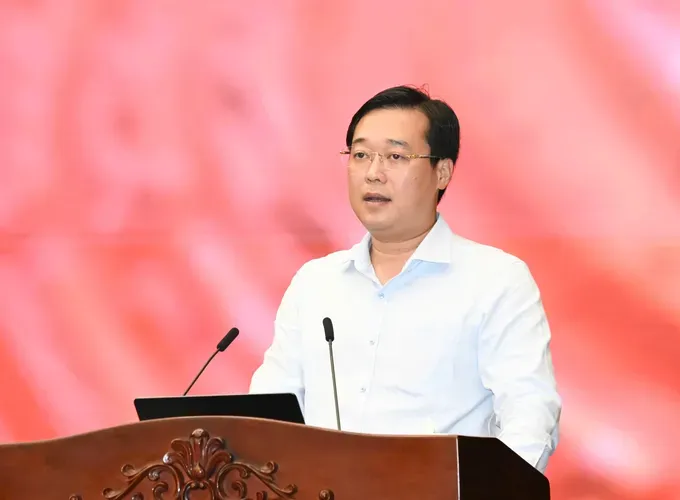
At the conference, Standing Deputy Secretary of the Ho Chi Minh City Party Committee Le Quoc Phong presented draft plans and action programs of the Ho Chi Minh City Party Committee concerning a resolution on building a disciplined, safe, civilized, harmonious, and developed society, as well as a resolution on the National Security Strategy.
Deputy Secretary of the Ho Chi Minh City Party Committee Van Thi Bach Tuyet delivered the draft plans and action programs of the Ho Chi Minh City Party Committee concerning regulations on what Party members are prohibited from doing; a conclusion on further improving and effectively operating the overall organizational model of the political system and the two-tier local government model; and amendments and supplements to Regulation No. 20-QD/TW of the Party Central Committee on implementation of the Party Charter.