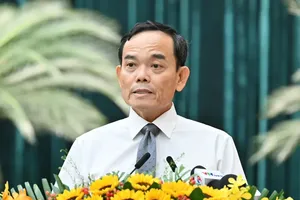
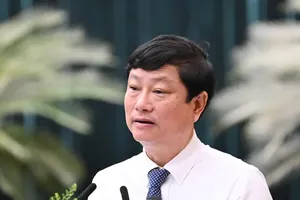
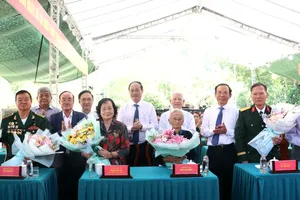
On August 7, a delegation from the Ho Chi Minh City Party Committee, led by Nguyen Phuoc Loc, Deputy Secretary of the Party Committee and Chairman of the Vietnam Fatherland Front Committee of Ho Chi Minh City, met with local authorities in Tan Phuoc Ward, Ba Ria, and Chau Pha Commune, Ho Tram to discuss expanding and developing healthcare facilities.
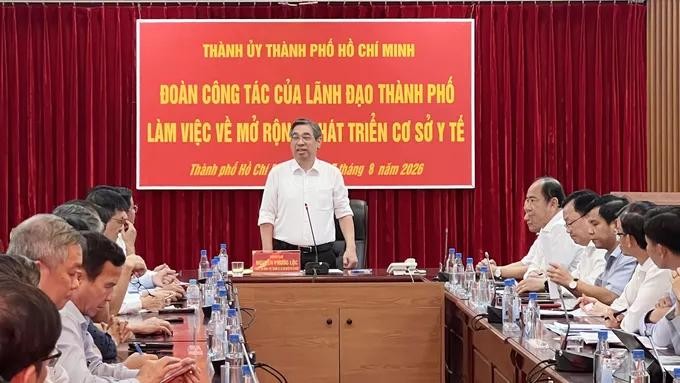
The delegation included leaders from relevant departments and representatives of 21 top-tier hospitals in Ho Chi Minh City.
At the meeting, local authorities reported on land availability, healthcare systems, transport infrastructure, electricity and water supply, digital transformation, medical waste treatment capacity, and rising demand for medical services. They also highlighted difficulties in preparing land for new healthcare projects.
Representatives from the Ho Chi Minh City Social Protection and Community Service Center reported on unused land at facilities in Chau Pha Commune and Tam Long Ward.
Mr. Nguyen Phuoc Loc stressed that Ho Chi Minh City is implementing investment and planning strategies to become a specialized medical hub for the region and the world. By 2030, the city aims to establish a regional medical cluster, and by 2045, expand its reach across Asia and globally. Plans include raising hospital bed capacity to more than 10,000 beds per 10,000 residents, developing full medical specialties, and designating key specialties for each area based on scientific data from electronic health records.
He emphasized that expansion must leverage local advantages and be based on scientific data to ensure accurate and practical investment. Projects must also meet requirements for transport, electricity, water, social welfare, and modern medical waste treatment.
The city encourages integrated healthcare models combining general and specialized hospitals, linking medical facilities with social support centers or local clinics, and piloting “school–clinic” models to strengthen student healthcare. According to Loc, the ultimate goal is comprehensive healthcare for all residents, ensuring no one is left behind.
He also called for establishing inter-hospital emergency centers in areas without major facilities, and building healthcare centers near seaports, airports, high-tech zones, and industrial parks to serve residents, skilled workers, and foreigners living in the city.
Regarding development plans, the Chairman of the Vietnam Fatherland Front Committee of Ho Chi Minh City requested relocation of inner-city medical facilities under a suitable timeline, with the goal of upgrading health centers into hospitals by the end of 2026. He also urged allocation of land for central-level hospitals and cooperation with businesses to link healthcare projects with social housing developments. The city plans to form specialized medical clusters, including one in Thu Duc.
For Chau Pha, Ho Tram, and state-managed social protection centers, he requested reviews based on actual conditions, ensuring environmental protection and green space, while linking development with revolutionary traditions, history, and the city’s overall growth strategy.
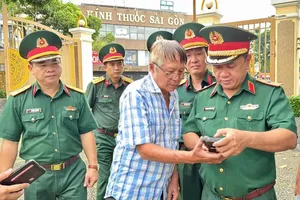
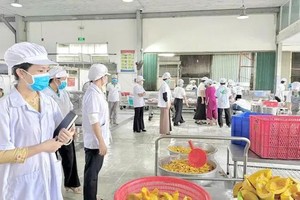
Before the meeting, the delegation surveyed land plots in Tan Phuoc Ward, Ba Ria, and Chau Pha Commune, as well as facilities of the Social Protection and Community Service Center in Tam Long Ward, Rach Dua and Chau Pha communes. At each site, Mr. Nguyen Phuoc Loc and the delegation discussed planning directions with local leaders to ensure effective land use aligned with the city’s healthcare expansion goals.