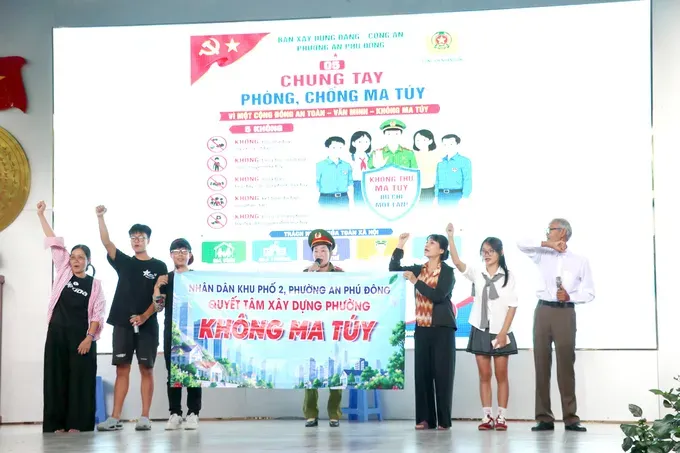
On a vibrant morning early this August, the courtyard of Thanh Loc High School in An Phu Dong Ward was much livelier than usual. Up on the stage, amateur “actors”, comprising local officials, union members, association affiliates, and ordinary citizens, immersed themselves into various characters to depict a compelling narrative about drug prevention.
One individual played an anxious parent frantically searching for their child, another portrayed a young adult lured by bad influences, while someone else stepped into the shoes of a neighborhood official persistently persuading a former addict to return to their family. Down below, the audience watched intently. Sometimes they burst into laughter at highly relatable everyday situations, and at other times, they teared up witnessing the tragic consequences reenacted on stage.
This was merely one of 27 theatrical works featured at the 2026 Anti-Drug Propaganda Contest themed “An Phu Dong says no to drugs – Stepping firmly into the future.” Over 1,000 members of the local Party Committee, the Ho Chi Minh Communist Youth Union, associations, and residents of the ward showed up to watch and cheer, successfully transforming a standard propaganda event into a vibrant community gathering space.
Through each performance, viewers didn’t just witness the devastating physical harm narcotics inflict upon users, but also saw the profound impacts for families, relatives, and the broader community clearly highlighted. Furthermore, numerous stories conveyed heartfelt messages about familial love, societal sharing, and the collective responsibility to support former offenders in their reintegration journey.
For Ms. Le Thi Mai, a resident of Neighborhood No.12 in An Phu Dong Ward, the theatrical approach resonated deeply. “These everyday situations make it much easier for viewers to understand, helping us realize that drug prevention isn’t solely the police force’s exclusive job, but strictly requires active participation from families and the community,” she observed while attending the event.
According to Permanent Deputy Secretary Ho Thi Thuy of the An Phu Dong Ward Party Committee, certain realities are difficult to touch listeners’ hearts if they’re merely propagated through dry text. However, when narrated through relatable stories leveraging genuine emotion and art, those messages become incredibly vivid, easy to remember, and boast a much stronger ripple effect on public awareness.
Anti-drug messages are also being pushed into cyberspace through a variety of fresh formats. The Tan Hung Ward Police Station independently scripted, filmed, and produced a short video series titled “Unveiling Vlog,” which vividly recreates their ongoing journey of combating local drug crimes. The ward police’s official Fanpage currently boasts nearly 25,000 followers, recording approximately 1.7 million views and a staggering 6.4 million reaches.
Visuals, short videos, and real-life scenarios help transmit drug warnings to the public much faster, aligning perfectly with modern information-consumption habits, particularly among the youth.
Alongside crafting theoretical works, shooting videos, and publishing information online, many localities dispatch functional forces directly into individual residential zones to monitor specific target groups and resolve concrete localized issues.
In Thoi An Ward, authorities reportedly maintain the “5+1” model alongside the “SOS Security and Order” and “3-in-1 Working Group” initiatives to successfully reintegrate former inmates. Neighborhood managing boards and grassroots forces seamlessly coordinate to monitor the area, ensuring management voids don’t emerge as a general rule of thumb.
Similar methodologies are rolling out in Long Hai Commune. For Senior Lieutenant Colonel Pham Phuoc Binh, Chief of the local police, rigorous demographic and narcotics management remains the ultimate priority. Functional forces conduct mandatory maritime drug tests and persistently screen every alley and suspect. Furthermore, grassroots models like “Breakfast with Fishermen” present excellent opportunities for officials to spread awareness while gauging the local situation for proactive crime prevention.
Meanwhile, Tan Uyen Ward boasts a highly effective operational strategy where one party member assumes supervisory responsibility for three households. It appears this formal commitment has fully leveraged exemplary grassroots leadership. In the end, it’s a system where authorities can firmly grasp demographic shifts, promptly detect addicts, and persuade them into rehab, thereby drastically pulling down local drug-related crimes to safeguard national security.
These innovative propaganda methods and creative models make it remarkably easy for citizens to comprehend and grasp the core issues, leaving them ready to pitch in alongside authorities and functional forces in the fight against drugs.
For Secretary Huynh Son Tuan of the Long Hai Commune Party Committee, institutional cooperation is crucial. He noted that building a drug-free locality can only succeed when the entire political system gets involved, ranging from police units, task forces, and hamlet party cells down to every individual citizen.
His locality has set an ambitious target for 2026 to have at least 30 percent of its hamlets achieve the “drug-free hamlet” criterion, steadily advancing toward the ultimate goal of establishing a completely drug-free Long Hai Commune by 2030.