Ho Chi Minh City is pushing forward with building digital government and data-based management, with the goal that once data is digitized, citizens and businesses will not have to re-declare or resubmit.

Speaking with SGGP reporters, Director Vo Thi Trung Trinh of the Ho Chi Minh City Digital Transformation Center said the city is restructuring administrative procedures on a data platform, turning data into a tool for directing and managing from the city level down to the grassroots.
Alongside the rollout of the two-tier local government model, Ho Chi Minh City has determined that digital transformation and administrative reform must be carried out on a data foundation. The city is not only digitizing records but also building a shared data system so that existing information can be exploited and reused multiple times, thereby minimizing paperwork and reducing time for citizens and businesses.
Data infrastructure continues to expand. The city’s system has connected 13 of 16 national and ministerial databases through integration and data-sharing platforms. These include key databases on population, business registration, land, electronic identification (VNeID), and judicial records. The city has also completed technical connections with the National Data Center to synchronize essential datasets on education and healthcare.
Previously, each time citizens carried out procedures, they often had to re-declare information or resubmit documents already provided. With connected and shared data, government agencies can proactively access residency information, business registration, and professional licenses. Citizens no longer need to resubmit documents already managed by the State.
With nearly 99 percent of results issued electronically, citizens can receive outcomes online, store them digitally, and reuse them for subsequent procedures, reducing the need for certified copies, authentication, and travel. This is the practical value of digital transformation: less paperwork, less time, lower costs, and improved service quality for citizens and businesses.
Administrative reform is entering a new phase: reform based on data. If the previous focus was shortening processing time, cutting record components, and simplifying procedures, now digital data has become the foundation for restructuring management methods and delivering public services.
The biggest difference is that data is not just scanned files for electronic storage. Data must be standardized, structured, and guaranteed to be “accurate, complete, clean, live, unified, and shared.” When data is interconnected, officials can use it to resolve tasks without requiring citizens to provide information already held by government agencies. Data also enables automation of processing steps, supports procedures beyond administrative boundaries, and creates smart public services.
From a management perspective, data allows city leaders to monitor case processing progress in real time, supervise service quality of each unit, and detect bottlenecks for timely intervention through dashboards at the Information and Operations Center (IOC). Data is becoming a strategic asset and a key driver of administrative reform.
Current bottlenecks lie not mainly in technology but in data quality and sharing capacity. Some ministerial systems are not yet stable; data connections and synchronization sometimes encounter technical errors. Statistical tools of certain specialized systems do not fully meet monitoring requirements for indicators such as digitization rate and data reuse rate. After administrative unit restructuring, some data on addresses, boundaries, coordinates, and specialized fields still need standardization and updates to ensure consistency across the city.
The city is focusing on reviewing and cleaning foundational data on identification, land, justice, healthcare, and education to feed into the shared data warehouse. At the same time, it is expanding two-way data connections with the National Data Center and ministries to enable automatic, safe, and seamless data exploitation.
Another important task is building an electronic data management repository for organizations and individuals, storing digitized results of administrative procedures. The city is also drafting regulations on data management, operation, and exploitation, assigning responsibility to each department, agency, and locality for updating, sharing, and using data. This will foster a culture of data-driven governance across the entire government system.
Ho Chi Minh City views record digitization as only the starting point. More importantly, data must become a resource for governance and citizen service. Therefore, the city is restructuring administrative procedures with data as the central principle. Instead of simply transferring paper forms into digital formats, the city is reviewing entire processes, eliminating verification steps and requests for information already available in national and specialized databases.
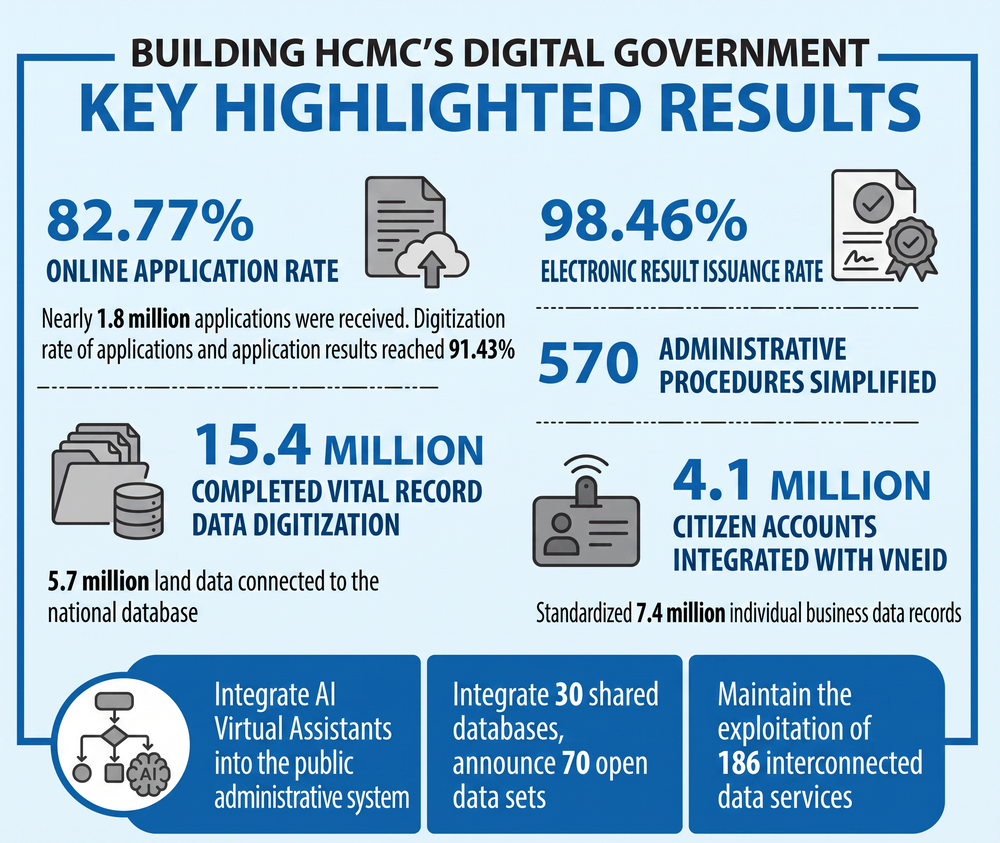
The city is deploying new technology platforms such as data mining and visualization, supporting automated processing, analysis, forecasting, and data sharing for management. It is also testing artificial intelligence (AI) and virtual assistants in drafting documents, extracting meeting content, supporting KPI evaluation, and gradually automating internal governance processes.
Another key direction is strengthening IOC. Essential data on socio-economic indicators, public investment, administrative procedures, feedback via Hotline 1022, healthcare, and education have been integrated into dashboards, enabling leaders to monitor, analyze, and make decisions in real time. The city is piloting commune-level IOC. When data reaches the grassroots, ward and commune leaders can track work progress through live data instead of relying mainly on manual reports. This is a major change for governance under the two-tier local government model.
The ultimate goal is to build a digital administration based on data, with citizens and businesses at the center. Each dataset is collected once but used many times, improving state management efficiency while delivering real convenience to citizens and enterprises.
The Ho Chi Minh City Digital Transformation Center is focusing on completing the shared data repository and ensuring seamless connections with the National Data Center and ministries and sectors to achieve administrative reform targets through 2030. These include reusing 90 percent of data and raising satisfaction among residents and businesses to more than 95 percent.
The center will improve data governance maturity, gradually building data that is “accurate, complete, clean and live” and can be shared and exploited citywide. It will also expand utilities on the HCMC Digital Citizen platform, deeply integrating essential services such as electronic health records, education, trade unions, digital maps and public services.
At the same time, the city will launch the “Digital Literacy for All” campaign to help residents easily access and use digital services.
The city will ensure stable operation of digital infrastructure and shared platforms down to the Commune level, while effectively deploying digital administration platforms for residential areas and hamlets and Commune-level IOC systems. The move aims to reduce manual administrative work, giving grassroots officials more time to serve residents and businesses.







)