Ho Chi Minh City has built centralized data systems over many years and now possesses major datasets on population, land, healthcare, education, urban planning, and public services. These are considered a “golden resource” for developing new business models.
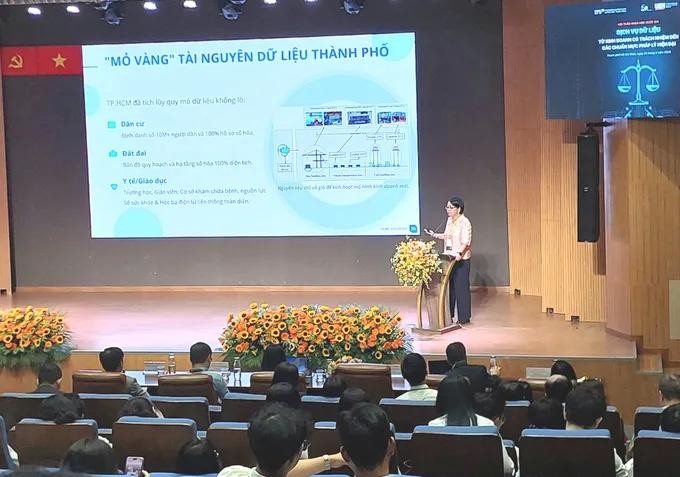
On May 21, the School of Economics, Law and State Management at the University of Economics Ho Chi Minh City (UEH), in collaboration with the Institute for Policy Studies and Media Development (IPS), organized the national scientific conference Dich vu du lieu: Tu kinh doanh co trach nhiem den cac chuan muc phap ly hien dai (Data services: From responsible business to modern legal standards).
Speaking at the conference, Ho Duc Thang, a member of the National Assembly’s Committee for Culture and Social Affairs, said Vietnam is facing a data paradox where the volume of global data is growing explosively while truly clean and AI-ready data remains extremely scarce. According to him, the world is expected to generate around 181 zettabytes of data in 2025, 90 times more than in 2010, yet only about 2 percent of data is actually retained.
He emphasized that data is becoming the “means of production” in the AI era, similar to the role of land in the agricultural age. In the global AI race, Vietnam may struggle to compete directly in developing massive AI models, but it holds an advantage in “sovereign data” such as Vietnamese language resources, legal, healthcare, education, cultural, and indigenous knowledge data.
National Assembly member Ho Duc Thang also warned that “whatever is not digitized will be absent from AI’s memory,” potentially leading to the erosion of Vietnamese language, culture, and knowledge in the digital space. He noted that the data services market is not simply about trading raw data but involves an ecosystem of data cleaning, standardization, labeling, testing, and auditing activities. At the same time, legal frameworks should clearly distinguish “red zones” for personal and sensitive data from “green zones” for non-personal and open data in order to promote responsible innovation.
According to Director Vo Thi Trung Trinh of the Ho Chi Minh City Digital Transformation Center, data services could become a new growth driver for the city’s digital economy if data can be transformed from mere storage into services that are ready for integration, sharing, and value creation for businesses and communities. Ho Chi Minh City has pursued centralized data development for many years and now holds large datasets covering population, land, healthcare, education, urban planning, and public services. These are important resources for developing new business models.
The Director of the Ho Chi Minh City Digital Transformation Center stressed that data can help optimize resources and reduce wasted time and costs, especially in public services, smart logistics, and international financial centers linked to digital assets. Ho Chi Minh City aims to build a data exchange platform, develop shared data warehouses, and apply cloud computing and AI to process large-scale data, targeting a digital economy contribution of 40 percent of GRDP by 2030.
According to the roadmap, in 2026 the city will standardize and clean core datasets; in 2027 it will pilot a data exchange platform; in 2028 it will connect data across the entire Southern Key Economic Region; and by 2030 it aims to achieve comprehensive AI- and DaaS-based smart governance.