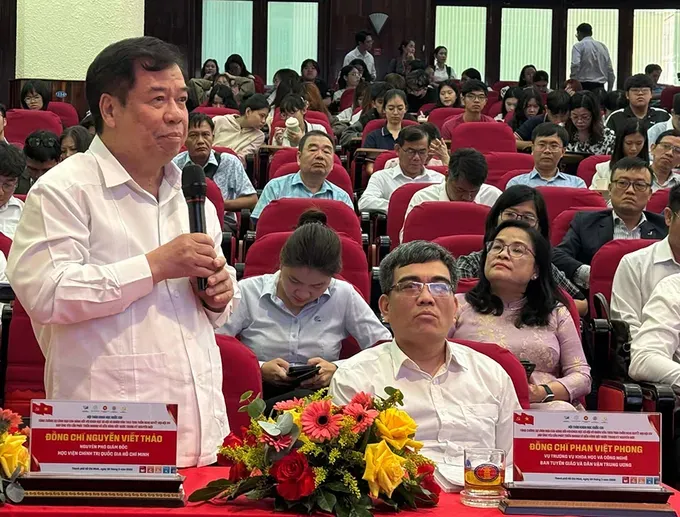
According to Prof Dr Le Van Loi, President of the Vietnam Academy of Social Sciences, SSH in this new era must either rise to truly become the nation’s strategic intellect or struggle and lose its relevance during this critical stage for the country. Given the current trajectory, there is a clear demand to build a robust, modern, and integrated SSH sector, one that can effectively provide strategic consultancy and contribute worthily to national development.
Currently, Vietnam’s science and technology workforce stands at approximately 207,838 individuals, with researchers accounting for over 83 percent. Notably, this contingent is primarily concentrated within higher education institutions, with 95,394 people, indicating that universities are becoming the nation’s most vital knowledge hubs. Within this total, the SSH field accounts for over 31 percent (Social Sciences at 26.2 percent and Humanities at 5.1 percent), affirming its position as a cornerstone of the scientific system.
Prof Dr Ngo Thi Phuong Lan, President of the University of Social Sciences and Humanities (Vietnam National University-HCM), observes a leadership deficit hindering internationally competitive research groups. Historically theoretical, Social Sciences and Humanities are being redefined by complex issues intertwined with technology and data.
It’s no longer just research; it’s direct participation in policy-making and development. Chancellor Nguyen Thi Thanh Mai of Vietnam National University-Ho Chi Minh City noted that digital governance, AI ethics, and behavioral changes require interdisciplinary approaches where these fields play a pivotal role. They’re no longer supplementary but the foundation ensuring sustainable, harmonious socio-economic progress. Strengthening empirical capacity and modernizing governance is now vital for Social Sciences to become the nation’s strategic intellect.
To ensure SSH effectively demonstrates its role in policy formulation, Prof Dr Le Van Loi proposed that doctoral and master’s programs undergo radical reform to modernize research methodologies and tools. Specifically, there’s a need to bolster empirical research capacity, quantitative methods, and big data analysis.
Alongside this, interdisciplinary research between SSH and science-technology and engineering should be encouraged, while enhancing international integration through overseas study and collaborative research during the training process.
On a broader scale, experts believe there should be mechanisms to attract international scholars and overseas Vietnamese intellectuals for long-term participation in training and research. Key universities could serve as the nucleus, piloting integrated human resource development models that link education, research, and international cooperation.
Meanwhile, Prof Dr Ta Ngoc Tan, former President of the Ho Chi Minh National Academy of Politics, emphasized that for SSH to fully realize its potential, the primary requirement is to continue perfecting the institutions and mechanisms governing this field. As innovation and digital transformation become vital drivers of development, creating a favorable environment for SSH is of paramount importance.
Prof Dr Vo Khanh Vinh from the Vietnam Academy of Social Sciences commented that the SSH intellectual community is the vital force providing scientific arguments for policy-making and governance. Developing this workforce is strategically significant, requiring interdisciplinary training combining traditional knowledge with data science and policy analysis. Moreover, raising ideological responsibility is crucial, as these intellectuals aren’t just researchers but subjects responsible for guiding social values and protecting the nation’s ideological foundation.
Director Tran Quoc Cuong of the Department of SSH and Natural Sciences (Ministry of Science and Technology) shared that SSH must serve as the nation’s strategic intellectual foundation. Breakthroughs require fundamentally renewing how the State utilizes social knowledge through radical innovation. Shifting from administrative management to modern governance is essential. Simultaneously, it’s necessary to perfect financial policies, develop a politically courageous workforce, and accelerate digital transformation to organize future research activities effectively.
Deputy Head Nguyen Viet Long of the Propaganda and Mass Mobilization Commission (HCMC Party Committee) said Resolution No. 57-NQ/TW is seen as the institutional key that has cleared many bottlenecks, paving the way for HCMC’s comprehensive, multi-polar, and hyper-connected development strategy toward 2030. More than ever, SSH research should be a top priority to stay one step ahead, not just in forecasting, but in accompanying the major decisions of the Central government and HCMC to shape the future. It must become an inseparable part of the science, technology, and innovation ecosystem.
The orientation regarding the seven pillars in the implementation of Resolution No. 57-NQ/TW, along with solutions to promote the “triple partner” collaboration model in the new landscape and the draft Comprehensive Scientific Research and Technological Development Program across all fields, represent concrete steps. These initiatives affirm the vital standing and role of SSH in the rapid and sustainable development of HCMC during the upcoming period.